
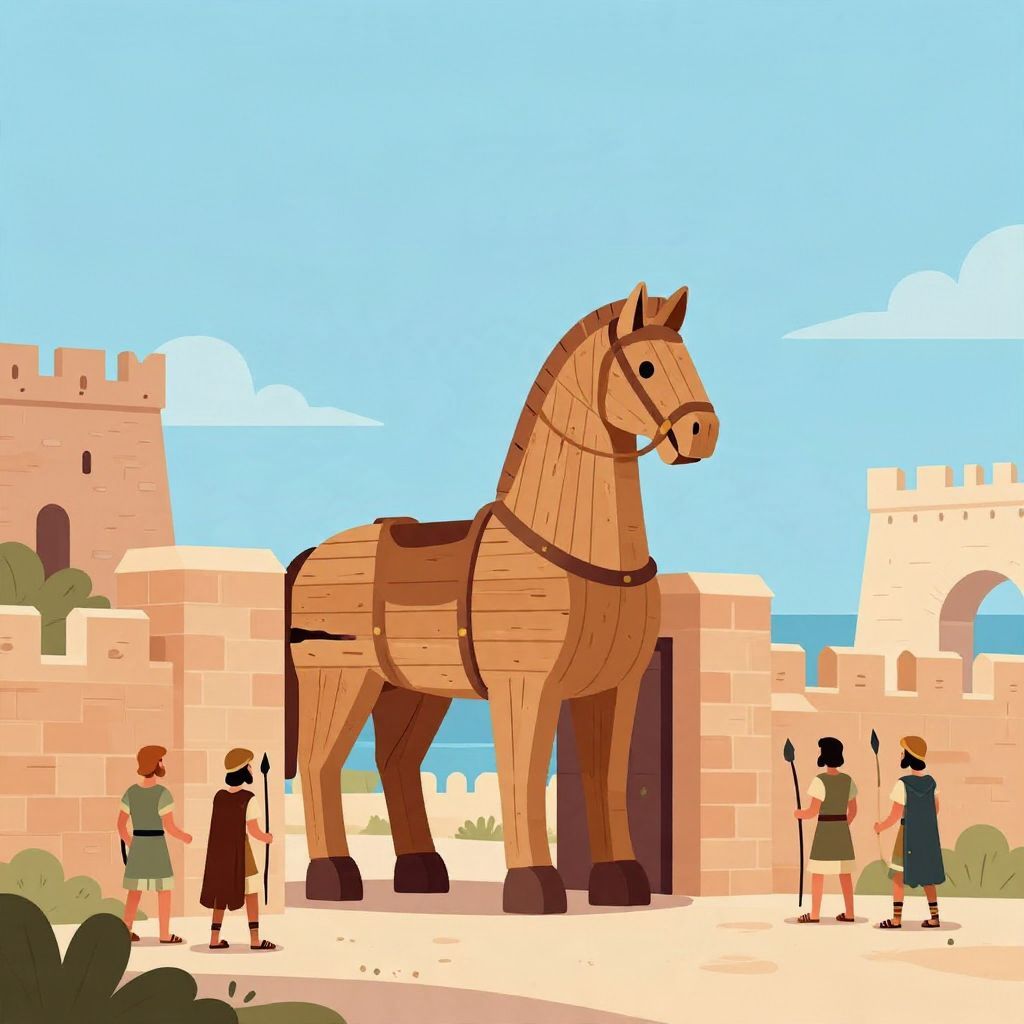
The phrase “Trojan Horse” is one of the most famous stories from ancient history, but it is also a symbol that has outlived the world that created it. People use it today to mean a hidden trick, a deceptive gift, or a way of entering a protected place by seeming harmless.
Historically, the Trojan Horse belongs to the legendary end of the Trojan War, a conflict placed by Greek tradition in the late Bronze Age. The story is best known from later Greek and Roman literature, especially The Aeneid, and it sits at the border between myth, memory, and possible historical experience.
What Is Trojan Horse?
The Trojan Horse is a famous Greek legend in which the Greeks supposedly built a large wooden horse, hid soldiers inside it, and left it outside the city of Troy as a fake offering. The Trojans brought it into the city, and at night the hidden warriors emerged and helped destroy Troy. It is a story of deception, strategy, and the danger of trusting appearances.
The Trojan Horse in the Trojan War
The Trojan Horse is usually presented as the final turning point in the Trojan War, the legendary conflict between the Greeks and the city of Troy. In the story, the Greeks had failed to capture Troy by force after a long siege, so they turned to cunning instead of direct attack.
A war from myth and epic
The Trojan War is not a straightforward historical event with secure records. It is known mainly through Greek epic poetry and later retellings, especially Homer’s Iliad, which focuses on an earlier part of the war and does not actually tell the full horse story. The horse appears more clearly in later works and traditions, which means the famous image comes from a broader mythic cycle rather than from one single ancient account.
Why the horse mattered
In the legend, the Greeks could not break Troy’s defenses by siege or assault. The horse solved that problem by using surprise and psychological deception. Whether or not any such event happened, the story captures an ancient idea that intelligence and trickery can succeed where brute force fails.
Where Did the Story Come From?
The exact origin of the Trojan Horse story is uncertain. It developed within Greek oral tradition and later literary retellings, and scholars have long debated whether it preserves a memory of an actual event, a symbolic tale, or a purely literary invention. There is no direct archaeological proof of a giant wooden horse entering Troy.
Ancient literary sources
Several ancient writers helped shape the version people know today. Homer’s epics established the broader Trojan War tradition. Later Greek poets and tragedians expanded the story, and the Roman poet Virgil gave it one of its most influential forms in The Aeneid, written in the late first century BCE. Virgil’s account strongly shaped later Western imagination.
Possible historical kernels
Some historians have suggested that the “horse” may have referred to something else: a siege engine, a ship, or even a symbolic image. Others think the story may preserve a memory of a city taken by stealth after a long conflict. These ideas remain speculative. What is established is that the horse story became a powerful narrative of conquest through deception.
What Happened in the Legend?
Although versions differ, the basic outline is familiar. The Greeks pretended to abandon the siege and sailed away, leaving behind a huge wooden horse. A Greek spy or messenger, depending on the version, helped persuade the Trojans that the horse was a sacred offering or a sign of victory. The Trojans dragged it inside the city despite warnings from some of their own people.
The role of warning and disbelief
In many retellings, a Trojan priest named Laocoön warns against accepting the horse, but his warnings are ignored. This part of the story emphasizes a tragic theme: people can be defeated not only by force, but by misjudgment, pride, or the failure to heed caution.
The hidden soldiers
At night, the Greeks inside the horse are said to have climbed out, opened the gates, and allowed the rest of the Greek force to enter Troy. The city was then sacked, and its people suffered death, enslavement, or exile. The horse therefore symbolizes both cunning strategy and catastrophic vulnerability.
Was There Really a Trojan Horse?
Most historians treat the Trojan Horse as a legend rather than a verified historical fact. There is no contemporary evidence proving that a massive wooden horse was used to capture Troy. However, the story may reflect a real memory of warfare in the eastern Mediterranean during the late Bronze Age, roughly around the 12th or 13th century BCE.
Troy as a real place
Troy itself was not imaginary. Archaeological excavations at Hisarlik in modern-day Turkey have identified a major ancient settlement often associated with Troy. The site shows layers of occupation and destruction over time. That does not prove the horse story, but it does show that the legend was attached to a real and important city in the region.
Legend versus evidence
It is important to separate three things:
- The city of Troy, which was real.
- The Trojan War tradition, which is ancient but partly legendary.
- The wooden horse episode, which belongs to myth and later literary tradition rather than confirmed history.
Why the Trojan Horse Story Lasted So Long
The Trojan Horse survived because it is memorable, dramatic, and easy to apply to many situations. It tells a clear story: a powerful enemy is defeated not by strength, but by cleverness. That makes it useful both as entertainment and as a moral lesson.
A story about deception
The horse is one of the oldest and most enduring symbols of hidden danger. It warns that gifts can conceal threats and that appearances can be misleading. This is why the term has remained useful far beyond ancient history.
A story about hubris and trust
The legend also reflects ancient concerns about pride, judgment, and the consequences of ignoring warnings. The Trojans’ decision to bring the horse inside can be read as a cautionary tale about overconfidence after apparent victory.
How the Troj an Horse Became a Modern Metaphor
Today, “Trojan Horse” is widely used to describe anything that appears harmless but hides a harmful purpose. The phrase appears in politics, literature, cybersecurity, and everyday speech. In computer security, for example, a “Trojan horse” is malicious software disguised as something useful.
Why the metaphor fits
The ancient story works so well as a metaphor because its structure is simple and vivid: a deceptive object is welcomed inside a protected space, and that trust is exploited from within. The modern use preserves the core meaning even when the historical details are not taken literally.
Key Facts About the Trojan Horse
- Origin: Ancient Greek legend connected to the end of the Trojan War.
- Best-known literary source: Virgil’s Aeneid, written in the 1st century BCE.
- Historical status: Unverified as a literal event; treated by scholars as myth or legend.
- Setting: Troy, a real ancient city in western Anatolia, near modern Hisarlik in Turkey.
- Main idea: Deception used as a military strategy.
- Modern meaning: A hidden threat disguised as something safe or helpful.
Why It Still Matters
The Trojan Horse remains important because it sits at the meeting point of history, literature, and cultural memory. Even if the wooden horse never existed in the literal sense, the story helped shape how later societies thought about warfare, trickery, and trust. It also shows how myths can preserve historical imagination long after the original events are lost.
So, what is Trojan Horse? It is a legendary Greek deception used to capture Troy, a story rooted in ancient tradition rather than secure historical proof. Its lasting power comes from the way it turns one dramatic episode into a universal lesson about hidden danger, strategy, and the risks of trusting appearances. For more on ancient tactics and historical strategy, you may also want to read about the value of letting an enemy make a mistake and the broader social structures that shaped ancient societies, such as what a feudal system was.