
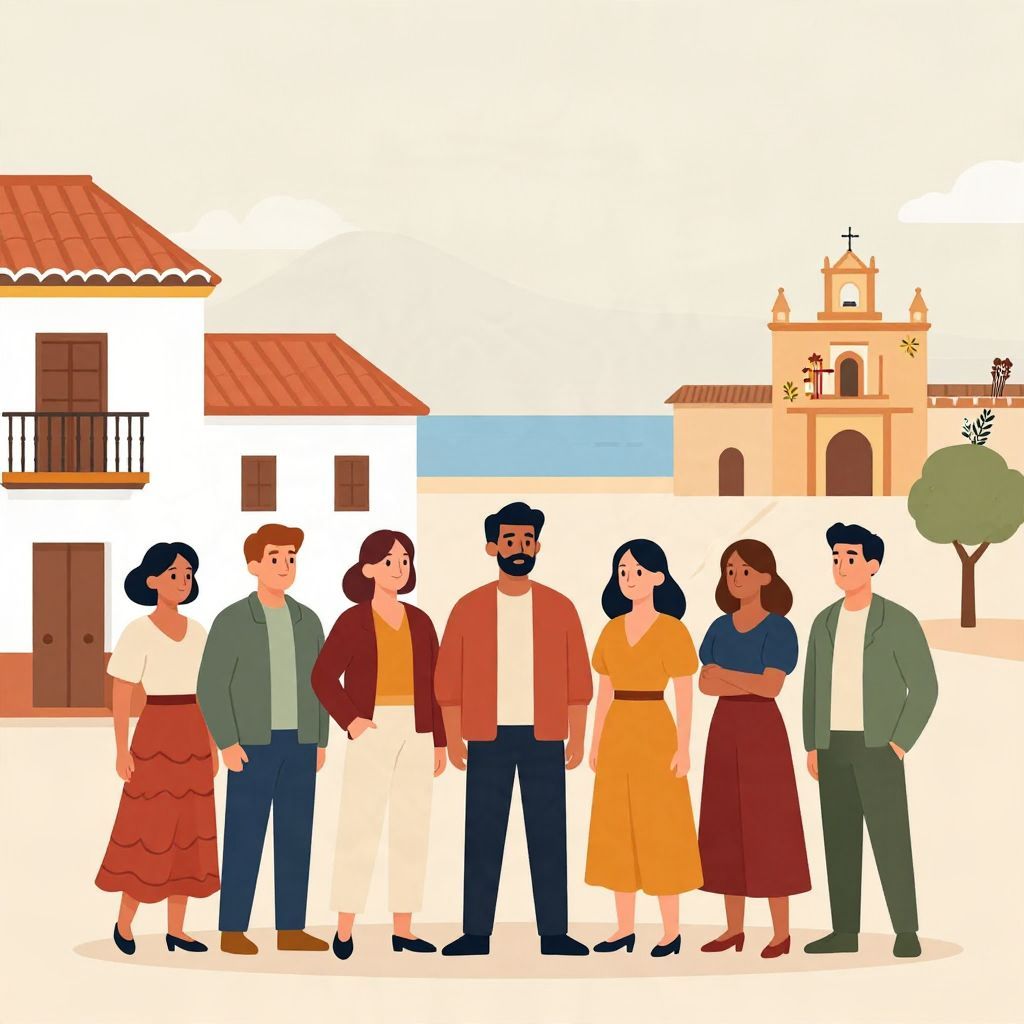
What do Spaniards look like? It is a simple question with a complicated answer, because Spain has never been a single, isolated population. Over centuries, the Iberian Peninsula has seen Romans, Visigoths, Muslims, Jews, Christians, and many regional communities mix in different ways.
So there is no one “Spanish look.” Spaniards today can have a wide range of skin tones, hair colors, eye colors, and facial features, shaped by geography, ancestry, and history. The most accurate answer is that Spaniards are diverse, and regional differences can be as noticeable as any national pattern.
What do Spaniards look like?
Spaniards do not have one fixed appearance. Many have medium to olive skin, dark brown hair, and brown eyes, but blond, red, and lighter-featured Spaniards are also common, especially in some northern regions. Spain’s long history of migration and settlement created a population with broad variation rather than a single “type.”
Why there is no single Spanish appearance
Modern Spain is the result of repeated layers of settlement and cultural change. Ancient Iberian peoples lived on the peninsula before Roman conquest beginning in the 3rd century BCE. Later came Germanic groups, Islamic rule in much of the peninsula from the 8th century onward, and centuries of movement within and beyond Spain. This long history makes appearance varied, not uniform.
Ancient foundations
Before the Roman period, the Iberian Peninsula was home to many local peoples, including Iberians, Celtiberians, Lusitanians, and others. Roman rule then connected the region to the wider Mediterranean world. After the fall of Roman authority in the West, Visigothic elites ruled parts of the peninsula, adding another historical layer, though the population remained largely local and mixed over time.
Islamic and medieval influences
In 711, Muslim forces entered the peninsula, and al-Andalus became a major political and cultural center for centuries. This did not mean that all Spaniards became one ethnic group; rather, the peninsula became a place of coexistence, conflict, conversion, and migration among Muslims, Christians, and Jews. Over time, these processes contributed to the genetic and cultural diversity visible in Spain today.
Common physical traits often associated with Spaniards
In popular imagination, Spaniards are often pictured as having dark hair, brown eyes, and olive-toned skin. That image is not wrong for many people in Spain, but it is only a partial picture. These traits are common across much of southern Europe and the Mediterranean, and they do not define every Spaniard.
Hair color
Dark brown and black hair are frequent in Spain, especially in the south and east, but lighter brown and blond hair also appear, particularly in northern areas. Hair color varies within families and regions, so it is not a reliable way to identify nationality on its own.
Eye color
Brown eyes are the most common in Spain, yet hazel, green, and blue eyes are also found. Eye color distribution reflects both deep ancestry and long-term regional mixing. People in northern Spain are sometimes described as having lighter eyes more often, but this is a tendency, not a rule.
Skin tone
Spanish skin tones range from fair to olive to medium-brown. Sun exposure can also shape how people appear in daily life, especially in a country with a warm climate and strong seasonal sun. Because skin tone is influenced by both genetics and environment, it should not be treated as a simple ethnic marker.
Regional differences within Spain
Spain is not visually uniform from north to south. Geography, historical settlement patterns, and local identity have all helped create regional variation. These differences are often subtle, but they are important for understanding why Spaniards cannot be described with one physical stereotype.
Northern Spain
In regions such as Galicia, Asturias, Cantabria, the Basque Country, and parts of northern Castile, people are sometimes stereotyped as having lighter skin, lighter eyes, or fairer hair than the national average. Some of this perception comes from historical links across the Atlantic and to western Europe, but it is easy to overstate. Northern Spain is diverse too.
Central Spain
In Castile and Madrid, appearance reflects centuries of internal migration. As the political and administrative center of Spain grew, people from many regions moved there, making the population especially mixed. Madrid in particular is one of the most diverse urban areas in the country.
Southern Spain
Andalusia, Murcia, and parts of Extremadura are often associated with darker hair and olive skin. This image is partly shaped by climate, regional history, and cultural stereotypes. Andalusia’s long contact with the Islamic world and the Mediterranean helped create a distinctive historical identity, but it did not produce a single physical type.
Island and coastal regions
The Balearic Islands and Canary Islands have their own histories of contact and migration. The Canary Islands, for example, were originally inhabited by the Guanches before Castilian conquest in the 15th century, and later became a crossroads between Europe, Africa, and the Atlantic world. As a result, island populations can show especially varied features.
How history shaped Spanish appearance
Appearance in Spain reflects centuries of movement, intermarriage, conquest, and local continuity. No single event created Spaniards as they look today. Instead, the population developed gradually through historical layers that left both cultural and biological traces.
Romanization and continuity
Roman rule spread Latin language and institutions across the peninsula, but it did not replace the local population. Most people remained descendants of earlier inhabitants, gradually adopting Roman customs. This is one reason modern Spaniards are not simply “Romans” in appearance, but rather people shaped by a long Mediterranean history.
Medieval coexistence and conflict
During the Middle Ages, the peninsula was divided among Christian kingdoms, Muslim polities, and Jewish communities. Conversion, expulsion, and resettlement changed the population repeatedly. The completion of the Reconquista in 1492 and later expulsions of Jews and Moriscos were major turning points, though the effects on appearance were gradual and uneven rather than immediate.
Atlantic expansion and migration
From the late 15th century onward, Spain became a global empire. Spanish migration to the Americas and return migration from colonial territories later brought new connections back to the peninsula. In the 19th and 20th centuries, internal migration from rural areas to cities, plus immigration from Latin America, North Africa, and elsewhere, further diversified Spain’s population.
Popular stereotypes versus historical reality
People often imagine Spaniards through film, tourism, or regional clichés: dark hair, dramatic features, flamenco dress, or a “Mediterranean” look. These images are culturally powerful but historically incomplete. Spain includes many regional identities, and physical appearance has never matched national identity in a neat or consistent way.
Spain is not one ethnic category
“Spanish” is primarily a national identity, not a single ethnic phenotype. Someone from Galicia, Andalusia, Catalonia, the Basque Country, or the Canary Islands may all be Spanish while looking quite different from one another. Language, citizenship, and culture often matter more than appearance in defining Spanish identity.
Appearance and regional identity
Historically, regional identities in Spain have been strong. Local dress, dialects, customs, and family networks often mattered more than any national standard of appearance. Even today, a person’s look may be read through regional stereotypes, but those stereotypes are social habits, not scientific categories.
What genetics can and cannot tell us
Modern genetics confirms that Spaniards, like other Europeans, have mixed ancestry from ancient Iberian populations and later historical migrations. But genetics does not produce a single visible “Spanish face.” Many traits are polygenic, meaning they are influenced by multiple genes and environmental factors, so appearance varies widely within families and regions.
Why genetics does not equal appearance
Two people can share similar ancestry and still look different. Likewise, people with different ancestry can share similar features. This is why historical and genetic evidence should be used carefully: ancestry helps explain diversity, but it cannot reduce Spaniards to one look or one origin story.
How Spaniards are often seen abroad
Outside Spain, especially in English-language media, Spaniards are sometimes grouped loosely with Italians, Greeks, or other southern Europeans. This can create a broad “Mediterranean” stereotype that ignores Spain’s internal diversity. In reality, Spaniards may resemble many neighboring populations, but they are not visually uniform.
Tourism and media images
Tourism has reinforced certain images of Spain: sun, beaches, dark hair, and lively street culture. While these are recognizable parts of Spanish life, they are not a biological portrait. Historical Spain was and remains more varied than the postcard version.
The best historical answer
Historically, Spaniards look like a diverse European and Mediterranean population shaped by centuries of settlement, empire, religion, migration, and regional identity. Many have dark hair and brown eyes, but fairer features are also common, and there is no single authentic Spanish appearance. The most accurate description is diversity within a shared national history.
In short, if you are asking what Spaniards look like, the honest answer is that they can look many different ways. History explains why. For a broader comparison of regional identity and appearance, you may also find what Scottish people look like and why Mexicans speak Spanish useful next reads.