
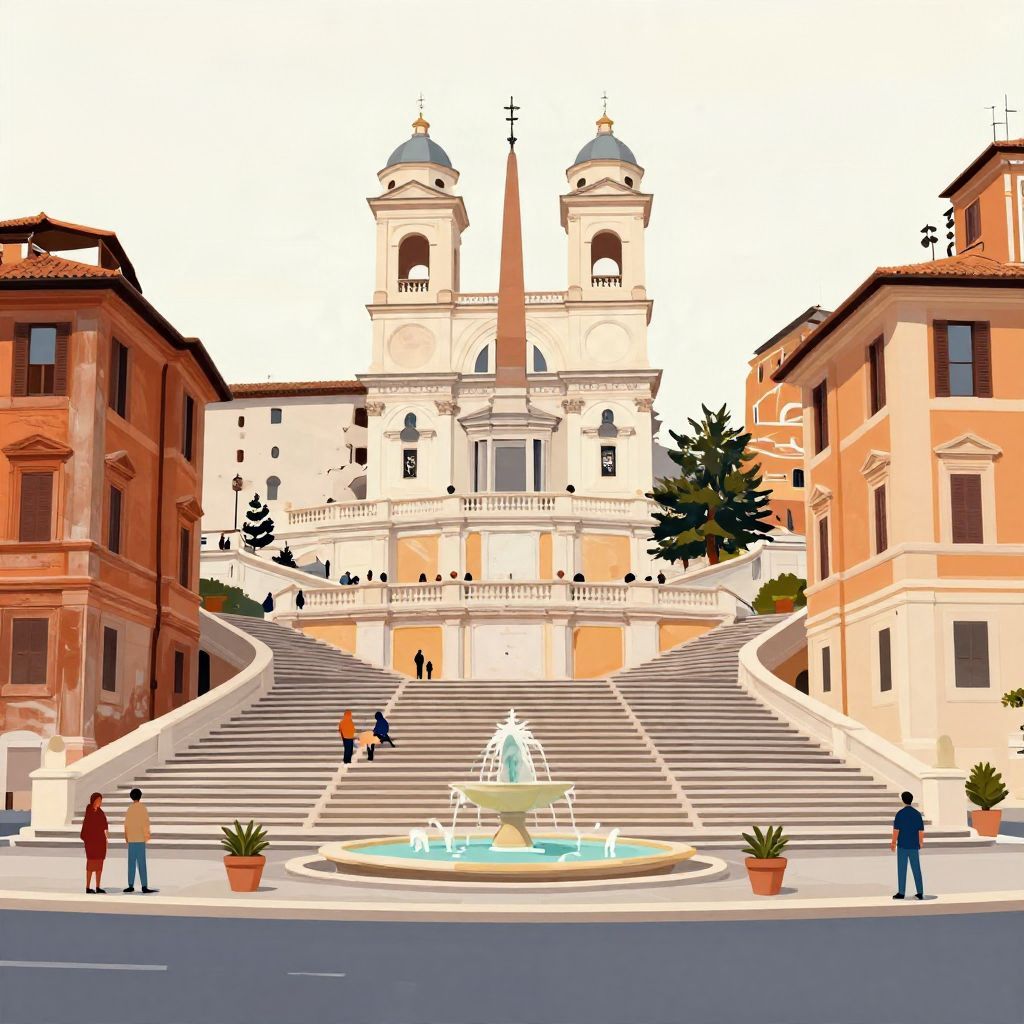
The Spanish Steps are one of Rome’s best-known landmarks, but their fame is not just about their beauty. They are famous because they connect a grand staircase, a famous church, a fashionable square, and centuries of diplomatic and artistic history in the heart of the city.
They also became a symbol of Roman elegance in the 18th century and later a global icon through tourism, cinema, and popular culture. Their name can be misleading: the steps are in Rome, not Spain, and their story reflects the international politics of early modern Europe.
Why Are The Spanish Steps Famous?
The Spanish Steps are famous because they are a striking 18th-century staircase in central Rome that links the Spanish Square below with the French church of Trinità dei Monti above. Their fame comes from their elegant design, their role as a social meeting place, and their long association with artists, travelers, and modern tourism.
What the Spanish Steps are and where they are located
The Spanish Steps, or Scalinata di Trinità dei Monti, rise from Piazza di Spagna to the church of Trinità dei Monti. They contain 135 steps and were completed in the 1720s. The staircase is not a monument to Spain itself, but to a diplomatic and urban landscape shaped by French, Spanish, and papal influence in Rome.
Why the name “Spanish”?
The name comes from the Spanish Embassy to the Holy See, which was historically located in the square below. That embassy gave the piazza its identity, even though the church at the top is French and the staircase was funded by a French diplomatic legacy. The name reflects Rome’s international neighborhoods more than any single national story.
The history behind the staircase
The Spanish Steps were built in the early 18th century after a long debate over how to connect the steep hill between the piazza and the church. The project was completed in 1725, following the design associated with Francesco de Sanctis. The staircase was intended to solve a practical problem while also creating a dramatic public space worthy of papal Rome.
A diplomatic and religious setting
Trinità dei Monti was a French church, and the Spanish square below was tied to the Spanish monarchy’s diplomatic presence in Rome. This unusual combination mattered. Rome was not only a religious capital; it was also a city where European powers maintained embassies, churches, and patronage networks. The steps visually linked those worlds.
Why the staircase was built
Before the staircase, the hill was difficult to cross. The steps offered a grand solution that was both useful and symbolic. In Baroque Rome, architecture often did more than serve a function: it created theatrical public spaces, guided movement, and displayed prestige. The Spanish Steps fit that tradition perfectly.
Why they became so famous
The Spanish Steps became famous because they were more than a staircase. They became a stage for Roman life. Visitors, artists, aristocrats, and later ordinary tourists used them as a place to meet, rest, admire the view, and be seen. Their fame grew from a combination of architecture, location, and social meaning.
A fashionable meeting place
By the 18th and 19th centuries, the area around the steps was part of the “Grand Tour” experience for wealthy Europeans. Travelers came to Rome to study classical ruins, art, and Catholic heritage, and the Spanish Steps became one of the city’s most recognizable gathering places. They were associated with style, conversation, and cosmopolitan life.
Artists, writers, and travelers
Rome attracted painters, poets, and scholars, many of whom spent time near the steps. The neighborhood around Piazza di Spagna developed as a center for foreign visitors and artistic circles. This helped turn the steps into a cultural landmark, not just a piece of urban infrastructure.
Hollywood and modern tourism
In the 20th century, films and photography made the Spanish Steps internationally famous. One of the best-known examples is Roman Holiday (1953), which helped fix the steps in the global imagination as a romantic Roman setting. Since then, millions of tourists have visited them, reinforcing their status as a must-see landmark.
The architecture and design of the Spanish Steps
The staircase is admired for its graceful, flowing design. Rather than a simple straight flight, it uses curves, terraces, and landings to create a sense of movement and ceremony. The steps are often praised as a fine example of Baroque urban design, where public space is shaped to produce visual drama and emotional effect.
Baroque style in an urban setting
Baroque architecture in Rome often aimed to impress and guide the eye. The Spanish Steps do this by unfolding upward in stages, drawing visitors toward the church at the top. The design also helps the staircase fit the steep slope while making the ascent feel elegant rather than harsh.
The fountain at the base
At the bottom of the steps is the famous Fontana della Barcaccia, or “Boat Fountain,” traditionally associated with Pietro Bernini and his son Gian Lorenzo Bernini. Its boat-like shape adds to the charm of the square and helps make the whole area feel like a unified ensemble rather than a single isolated monument.
How the Spanish Steps fit into Roman history
The Spanish Steps are famous because they sit at the intersection of several layers of Roman history. They are not ancient like the Colosseum or the Forum, but they belong to a later chapter in Rome’s story: the age of papal power, European diplomacy, and the transformation of the city into a center of pilgrimage and culture.
Rome in the early modern period
In the 17th and 18th centuries, Rome was shaped by the papacy and by the presence of foreign religious and diplomatic communities. Churches, embassies, and aristocratic residences were important markers of influence. The Spanish Steps emerged from that world, where architecture could express both civic pride and international rivalry.
A landmark of the Grand Tour
For educated European travelers, Rome was a destination of learning and taste. The Spanish Steps became one of the places where that experience was lived publicly. Their fame grew because they were easy to recognize, visually appealing, and tied to the social rituals of travel in a city full of memorable monuments.
Famous facts about the Spanish Steps
Several details help explain why the Spanish Steps remain so well known today. Some are historical, while others reflect later popularity and modern habits of tourism.
- They were completed in 1725, after decades of discussion about how to link the hill and the piazza.
- They have 135 steps, though counts can vary slightly depending on how one measures the landings and levels.
- They connect two important sites: Piazza di Spagna below and Trinità dei Monti above.
- Their name comes from the Spanish Embassy, not from Spain owning the site.
- They are a major tourist destination and one of the most photographed places in Rome.
Myths, etiquette, and modern preservation
Because the Spanish Steps are so famous, they are also surrounded by popular habits and rules. One common misunderstanding is that they are somehow “Spanish” in origin. Another is that they are simply a scenic backdrop. In reality, they are a carefully designed historic site that requires protection from heavy foot traffic and wear.
Why visitors are often told not to sit or eat there
In recent years, Rome has introduced restrictions to protect the steps from damage, litter, and overcrowding. These rules reflect a broader challenge faced by historic cities: how to preserve a fragile monument while still allowing the public to enjoy it. Their fame creates pressure, and preservation has become part of their modern history.
From local landmark to global symbol
The Spanish Steps began as a Roman urban project tied to local and diplomatic needs. Over time, they became a symbol of Rome itself: elegant, social, photogenic, and layered with history. Their fame now rests on both their original 18th-century setting and the modern culture of travel that keeps them in the spotlight.
Why they still matter today
The Spanish Steps remain famous because they capture something essential about Rome: the city’s ability to turn history into lived space. They are not only an object to look at but a place shaped by movement, ceremony, and memory. Their staircase tells a story of diplomacy, design, tourism, and the long afterlife of urban monuments.
In short, the Spanish Steps are famous because they combine beauty, history, and cultural symbolism in one of Rome’s most visited places. If you want to explore more of the city’s layered past, you may also enjoy what the Roman Forum was and how Rome’s historical identity developed over time.