
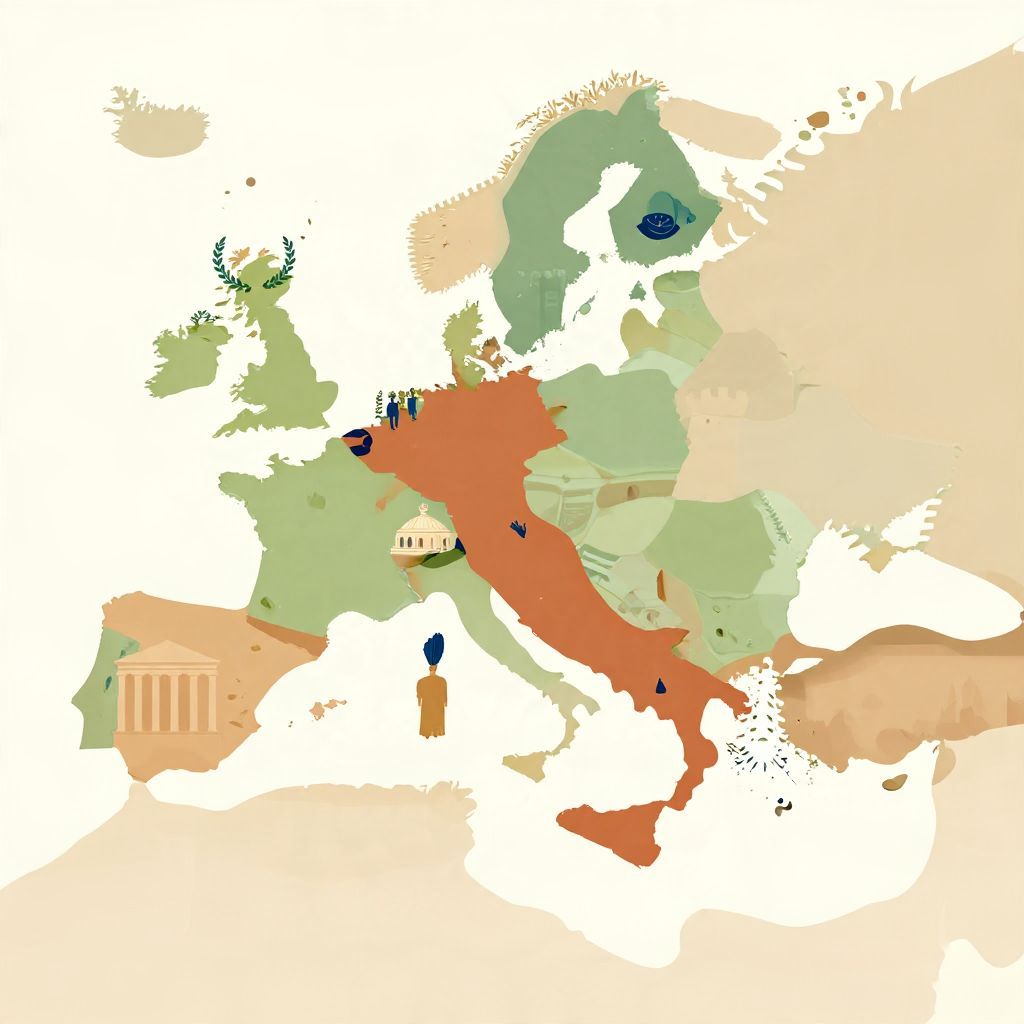
How old is Italy? The answer depends on what you mean by “Italy.” If you mean the modern nation-state, Italy is young: it was unified in 1861, with Rome added as the capital in 1871. If you mean the land, culture, and name of Italy, then its history stretches back thousands of years.
That difference matters. Italy has been a peninsula of many peoples, city-states, kingdoms, and empires long before it became one country. So the age of Italy is both a modern political story and a much older historical one.
How old is Italy?
Italy as a unified country is 165 years old in 2026, dating from the Kingdom of Italy proclaimed in 1861. If you count the completion of unification with Rome’s annexation in 1870 and its becoming the capital in 1871, the modern state is slightly younger in its final form. But the name “Italy” and the peninsula’s history go back far earlier, into antiquity.
What counts as “Italy” in history?
The question is tricky because “Italy” can mean several different things: a geographic peninsula, a cultural region, a Roman administrative area, or a modern sovereign state. Historians usually separate these meanings rather than giving one single age. The answer changes depending on whether you are asking about the land, the identity, or the political nation.
The peninsula is ancient
People have lived on the Italian peninsula since prehistoric times. Long before any unified state existed, communities developed in the Alps, along the coasts, and in the fertile plains. By the first millennium BCE, the peninsula was already home to Etruscans, Greeks in the south, and many Italic-speaking peoples, among others.
The name “Italy” is old, but its meaning changed
The word “Italy” likely began as a regional name in the south of the peninsula and gradually expanded to cover a larger area. By Roman times, Italia referred to the peninsula under Roman control. In that sense, Italy as a named historical region is more than 2,000 years old, though its borders and political meaning changed many times.
A short historical timeline of Italy
Prehistory and early peoples
- Prehistoric era: Human settlement on the peninsula dates back tens of thousands of years.
- 1st millennium BCE: Etruscans, Greeks, Celts, Latins, Samnites, and other peoples shaped the region.
Before a state called Italy existed, the peninsula was a mosaic of languages, religions, trade networks, and local powers. This diversity is one reason Italian history is so rich and so complex.
Rome and the ancient meaning of Italy
- c. 753 BCE: Traditional founding date of Rome, though this is legendary rather than securely historical.
- 3rd–1st centuries BCE: Rome conquers much of the peninsula and then the Mediterranean world.
- 1st century BCE: “Italia” becomes a major Roman territorial concept.
Rome transformed the peninsula from a collection of peoples into the center of a vast empire. Under Roman rule, Italy gained a special status. It was not just another province; it was the heartland of Roman power, law, roads, and identity.
Late antiquity and the fall of Roman unity
- 5th century CE: The Western Roman Empire collapses.
- 6th–8th centuries: Italy is contested by Byzantines, Lombards, and others.
After Rome’s western empire fell, the peninsula fractured politically. No single Italian kingdom replaced Roman unity. Instead, Italy became a patchwork of duchies, papal lands, city-states, and foreign-controlled territories. This fragmentation lasted for centuries.
Medieval and Renaissance Italy
- 11th–15th centuries: Powerful city-states such as Venice, Florence, Milan, and Genoa flourish.
- 14th–16th centuries: The Renaissance reshapes art, learning, and politics.
Medieval and Renaissance Italy was not one country, but it was one of the most influential regions in Europe. Trade, banking, art, and scholarship made Italian cities famous. Yet their rivalry also prevented unification. Italy was culturally connected long before it was politically united.
Foreign domination and the road to unification
- 16th–18th centuries: Much of Italy falls under Spanish, Austrian, or other foreign influence.
- 1796–1815: Napoleon reorganizes parts of Italy and spreads modern political ideas.
- 1815: The Congress of Vienna restores old boundaries and foreign control in many areas.
Modern Italian nationalism grew partly in reaction to foreign rule and political fragmentation. Writers, revolutionaries, and statesmen increasingly argued that Italians shared a common language, history, and destiny. That idea eventually became the Risorgimento, the movement for unification.
Unification and the birth of modern Italy
- 1861: The Kingdom of Italy is proclaimed.
- 1866: Venetia is added to the kingdom.
- 1870: Rome is annexed.
- 1871: Rome becomes the capital of Italy.
This is the clearest answer to “How old is Italy?” if you mean the modern state. In 1861, most of the peninsula was brought together under one monarchy. The process was not complete until Rome joined the kingdom, but 1861 is the standard founding date for unified Italy.
Why 1861 is the key date
Historians usually mark 1861 because that is when the Kingdom of Italy was formally proclaimed. The new state was built from the Kingdom of Sardinia-Piedmont’s expansion under leaders such as Victor Emmanuel II, Camillo Benso, Count of Cavour, and Giuseppe Garibaldi. Their efforts combined diplomacy, war, and popular mobilization.
Unification was gradual, not instant
Italy did not become fully unified overnight. Different regions had different laws, economies, and loyalties. Some areas joined through plebiscites, some through military conquest, and some through diplomacy. Even after 1861, the new state still had to build institutions, roads, schools, and a shared national identity.
Rome’s role in the national story
Rome had enormous symbolic importance. Many Italians saw it as the natural capital because of its ancient and papal heritage. Its annexation in 1870 completed the territorial unification of the peninsula’s main core and gave the new kingdom a capital that linked modern Italy to its Roman past.
How old is Italy compared with ancient Rome?
Italy is much younger than Rome as a political power, but older than the modern nation in cultural and geographic terms. Rome as a city is traditionally dated to 753 BCE, though that date is based on legend. The Roman state, the Roman Republic, and later the Roman Empire all developed long before modern Italy existed.
Ancient Rome and modern Italy are not the same thing
It is tempting to treat ancient Rome and modern Italy as one continuous state, but that would be misleading. Rome ruled a Mediterranean empire; modern Italy is a nation-state centered on the peninsula. The two are connected historically, but they are not identical political entities.
The Roman legacy shaped Italian identity
Even so, Rome deeply influenced later ideas of Italy. Language, law, architecture, and political symbolism all drew on Roman heritage. The modern Italian state inherited not Roman government, but a powerful memory of Roman greatness that helped shape national identity.
How old is the idea of Italy?
The idea of Italy is older than the modern country by many centuries. In antiquity, the peninsula was already seen as a distinct region. Under Rome, Italia became a recognized geographic and political term. Later, medieval and Renaissance writers continued to use “Italy” even when the peninsula was divided into many states.
Cultural Italy before political Italy
Shared language and culture developed gradually, especially through Latin and its descendants. In the Middle Ages, no single government ruled all of Italy, but educated people could still think of the peninsula as a meaningful whole. That cultural continuity helped make unification possible in the 19th century.
Language and identity
Standard Italian emerged from Tuscan literary traditions, especially the prestige of writers like Dante, Petrarch, and Boccaccio. Their influence helped create a cultural language that later became a national language. This means Italy’s identity was built not only by armies and kings, but also by literature and education.
How old is Italy today in historical terms?
If you want a simple answer, here it is: modern Italy is 165 years old in 2026, counting from 1861. If you count from the completion of territorial unification in 1871, it is 155 years old. If you mean the historical region called Italy, then its story is over 2,000 years old, and its human past is far older than that.
Why the question matters
Asking how old Italy is reveals how nations are made. A country can have ancient roots, a medieval cultural identity, and a modern political birthdate all at once. Italy is a strong example of that layering: prehistoric settlement, Roman unity, centuries of division, and finally 19th-century unification.
So Italy is both old and young. The land and name are ancient, but the modern nation is relatively recent. That dual history is part of what makes Italy so historically distinctive. For more context, you may also enjoy reading about how old the Colosseum is and how old Latin is.