
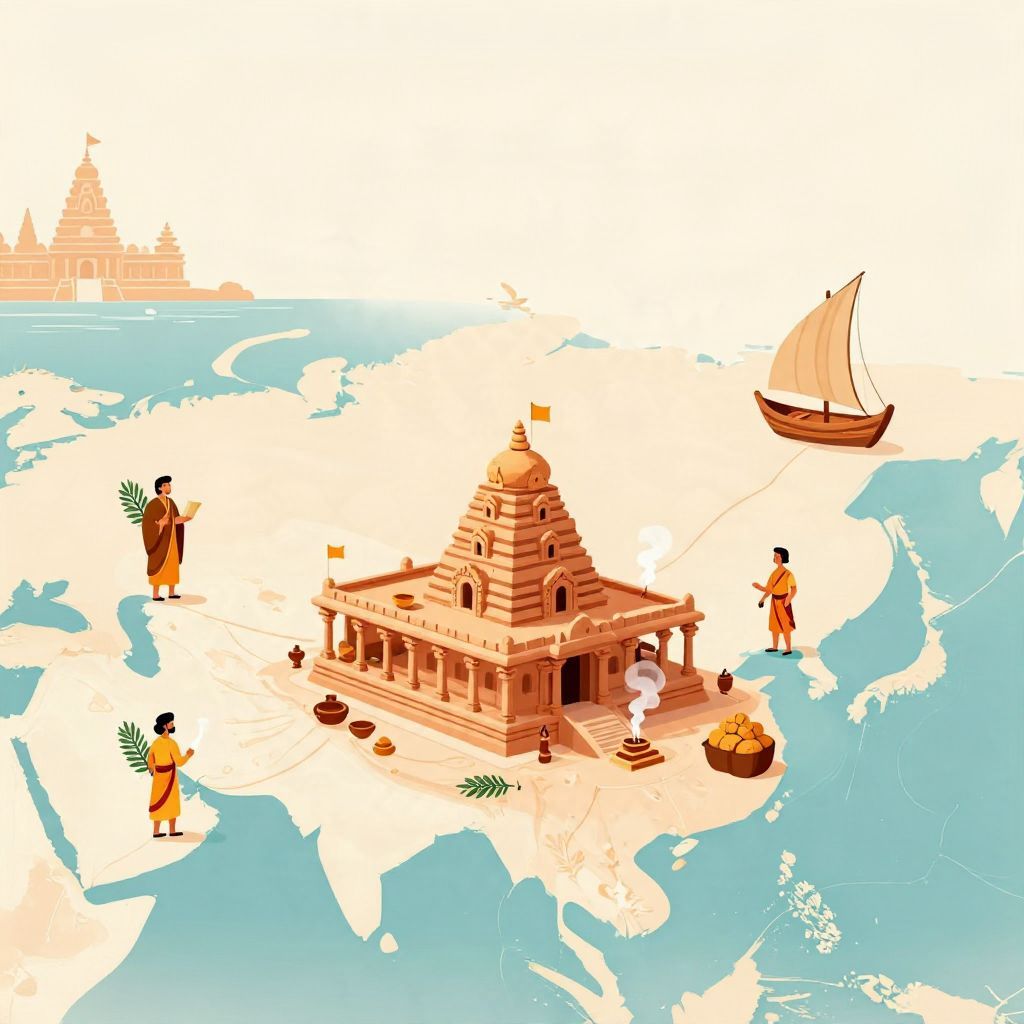
How did Hinduism spread, and why did it become one of the world’s major living religious traditions? The answer is not a single conquest, mission, or conversion campaign. Hinduism spread gradually over many centuries through migration, trade, royal patronage, local adaptation, temple building, and the absorption of diverse beliefs and practices across South Asia and beyond.
Because it developed over such a long period, Hinduism’s spread looks different from the expansion of religions with centralized missionary structures. Its history is tied to the ancient Indian subcontinent, especially the movement of people, ideas, and rituals from the Vedic age onward.
How Did Hinduism Spread?
Hinduism spread mainly through cultural exchange, migration, political backing, and regional adaptation rather than through formal conversion campaigns. Its core ideas grew in northern India, then moved across the subcontinent as Sanskrit learning, temple worship, pilgrimage networks, trade routes, and local rulers helped reshape and transmit Hindu traditions over time.
From the Vedic world to a broader Indian civilization
The earliest roots of Hinduism are usually traced to the Vedic period, roughly from 1500 to 500 BCE, though the tradition’s deeper origins are more complex and debated. Early Vedic religion centered on ritual sacrifice, hymns, and gods such as Indra, Agni, and Varuna. As communities settled more firmly in the Indo-Gangetic plain, religious life changed. New texts, including the Upanishads, emphasized ideas such as karma, rebirth, and liberation, helping create the philosophical foundations of later Hindu traditions.
This was not “spread” in the modern missionary sense. Rather, it was a slow process of religious formation and diffusion across communities that shared language, ritual specialists, and social customs. Over time, many local beliefs and deities were incorporated into a wider Hindu framework.
Migration and settlement helped carry early traditions
One important factor was the movement of Indo-Aryan-speaking groups into northern India in the second millennium BCE. Historians and archaeologists debate the exact nature and scale of this movement, but there is broad agreement that it helped shape early Vedic culture. As these groups settled, they interacted with existing populations and traditions, creating a religious world that was never purely one thing.
That blending mattered. Hinduism did not spread by replacing every local practice. Instead, it often expanded by absorbing regional gods, sacred places, and customs into a larger religious system. This flexibility helped it take root in many different parts of India.
Royal patronage and temple culture
From the first centuries BCE and especially in the early centuries CE, Indian rulers played a major role in Hinduism’s spread. Kings and dynasties supported Brahmins, sponsored sacrifices, built temples, and linked their authority to Hindu ideas of kingship and cosmic order. This gave Hindu traditions political prestige and public visibility.
Temples became powerful centers of religious life. They were not only places of worship but also hubs of learning, landholding, art, music, and social organization. When rulers endowed temples, they helped Hindu practices travel into new regions and become embedded in local society.
Trade routes carried beliefs beyond the subcontinent
Hinduism also spread through commerce. Merchants, priests, and artisans traveled along overland and maritime routes connecting India with Southeast Asia, Central Asia, and the Indian Ocean world. Along these routes, Hindu ideas mixed with local traditions and with Buddhism, which also spread widely from India.
By the early centuries CE, Hindu influence had reached parts of present-day Cambodia, Thailand, Indonesia, Malaysia, and Vietnam. In these places, Hinduism did not always become the dominant everyday religion, but its symbols, stories, temple forms, and royal ideas left a deep mark. Sanskrit inscriptions, Hindu epics, and court rituals show how influential Indian culture became abroad.
What Were the Main Ways Hinduism Expanded?
Hinduism expanded through a combination of social, political, and cultural forces: migration, Sanskrit education, temple networks, pilgrimage, trade, and the adoption of Hindu practices by local communities and rulers. Its spread was often gradual and regional, with different forms of Hindu worship developing in different places rather than one uniform religion moving in a straight line.
1. Sanskrit and religious learning
Sanskrit was a major vehicle of Hindu spread. Learned elites used it for sacred texts, law, philosophy, poetry, and royal inscriptions. Because Sanskrit carried religious authority, rulers and scholars used it to connect local courts to a wider civilizational world. This helped standardize some ideas while still allowing local variation.
At the same time, many Hindu traditions were transmitted in vernacular languages. Epics such as the Ramayana and Mahabharata, along with devotional poetry, made Hindu ideas accessible to wider audiences. This combination of elite and popular transmission was one reason Hinduism could adapt across regions and social groups.
2. Temple building and pilgrimage
Temples anchored Hinduism in place. Once a temple was established, it attracted priests, donors, pilgrims, markets, and festivals. Sacred geography mattered too: rivers, mountains, forests, and shrines became part of a religious landscape that people traveled across to worship.
Pilgrimage routes helped spread shared stories and rituals. A person visiting a sacred site might return home with new practices, new devotional ideas, or stronger ties to a wider Hindu world. In this way, movement through sacred space reinforced religious continuity.
3. Local adaptation and incorporation
Hinduism spread successfully because it was highly adaptable. Many local communities did not simply abandon their older deities or customs. Instead, they identified them with Hindu gods, saints, or goddesses, or placed them within a broader Hindu cosmology. This process is one reason scholars often describe Hinduism as a family of traditions rather than a single fixed creed.
That flexibility helped Hinduism expand into diverse environments, from the Himalayan foothills to coastal South India and island Southeast Asia. The religion could look very different from one region to another while still sharing core ideas such as dharma, karma, rebirth, and devotion.
4. Bhakti and popular devotion
From roughly the early medieval period, devotional movements known as bhakti became especially important. Bhakti emphasized personal devotion to a chosen deity such as Vishnu, Shiva, or the Goddess. It often used local languages and emotional poetry, making religion more accessible to ordinary people.
Bhakti did not create Hinduism, but it helped broaden its appeal. By focusing on devotion rather than only ritual expertise, bhakti traditions made Hindu practice more inclusive in social and regional terms, even while inequalities remained deeply present.
How Did Hinduism Spread Outside India?
Outside India, Hinduism spread mainly through cultural influence rather than mass conversion. Indian merchants, priests, and political ideas traveled to Southeast Asia, where local rulers adopted Hindu symbols and court traditions. In many places, Hinduism blended with indigenous beliefs instead of replacing them completely.
Southeast Asia and the Indianized kingdoms
Between about the first and fifteenth centuries CE, Hindu influence was visible in kingdoms such as Funan, Champa, Khmer Cambodia, and parts of Java and Bali. Rulers adopted Sanskrit titles, Hindu myths, and temple architecture to strengthen their legitimacy. The great temple complexes of the region, including Angkor Wat in Cambodia, reflect this deep cultural exchange.
It is important not to oversimplify this as India “conquering” Southeast Asia. In most cases, local elites selectively borrowed Indian religious and political forms to support their own power. Hinduism spread because it was useful, prestigious, and adaptable in new settings.
Bali as a lasting example
Bali remains one of the best-known examples of Hindu tradition outside the Indian subcontinent. Balinese Hinduism developed through centuries of interaction with Indian ideas, Javanese court culture, and local religious practices. It shows how Hinduism could survive and evolve far from its original heartlands.
This example is important because it demonstrates that Hindu spread was not a one-time event. It was an ongoing process of adaptation, preservation, and transformation.
Did Hinduism Spread Through Conquest or Conversion?
Not usually. Unlike some religions that expanded through missionary institutions or imperial conquest, Hinduism spread mostly through gradual cultural integration. There were certainly wars, dynastic expansion, and political changes in South Asia, but these were not the main mechanism by which people became Hindu.
Instead, Hindu identity often formed through participation in local ritual life, temple worship, caste and kinship structures, and shared sacred narratives. In many cases, communities became more fully integrated into Hindu civilization over generations rather than through a single conversion moment.
What about social boundaries?
Hinduism’s spread was shaped by social hierarchy as well as inclusion. The caste system and related social structures influenced who could perform certain rituals, study sacred texts, or serve in temple roles. These boundaries sometimes helped organize religious life, but they also limited access and created inequality.
So while Hinduism spread widely, it did not spread in a simple egalitarian way. Its growth was tied to power, status, and local social order.
How Did Colonialism Change Hinduism’s Spread?
Under European colonial rule, especially from the eighteenth century onward, Hinduism entered a new global context. British administrators, missionaries, and scholars studied Indian texts and classified Hinduism as a “religion” in ways that often simplified its diversity. At the same time, Indian migration carried Hindu communities to places such as the Caribbean, East Africa, Southeast Asia, and the Pacific.
These migrations created new Hindu diasporas. In those communities, Hindu practice often changed to fit new social and political conditions while remaining connected to older traditions through festivals, language, and family ritual.
Modern global Hindu communities
Today, Hinduism exists far beyond India because of migration, diaspora, and transnational religious networks. Temples, festivals like Diwali, and digital media help sustain connections among Hindu communities worldwide. This modern spread is different from ancient expansion, but it still reflects Hinduism’s long history of adaptation across cultures and places.
Why Does the Spread of Hinduism Matter?
Understanding how Hinduism spread helps explain one of the most influential religious traditions in world history. It shows how religions can grow without centralized missionary systems, how culture travels alongside trade and politics, and how local traditions can become part of a larger civilizational framework.
It also helps explain why Hinduism is so diverse today. Its spread was never uniform, so there is no single Hindu practice or belief system. Instead, Hinduism developed through centuries of regional variation, philosophical debate, devotional movements, and cultural exchange.
Conclusion
Hinduism spread through a long historical process of migration, royal support, temple culture, trade, pilgrimage, Sanskrit learning, and local adaptation. It expanded across South Asia and beyond not by one method, but by many overlapping ones that allowed it to take root in different societies. To explore its beginnings in more detail, see where Hinduism began and compare its historical diffusion with how Islam spread.