
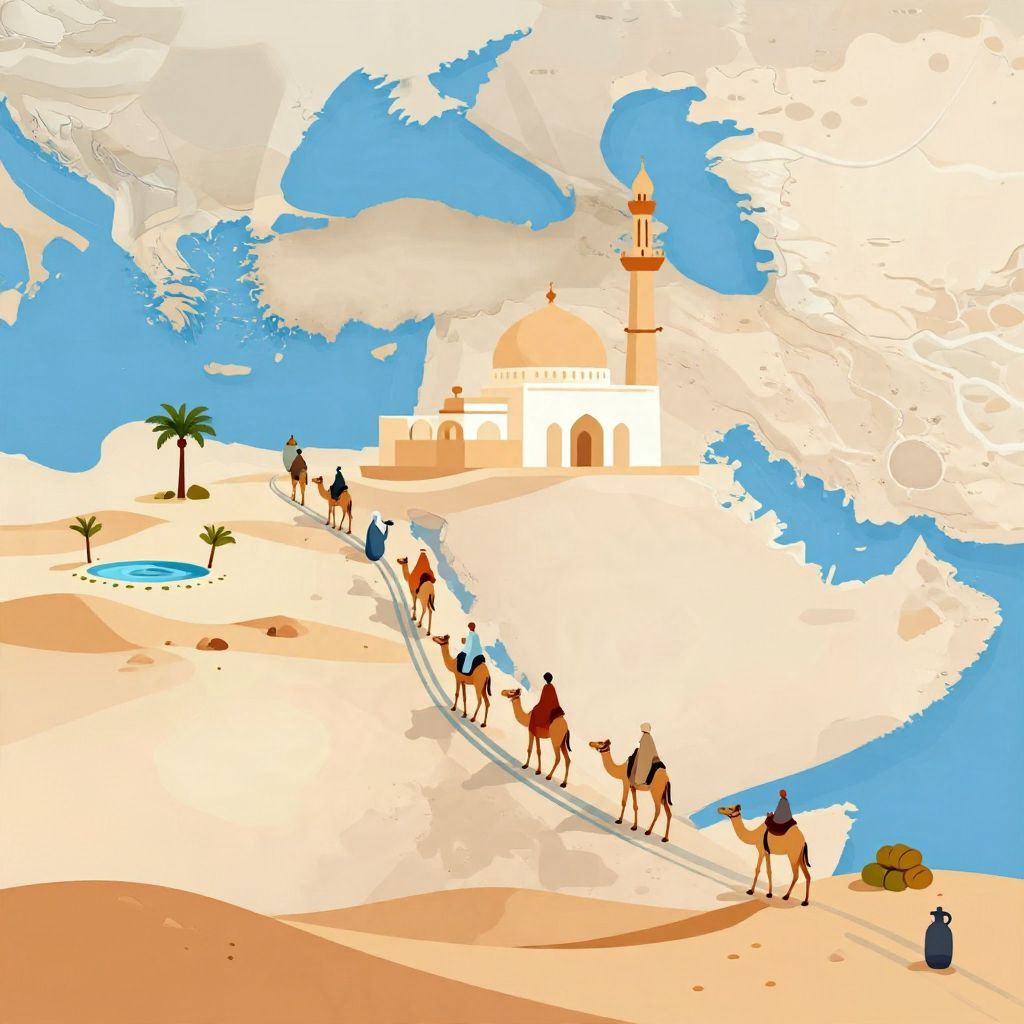
How did Islam spread from a local revelation in western Arabia to one of the world’s major religions? The answer is not a single event but a long historical process shaped by preaching, trade, state-building, conquest, scholarship, and conversion over many centuries.
Its spread began in the 7th century after the Prophet Muhammad’s message in Mecca and Medina, then expanded across the Middle East, North Africa, parts of Europe, Central Asia, South Asia, and beyond. Different regions adopted Islam in different ways, and the reasons ranged from political change to social mobility and cultural exchange.
How did Islam spread?
Islam spread through a combination of early Arab conquests, missionary activity, trade networks, and the gradual conversion of local populations. Military expansion created Muslim-ruled states, but most people outside Arabia became Muslim over time through contact, administration, intermarriage, scholarship, and the appeal of new religious and social communities.
The beginnings in Arabia
Islam began in the early 7th century in the Arabian Peninsula, where Muhammad preached monotheism, moral accountability, and submission to one God, Allah. His followers formed a new religious community, the ummah, first in Mecca and then in Medina after the Hijra in 622 CE, the migration that marks the start of the Islamic calendar.
Why the first community mattered
The early Muslim community was not only religious but political and social. In Medina, Muhammad helped organize alliances, resolve disputes, and build a community that could survive outside Meccan opposition. This made Islam more than a private faith; it became a public order with laws, obligations, and leadership.
How did Islam spread after Muhammad’s death?
After Muhammad died in 632 CE, the first caliphs led rapid expansion beyond Arabia. Under the Rashidun Caliphate, Muslim armies conquered Syria, Iraq, Egypt, and parts of Persia and North Africa in the 630s and 640s. These victories spread Muslim rule quickly, but they did not instantly make most people Muslim.
Conquest and conversion were not the same thing
This distinction is important. Muslim armies could defeat empires and establish new governments, but conversion usually took generations. In many conquered lands, Christians, Jews, Zoroastrians, and others remained a large part of the population for centuries. Islam spread through rule first, then through gradual social and religious change.
Why did Muslim rule expand so quickly?
Several historical conditions made early expansion possible. The Byzantine and Sasanian empires had been weakened by long wars, internal tensions, and economic strain. Arab forces also benefited from mobility, local knowledge, and strong political cohesion after unifying under Islam. Historians generally see these factors as more important than any single cause.
Key factors in early expansion
- Weakened empires: Byzantium and Persia were exhausted by decades of conflict.
- Arab unity: Islam helped unify tribes that had previously been divided.
- Leadership: Early caliphs organized campaigns and administration effectively.
- Local conditions: Some communities preferred new rulers to old imperial authorities.
How did Islam spread through trade?
Trade was one of the most important long-term forces in the spread of Islam. Muslim merchants carried the faith along routes across the Indian Ocean, the Sahara, and Central Asia. In many places, Islam spread first among traders, urban elites, and rulers before reaching rural populations.
The Indian Ocean world
From East Africa to India and Southeast Asia, Muslim merchants linked ports through commerce in spices, textiles, gold, and ceramics. Because trade depended on trust, shared legal practices, and multilingual networks, Islam often traveled with merchants, scholars, and Sufi teachers rather than with armies.
The Sahara and West Africa
Across the Sahara, caravans connected North Africa with West African kingdoms such as Ghana, Mali, and later Songhai. Muslim traders introduced Islamic ideas to courts and cities. Rulers sometimes adopted Islam because it strengthened diplomatic ties, literacy, and access to wider commercial networks. The famous pilgrimage of Mansa Musa in the 14th century symbolized this connection, though it did not mean all his subjects became Muslim at once.
The role of Sufis, scholars, and missionaries
Islam also spread through religious teachers, judges, and Sufi orders. Sufism, the mystical tradition within Islam, often emphasized devotion, discipline, and local adaptation. In many regions, Sufi teachers made Islam understandable to people who already had established customs, helping the religion take root in culturally diverse societies.
Education and law
As Islamic states developed, scholars built mosques, schools, and legal institutions. The Qur’an, Arabic learning, and Islamic law became important in administration and daily life. People often converted because Islam offered access to education, government service, legal standing, or a respected religious community.
How did Islam spread in different regions?
Islam spread unevenly and by different routes depending on geography and politics. Some regions were conquered early; others adopted Islam much later through trade or voluntary conversion. The timeline matters because it shows that Islam’s expansion was not a single wave but a series of regional histories.
The Middle East and North Africa
These areas were among the first to come under Muslim rule in the 7th century. Over time, Arabic became a major language of administration and culture, especially in the eastern Mediterranean and North Africa. Conversion was gradual and varied by place, with some communities maintaining older religions for centuries.
Persia and Central Asia
In Persia, Islam spread after the fall of the Sasanian Empire, but Persian culture did not disappear. Instead, it deeply influenced Islamic civilization in literature, art, government, and scholarship. Central Asia saw a long process of Islamization through conquest, trade, and later Turkic Muslim dynasties.
South Asia
Islam reached South Asia through multiple channels: Arab trade on the western coast, military campaigns in parts of the northwest, and later the expansion of Muslim sultanates and the Mughal Empire. Large-scale conversion happened over centuries and differed by region, caste, local power structures, and the influence of Sufi networks.
Southeast Asia
Islam spread to Indonesia, Malaysia, and nearby regions mainly through trade and the conversion of rulers and coastal elites. Because Muslim merchants were active in the ports of the Indian Ocean, Islam entered a region of many faiths and kingdoms without a single conquering empire. This is one of the clearest examples of peaceful, network-based expansion.
Sub-Saharan Africa
In parts of Africa, Islam spread through commerce, scholarship, and state patronage. It often coexisted with local religious traditions, producing blended cultural forms. In many places, conversion was selective and gradual, especially in rural areas far from major trade centers.
Did Islam spread by force?
Sometimes Islam spread alongside military conquest, but it is inaccurate to say it spread only by force. Early Muslim states expanded through war, as many premodern empires did, yet most conversions happened later and were shaped by social, economic, and political incentives. Coercion existed in some contexts, but it was not the sole or universal pattern.
A more accurate historical picture
Historians generally emphasize that rule and religion should be separated in analysis. A territory could become Muslim-ruled long before it became majority Muslim. In many places, non-Muslim communities were allowed to continue practicing their faiths as protected groups, though often with special taxes or social disadvantages. That arrangement encouraged gradual rather than immediate conversion.
Why did people convert to Islam?
People converted for many reasons, and these reasons differed by time and place. Some were drawn by sincere belief in Islam’s teachings. Others were influenced by marriage, social networks, political loyalty, or the practical advantages of belonging to the ruling religious community. Often, several motives worked together.
Common historical reasons for conversion
- Faith: genuine religious conviction and attraction to Islamic monotheism.
- Social belonging: joining a new community with shared rituals and identity.
- Political advantage: access to power, patronage, or safer relations with rulers.
- Economic opportunity: participation in trade and administration.
- Cultural influence: exposure through scholars, Sufis, and urban life.
How did Islam become a world religion?
Islam became a world religion because it was carried by empires, merchants, scholars, and pilgrims across a vast connected world. The Hajj, the pilgrimage to Mecca, helped bind distant Muslim communities together. Arabic scholarship linked law, theology, and science, while local cultures adapted Islam in distinctive ways without abandoning its core beliefs.
Diversity within Islam
As Islam spread, it developed many regional expressions. Sunni and Shi‘a traditions, legal schools, local customs, and languages all shaped Muslim societies differently. This diversity is part of Islam’s history, not a departure from it. The religion spread so widely partly because it could be rooted in many cultures while preserving a shared framework of belief.
Why does the spread of Islam matter today?
The spread of Islam reshaped politics, language, art, law, and commerce across three continents. It helped create new states and cities, connected regions through trade and pilgrimage, and produced traditions of learning that influenced world history. Understanding how Islam spread also helps correct the common mistake of treating it as either purely peaceful or purely coercive.
In historical terms, Islam spread through a mix of conquest, conversion, and exchange, with different balances in different regions. That complexity is exactly why the story matters: it shows how religions can grow through both power and persuasion, and how local societies reshape a global faith. For related context, you may also want to read about how Muhammad died and other turning points in ancient power transitions such as the death of Brutus.