
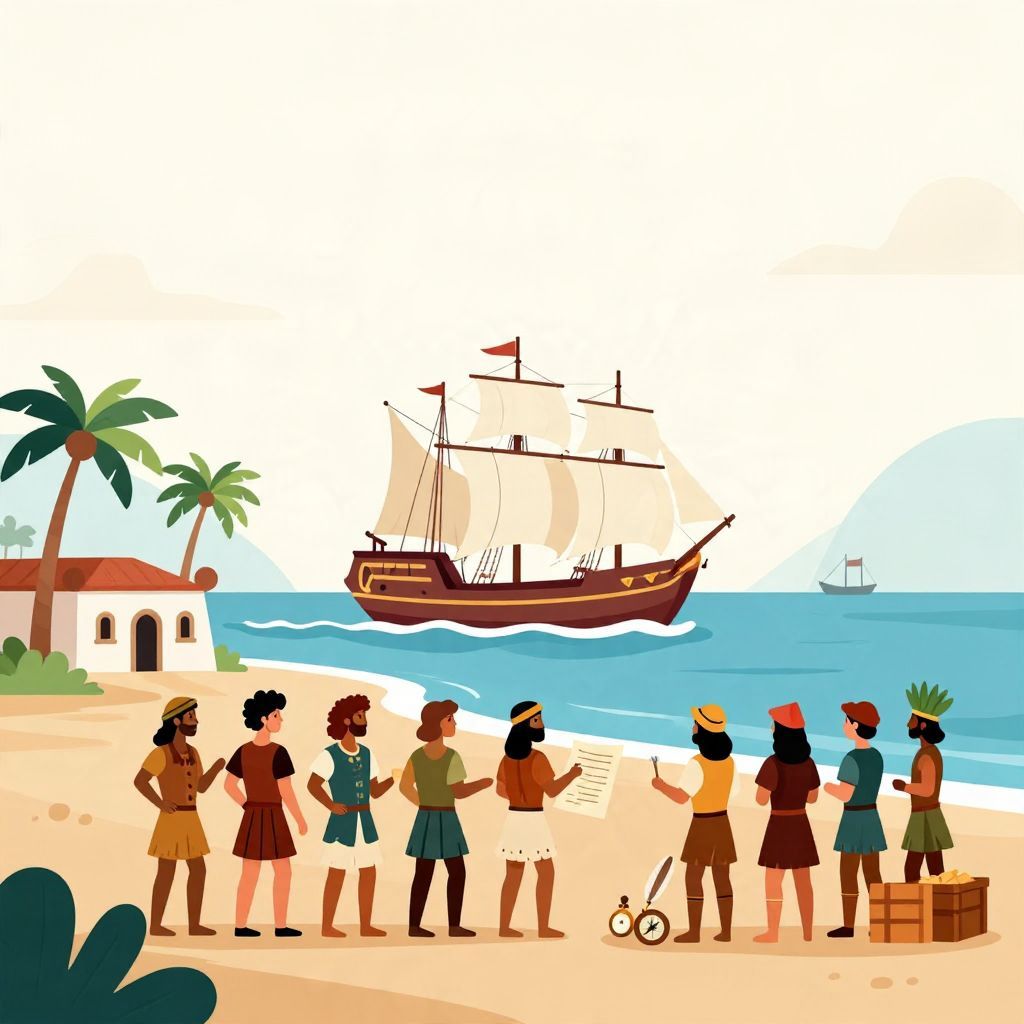
Why does Brazil speak Portuguese? The short answer is that Brazil was colonized by Portugal beginning in the early 1500s, and Portuguese became the language of government, settlement, religion, and eventually national identity. Over time, it spread far beyond the small colonial elite and replaced many Indigenous and African languages in public life.
That outcome was not automatic. Brazil’s language history was shaped by conquest, migration, forced labor, missionary activity, and state policy over several centuries. Understanding why Portuguese took root in Brazil means looking at the colonial period, the diverse peoples who lived there, and the political choices that later turned Portuguese into the country’s dominant language.
Why does Brazil speak Portuguese?
Brazil speaks Portuguese because Portugal claimed the territory in 1500 and governed it as a colony for more than 300 years. Portuguese became the language of administration, law, trade, and education, and after independence in 1822 it remained the language of the new nation. Local languages survived, but Portuguese steadily became dominant.
How Portuguese arrived in Brazil
Portuguese entered Brazil with the arrival of the Portuguese expedition led by Pedro Álvares Cabral in 1500. Portugal had already been building an empire along the Atlantic, in Africa and Asia, and Brazil became part of that expanding world. At first, the Portuguese presence was limited to coastal contact, trade, and a few settlements.
For decades, Portugal did not fully occupy the territory. Brazil was vast, and the Portuguese population was small. Early colonial life depended on interaction with Indigenous peoples, whose languages were widely used in daily communication. Still, the colonial state, Catholic missions, and later plantation society all reinforced Portuguese as the language of power.
The Treaty of Tordesillas and Portuguese claims
Portugal’s claim to Brazil was tied to the Treaty of Tordesillas of 1494, an agreement between Portugal and Spain that divided newly explored lands outside Europe. The treaty did not create Brazil, but it helped Portugal justify its claim to the eastern part of South America. That political claim later shaped the language map of the continent.
The colonial period: Portuguese became the language of power
Language usually follows institutions, and in colonial Brazil the institutions were Portuguese. The colonial government, courts, land grants, and official records all used Portuguese. Catholic clergy also played a major role, especially after the Jesuits and other missionaries began working among Indigenous communities in the 1500s.
In practice, language use was more complicated. In many regions, especially in the early centuries, settlers, missionaries, and Indigenous peoples used a mix of languages. One important example was the Língua Geral, a broad contact language based largely on Tupi languages and used in parts of Brazil for communication between different groups. This shows that Portuguese was not immediately universal.
Why Portuguese spread despite many other languages
- Colonial administration: official business used Portuguese.
- Settlement patterns: Portuguese-speaking settlers grew in number over time.
- Missionary education: churches and schools increasingly taught Portuguese.
- Trade and law: economic and legal life favored the colonial language.
- State pressure: later policies discouraged other languages in public use.
Portuguese spread slowly, not instantly. In the interior and in remote areas, many people continued speaking Indigenous languages for generations. But as colonial society expanded, Portuguese became the language that connected different regions and social groups to the colonial state.
Indigenous languages and the languages of enslaved Africans
Brazil was never linguistically empty before the Portuguese arrived. Hundreds of Indigenous languages were spoken across the territory, though many were later lost because of disease, displacement, warfare, and forced assimilation. The colonial economy also brought millions of enslaved Africans to Brazil, especially from the 16th through the 19th centuries, adding further linguistic diversity.
Enslaved Africans came from different regions and spoke different languages, so they often had to learn Portuguese to communicate across ethnic lines and to survive under colonial rule. At the same time, African languages and cultural traditions left deep marks on Brazilian speech, religion, music, food, and everyday life. Brazilian Portuguese contains many words of Indigenous and African origin, reflecting this complex history.
Brazilian Portuguese was shaped by contact
Brazilian Portuguese did not develop in isolation. It evolved through contact with Indigenous languages, African languages, and later immigrant languages from Europe and Asia. That is one reason Brazilian Portuguese has distinctive pronunciation, vocabulary, and expressions compared with European Portuguese, even though both are forms of the same language.
Why Portuguese, not Spanish?
A common question is why Brazil became Portuguese-speaking while most of Latin America became Spanish-speaking. The answer lies in imperial rivalry. Spain controlled much of the Americas, but Portugal secured Brazil through early exploration and diplomatic agreements. Once Portugal established colonial authority there, Spanish rule never replaced it.
Geography also mattered. Brazil’s Atlantic coastline made it easier for Portugal to connect the colony to Lisbon by sea. Over time, Portuguese settlers, officials, and merchants built a colonial network that tied Brazil to Portugal rather than to the Spanish American world. Borders in South America shifted repeatedly, but Brazil remained within the Portuguese imperial sphere.
Different empires, different language outcomes
Language in the Americas often reflects which European empire gained lasting control. Where Spain ruled, Spanish became dominant; where Portugal ruled, Portuguese did. Brazil is the largest and most important example of a Portuguese-speaking colony in the Western Hemisphere, and its size helped preserve that linguistic legacy after independence.
The role of the Jesuits and the “general language”
Jesuit missionaries arrived in Brazil in the mid-1500s and often learned Indigenous languages to evangelize local communities. In some areas, they promoted Indigenous languages rather than Portuguese, because it was more effective for missionary work. This helped keep non-Portuguese languages alive in certain regions for a time.
However, colonial authorities eventually preferred Portuguese. In the 18th century, the Portuguese crown moved to strengthen central control and reduce the influence of missionary languages. One major turning point came under the reforming government of Marquis of Pombal, who supported policies that pushed Portuguese more strongly into schools and administration and limited the public role of Indigenous languages.
18th-century language policy
Pombaline reforms did not single-handedly create Portuguese-speaking Brazil, but they accelerated a process already underway. By favoring Portuguese in official life and weakening missionary autonomy, the state made the colonial language more dominant. This was part of a broader effort to centralize imperial authority.
Independence did not change the language
When Brazil became independent in 1822, it did not break with Portuguese as its language. That was partly practical: the educated elite, the bureaucracy, the courts, and the press already operated in Portuguese. Replacing it would have been difficult and unnecessary for the new empire.
Instead, Portuguese became a marker of continuity and unity. Brazil was enormous, and a shared language helped bind together a territory far larger than most new nations in the Americas. In that sense, Portuguese was not only a colonial inheritance; it became a national language that helped define the Brazilian state.
Why Brazil’s Portuguese is not exactly Portugal’s Portuguese
Although Brazil and Portugal share the same official language, Brazilian Portuguese developed its own character. Pronunciation, rhythm, grammar, and vocabulary changed over time through local usage and contact with other languages. The differences are comparable to those between other major world languages that share a common origin but evolved in separate societies.
Brazilian Portuguese also became standardized through its own schools, literature, newspapers, and later radio, television, and digital media. Today, it is the main language of more than 200 million people and one of the most widely spoken languages in the world.
Examples of historical influence on Brazilian Portuguese
- Indigenous influence: words for plants, animals, foods, and places.
- African influence: vocabulary linked to religion, music, cuisine, and daily life.
- European immigration: later arrivals added regional accents and loanwords.
What happened to the other languages?
Many Indigenous languages survived colonization, and some are still spoken today, but many others disappeared. The decline of these languages was not a natural or peaceful process. It was tied to violence, displacement, disease, slavery, and state pressure. Language loss in Brazil is part of the broader history of conquest and inequality in the Americas.
At the same time, Brazil remains linguistically diverse. Indigenous communities continue to defend and revitalize their languages, and immigrant communities have also preserved languages such as German, Italian, Japanese, and others in specific regions. Even so, Portuguese remains the national language because it became embedded in the institutions of power early and deeply.
Conclusion: a colonial language that became Brazilian
Brazil speaks Portuguese because Portuguese colonization began in the early 1500s, expanded over centuries, and left behind a state, church, and social order built around that language. Brazilian Portuguese then developed its own identity through contact with Indigenous and African peoples and through the experience of nation-building after independence. It is a colonial inheritance, but also a distinctly Brazilian language.
If you want to compare Brazil’s language history with other cases of colonial language spread, you may also find why Mexicans speak Spanish and whether Portugal is in Spain helpful for broader context.