
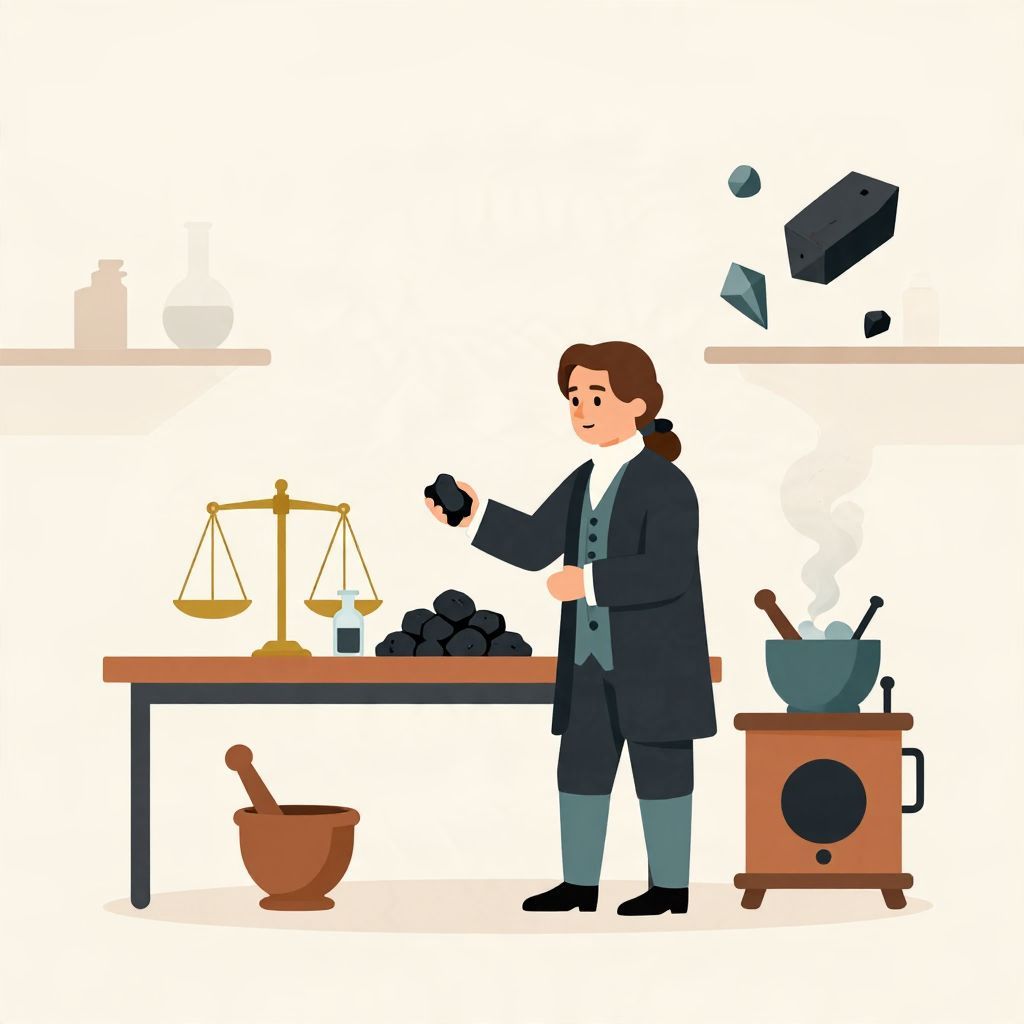
When was carbon discovered? The short answer is that carbon was not “discovered” in a single moment the way a new planet or mineral might be. People have known and used carbon in forms such as charcoal, soot, and diamond since antiquity, but carbon as a distinct chemical element was identified in the late 18th century.
Most historians of science point to the work of Antoine Lavoisier and his contemporaries in the 1770s and 1780s as the key turning point. By then, chemistry was beginning to separate substances into elements and compounds, and carbon emerged as a recognizable element through careful experiments on combustion, charcoal, and carbon dioxide.
When was carbon discovered?
Carbon was scientifically identified as an element in the late 18th century, especially through the work of Antoine Lavoisier around the 1770s–1780s. However, humans had long used carbon-containing materials such as charcoal and diamond, so the “discovery” refers to recognizing carbon as a fundamental substance, not first encountering it in nature.
Why carbon’s discovery is not a simple one-date story
Unlike a newly found island or artifact, carbon was always present in the world around people. Ancient societies burned wood into charcoal, used soot for ink and pigment, and prized diamonds as gemstones. What changed in the 18th century was not carbon’s existence, but the scientific understanding of what these different materials had in common.
That distinction matters. In older chemistry, substances were often classified by appearance, use, or origin. Modern chemistry asked a different question: what are the basic building blocks of matter? Carbon became one of those building blocks once scientists learned to isolate, compare, and explain it systematically.
Carbon in the ancient world
Long before the word “carbon” carried its modern scientific meaning, people knew several carbon-rich materials:
- Charcoal, made by heating wood in low oxygen, was used for fuel, metalworking, and art.
- Soot was collected for writing inks and black pigments.
- Diamond was known as a rare and valuable gemstone.
- Graphite, though not always clearly distinguished from other black minerals, was used for marking and later for pencils.
These materials were useful, but their shared chemical nature was not yet understood. Ancient thinkers had theories about matter, but they did not have the experimental chemistry needed to identify a single element behind all of them.
The late 18th-century breakthrough
The modern scientific discovery of carbon emerged during the Chemical Revolution of the 18th century. Antoine Lavoisier, often called the father of modern chemistry, helped redefine what counted as an element. Through combustion experiments, he showed that charcoal and diamond produced the same gas when burned: carbon dioxide. This was crucial evidence that they were forms of the same substance.
By the 1780s, Lavoisier and other chemists had concluded that carbon was a distinct element. In modern terms, this is the point at which carbon was “discovered” scientifically—not because it was first seen then, but because it was first properly understood as an element.
What Lavoisier contributed
Lavoisier did not work in isolation, and science rarely advances through a single person alone. Still, his experiments and his new chemical language were decisive. He helped replace older ideas such as phlogiston with a more exact system based on measurement and conservation of mass. In that framework, carbon could be studied as a substance with consistent properties and predictable reactions.
One of the most important insights was that burning carbon-rich materials produced a gas now called carbon dioxide. That observation linked charcoal, diamond, and other substances into a shared chemical family. It also helped scientists understand respiration, combustion, and the chemistry of the atmosphere.
The date most historians use
If you want a single historical answer, the best date is the late 1770s to 1780s, with Lavoisier’s work in the 1780s serving as the clearest milestone. There is no universally agreed “birthday” for carbon, because its recognition developed gradually through several experiments and publications rather than one dramatic announcement.
That said, many reference accounts summarize the discovery as occurring in the 18th century, especially around Lavoisier’s period of research. This is the most accurate way to answer the question without pretending that the history is simpler than it really is.
How scientists learned carbon was an element
The discovery of carbon depended on a shift in scientific method. Chemists began to compare substances by what they did in reactions, not just by how they looked. Several lines of evidence mattered.
1. Combustion experiments
When charcoal or diamond burned, they produced the same invisible gas, carbon dioxide. That meant the materials shared a common component. If two very different substances yield the same product under the same conditions, scientists can suspect a shared elemental basis.
2. Measurement and mass
Lavoisier emphasized weighing reactants and products carefully. This made chemistry more exact. Instead of vague speculation, chemists could track how much material was consumed and what new substances were formed. Carbon’s role in combustion became measurable rather than theoretical.
3. Comparison across materials
Charcoal, soot, graphite, and diamond seemed different in everyday life, but chemists increasingly saw that they were all carbon-rich or carbon itself in different forms. This was an important step toward the modern idea that one element can appear in multiple allotropes, or structural forms.
Who should be credited with discovering carbon?
There is no single universally accepted “discoverer” of carbon in the way there is for some later scientific discoveries. The strongest historical credit goes to Antoine Lavoisier for identifying carbon as an element within modern chemistry. But the story also includes earlier and later contributors.
Earlier natural philosophers knew carbon-containing materials existed, even if they did not understand them chemically. Later scientists refined the picture by studying carbon compounds, allotropes, and atomic structure. So the discovery was cumulative: ancient use, early modern experimentation, and 18th-century chemical theory all played a part.
Related figures in carbon’s history
- Antoine Lavoisier — central figure in defining carbon as an element.
- Joseph Priestley — contributed to the broader study of gases and combustion.
- Henry Cavendish — helped advance gas chemistry in the same era.
- Smithson Tennant — later showed that diamond and graphite were forms of carbon through combustion analysis.
Carbon after its discovery: why it mattered
Once carbon was recognized as an element, it became one of the most important concepts in chemistry. Scientists could now explain why living things, fuels, and many minerals behaved as they did. Carbon also became central to the study of organic chemistry, because it forms the backbone of the molecules associated with life.
The significance of carbon went far beyond the laboratory. It helped explain the chemistry of burning, the composition of air, the nature of diamonds, and the structure of countless compounds. In the 19th and 20th centuries, carbon chemistry became essential to medicine, industry, agriculture, and materials science.
Why carbon is so important historically
Carbon’s history is not just about one element. It is about the rise of modern science itself. The recognition of carbon showed that careful experiments could reveal hidden relationships among substances that had long seemed unrelated. That was exactly the kind of thinking that transformed chemistry from a craft tradition into a modern scientific discipline.
Carbon, charcoal, and diamond: the same element in different forms
One reason carbon’s discovery was so striking is that it appears in dramatically different forms. Charcoal is black and brittle. Diamond is transparent and extremely hard. Graphite is soft and slippery. Yet all are made of carbon, arranged differently.
This was not obvious before modern chemistry. The realization that one element could exist in multiple forms helped expand scientific ideas about matter. In later centuries, the term allotrope was used to describe these different structural forms of the same element.
How historians should answer the question
The most accurate historical answer is layered:
- Carbon was used and known in practice since antiquity in charcoal, soot, and diamond.
- Carbon was scientifically identified as an element in the late 18th century, especially through Lavoisier’s work.
- No single exact discovery date exists, because the recognition developed gradually through experiments and debate.
So if someone asks, “When was carbon discovered?” the best reply is: carbon was recognized as an element in the late 1700s, especially in the 1780s, though people had used carbon-bearing materials for thousands of years before that.
Conclusion: the real story behind carbon’s discovery
Carbon was not discovered all at once; it was understood over time. Ancient people knew its forms, but 18th-century chemists, led by Antoine Lavoisier, identified carbon as a distinct element and linked charcoal, diamond, and combustion products into one scientific story. That breakthrough helped launch modern chemistry and changed how scientists understood matter itself. If you’re interested in similar history questions, you may also want to read about when germs were discovered and when hydrogen was discovered.