
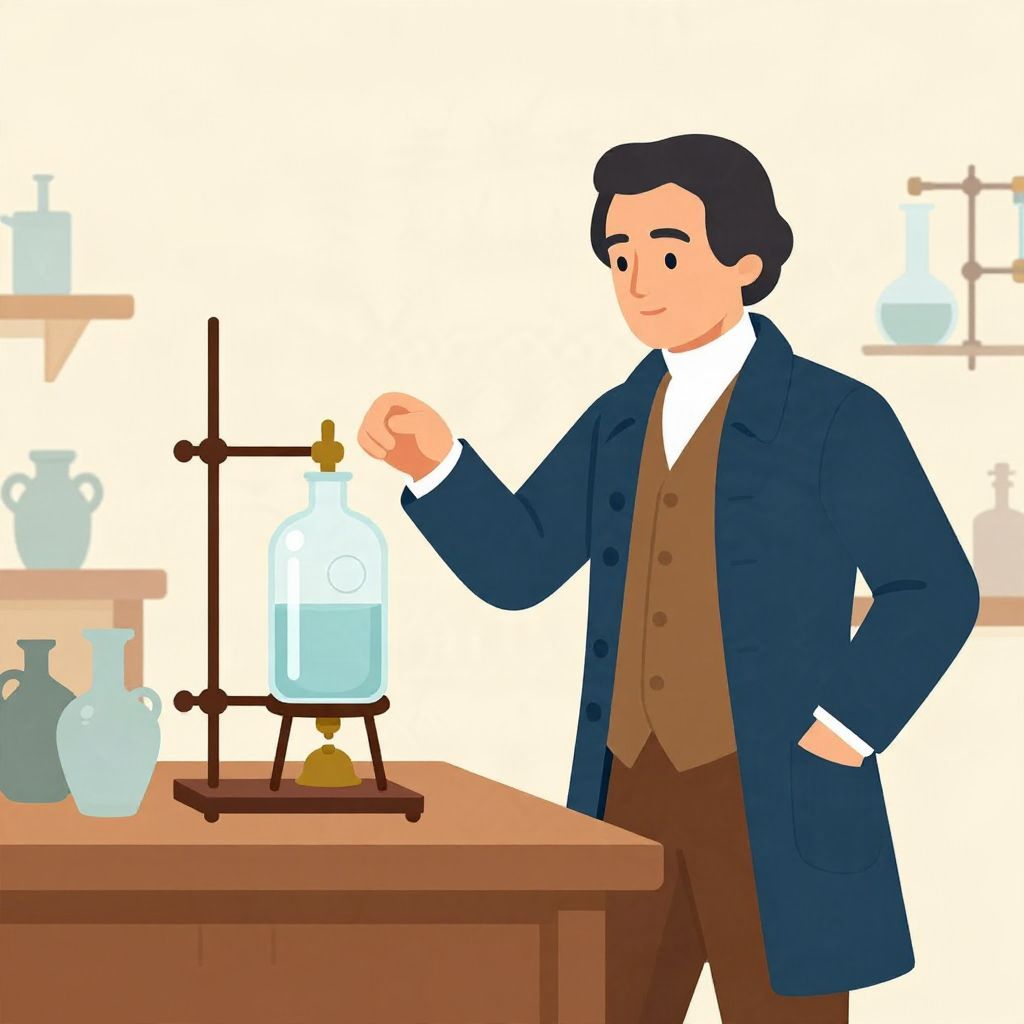
When was hydrogen discovered? The short answer is that hydrogen was first recognized as a distinct substance in the late 18th century, with Henry Cavendish identifying it in 1766. He showed that the gas was different from ordinary air and that it produced water when burned.
That discovery did not happen overnight. Earlier chemists had seen the gas in reactions with metals and acids, but Cavendish’s careful experiments turned a puzzling substance into a new element in the history of chemistry.
When was hydrogen discovered?
Hydrogen was discovered in 1766, when Henry Cavendish isolated and studied the gas produced by reacting metals with acids. He called it “inflammable air,” and later work by Antoine Lavoisier helped establish that it was a distinct chemical element, eventually named hydrogen.
The story behind hydrogen’s discovery
Hydrogen’s discovery was part of a larger scientific revolution. In the 17th and 18th centuries, European chemists were moving away from alchemy and toward careful measurement, repeatable experiments, and the idea that matter could be analyzed into basic components. Hydrogen emerged from that shift.
Early observations before 1766
Long before hydrogen had a name, experimenters noticed a light, flammable gas released when metals were dissolved in acids. The gas was known in practical terms, but it was not yet understood as a separate substance. It was often treated as one of many curious vapors produced in chemical reactions.
These earlier observations mattered because they showed that gases could be studied scientifically. But without a clear framework for chemical elements, the gas remained a phenomenon rather than a defined discovery.
Henry Cavendish and “inflammable air”
Henry Cavendish, an English natural philosopher, is usually credited with the discovery of hydrogen because he investigated the gas systematically in 1766. He measured its properties, especially its extreme lightness and flammability, and distinguished it from other airs known at the time.
Cavendish’s key insight was that this gas was not just a byproduct. It had consistent properties and could be identified as a distinct substance. In modern terms, he had isolated hydrogen, even though the concept of a chemical element was still developing.
Why the gas was not immediately called hydrogen
The word hydrogen came later. Antoine Lavoisier, the French chemist who helped reshape chemistry in the late 18th century, recognized that burning this gas produced water. From this, he concluded that water was not an element, as many had believed, but a compound made from hydrogen and oxygen.
Lavoisier gave the gas the name hydrogen, from Greek roots meaning “water-former.” That name reflects the major scientific conclusion associated with the gas: it is a substance that helps form water, not a form of air or a variant of fire.
Why 1766 is the key date
1766 is the most important date because it marks the moment when hydrogen moved from being an observed gas to a scientifically recognized substance. Cavendish’s experiments were the first to clearly define its properties and separate it from other gases. Later naming and theory built on that foundation.
In history, discovery dates can be tricky. Sometimes a substance is noticed first, named later, and understood fully only after further experiments. Hydrogen is a good example of that process. If the question is “when was it first discovered as a distinct gas,” 1766 is the best answer.
Discovery versus naming
- Observed earlier: flammable gas from metal-acid reactions was known before 1766.
- Identified scientifically: Cavendish’s work in 1766 established hydrogen as a distinct substance.
- Named later: Lavoisier introduced the name hydrogen in the 1780s.
This distinction is important because many “discoveries” in science unfold in stages. The first observation, the first isolation, and the first correct explanation are not always the same event.
What Cavendish actually found
Cavendish studied the gas produced by acids acting on metals such as zinc and iron. He noticed that it was much lighter than air and burned readily. He also investigated what happened when the gas was ignited, helping to show that it produced water.
That last point was especially significant. For centuries, water had often been treated as one of the basic elements of nature. Cavendish’s work, followed by Lavoisier’s interpretation, helped overturn that older view and laid the groundwork for modern chemistry.
The role of measurement
Cavendish’s importance lies not only in what he saw but in how he studied it. He used careful measurement and comparison, which allowed him to distinguish one gas from another. This was a hallmark of Enlightenment science: knowledge based on controlled experiment rather than inherited assumptions.
Because of that approach, hydrogen became one of the first gases to be understood in a modern scientific sense. It was not just “air” with unusual behavior. It was a substance with its own identity.
How hydrogen got its name
The name hydrogen was introduced by Antoine Lavoisier in the 1780s, after experiments showed that the gas combined with oxygen to form water. The name comes from Greek words meaning “water producer” or “water former.”
This naming was more than a label. It reflected a new chemical theory in which elements were defined by their behavior and composition, not by older ideas about the four classical elements. Hydrogen became central to the new chemistry because it helped explain water itself.
From “inflammable air” to a chemical element
Before modern chemistry, gases were often described by appearance or behavior. Cavendish’s “inflammable air” was a practical name, but it did not fully explain what the substance was. Lavoisier’s system moved chemistry toward a more standardized language, where elements had fixed identities and reactions could be understood in terms of composition.
That shift is one reason hydrogen is so important in the history of science. Its discovery was not just about one gas; it helped change how chemists thought about matter itself.
Why hydrogen mattered historically
Hydrogen became important far beyond its initial discovery. It helped chemists understand combustion, water, and the composition of substances. Later, it would become central to industrial chemistry, fuel technology, and astrophysics, where it is recognized as the most abundant element in the universe.
But in the 18th century, its significance was mainly intellectual. Hydrogen helped break old assumptions and support a new chemical worldview. That made it one of the foundational discoveries of modern science.
Long-term scientific impact
- Helped prove that water is a compound, not an element.
- Supported the development of modern chemical nomenclature.
- Contributed to the study of gases as distinct substances.
- Opened the way for later research in energy, fuels, and atomic theory.
Common misunderstandings about hydrogen’s discovery
One common misunderstanding is that hydrogen was “discovered” only when it was named. In fact, the scientific discovery came first, and the name followed later. Another misunderstanding is that one person alone completed the whole story. In reality, hydrogen’s discovery was a sequence of contributions from several chemists.
It is also easy to assume that discovery means a single dramatic moment. For hydrogen, the better historical picture is gradual: observation, isolation, measurement, explanation, and naming. Each step mattered.
The answer in one sentence
Hydrogen was discovered in 1766 by Henry Cavendish, who identified it as a distinct flammable gas; it was later named hydrogen by Antoine Lavoisier in the 1780s after its role in forming water was understood.
So, if you are asking when was hydrogen discovered, the best historical date is 1766. If you want the full story, it is a reminder that scientific discovery often happens in stages, with observation, explanation, and naming unfolding over time. For more on related history of scientific discovery, see when germs were discovered and when gasoline was invented.