
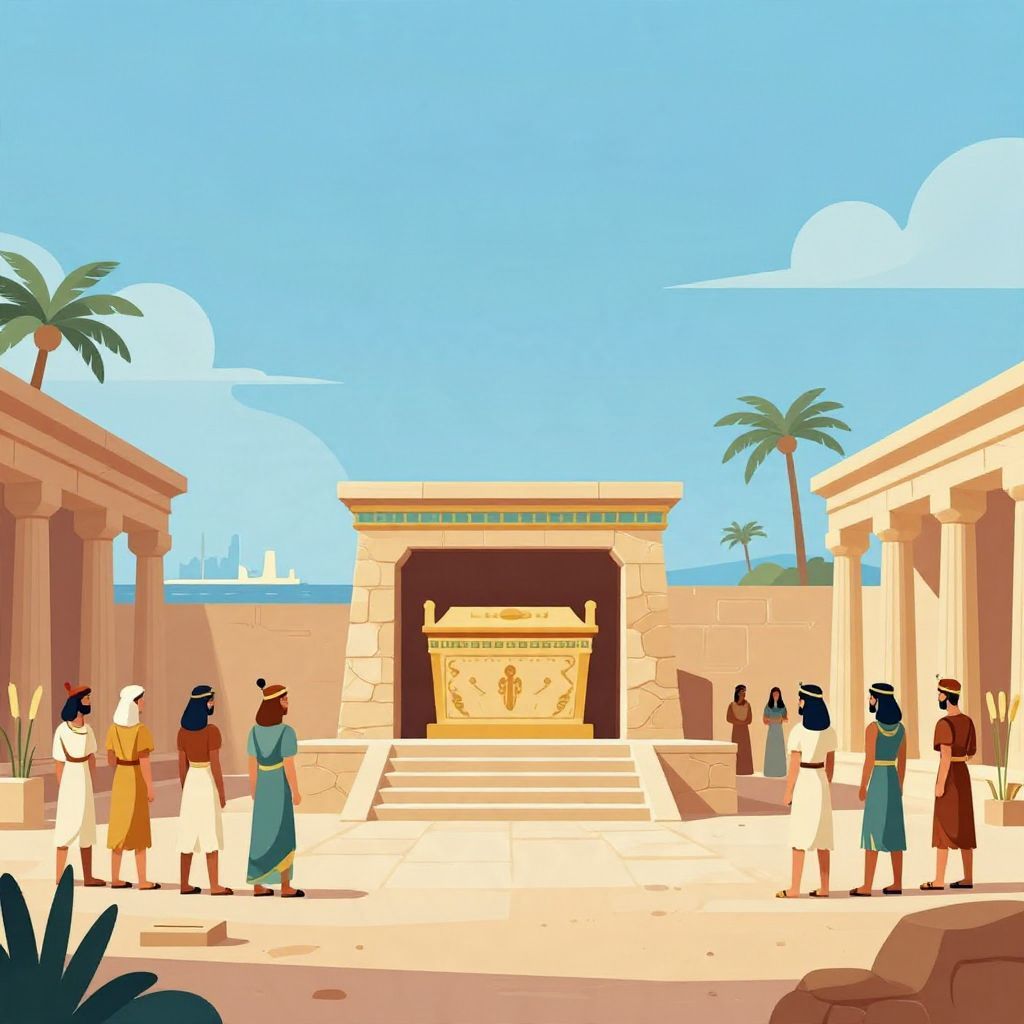
Where is Alexander the Great buried? It is one of the most famous unanswered questions in ancient history. Alexander died in Babylon in 323 BCE, but the location of his final resting place soon became part of a struggle over power, memory, and legitimacy.
Ancient writers describe a funeral procession and a tomb that was eventually associated with Alexandria in Egypt, yet the exact burial site has been lost. What survives today is a historical trail of reports, later visits, and long uncertainty rather than a confirmed grave.
Where Is Alexander the Great Buried?
Alexander the Great is believed to have been buried in Alexandria, Egypt, where his body was taken after elaborate funerary arrangements. However, the tomb’s exact location has never been securely identified, and no surviving archaeological discovery has definitively confirmed it. The most accepted historical answer is that his burial place is lost.
What Happened to Alexander’s Body After His Death?
Alexander died in Babylon in June 323 BCE, likely at the age of 32. After his death, his body became a political prize. His successors understood that possessing Alexander’s remains could strengthen their claims to rule his empire, so the corpse was not simply laid to rest and forgotten. Instead, it entered a long and contested journey.
Ancient sources indicate that Alexander’s body was prepared with great care and placed in a coffin or sarcophagus. A funerary carriage was then arranged to transport it westward. The details differ among ancient authors, but the broad outline is clear: the body was meant to travel to Macedonia, the homeland of Alexander’s royal family, before events took a different turn.
The journey from Babylon to Egypt
According to later ancient accounts, the funeral procession was diverted by Ptolemy, one of Alexander’s generals and later ruler of Egypt. Ptolemy brought the body to Egypt, first to Memphis and then, in a later tradition, to Alexandria. This move was not only about burial customs; it was a political statement. By controlling Alexander’s remains, Ptolemy linked his new dynasty to the conqueror’s prestige.
The transfer of the body to Egypt is one of the best-attested parts of the story, though the precise route and timing remain debated. Ancient historians wrote centuries after the event, and their accounts do not always agree. Still, most scholars accept that Alexander’s body ended up in Egypt rather than Macedonia.
Why Was Alexander Buried in Egypt?
Alexander was buried in Egypt because his successors fought over his legacy. Ptolemy, who governed Egypt after Alexander’s empire fragmented, likely wanted the body as both a sacred relic and a symbol of legitimacy. In the Hellenistic world, rulers often used monuments, tombs, and religious honors to prove authority. Alexander’s remains fit that political culture perfectly.
Egypt also offered a powerful setting for the cult of Alexander. Alexandria, the city Alexander founded in 331 BCE, became a major center of Greek and Egyptian culture. Placing his tomb there would have made sense symbolically: the city embodied his conquest, his vision, and the new world that emerged after his campaigns.
Memphis or Alexandria?
One of the main historical uncertainties is whether Alexander was first buried in Memphis and later moved to Alexandria, or whether his body was taken directly to Alexandria after an initial stop. Ancient evidence suggests both possibilities at different stages. Many historians think the tomb in Alexandria became the famous final resting place, even if Memphis may have played an earlier role in the burial process.
This uncertainty matters because it shows how ancient burial traditions could change over time. A royal body might be moved, re-honored, or reinterpreted by later rulers. Alexander’s tomb was not just a grave; it was a living political monument that could be reshaped by those who controlled it.
What Do Ancient Sources Say About the Tomb?
Several ancient authors mention Alexander’s burial place, but none provide a modern-style, fully reliable map or description. The most useful clues come from writers such as Strabo, Plutarch, Arrian, and later Roman-era observers. Their accounts suggest that Alexander’s tomb in Alexandria was famous and visible for centuries, especially in the city’s royal quarter.
By the Roman period, the tomb had become a celebrated site. Emperors and elite visitors reportedly came to see it. Ancient tradition says that figures such as Julius Caesar, Augustus, and Caracalla were associated with visits to Alexander’s body or tomb, though details vary and some stories may be embellished. What matters historically is that the tomb was known and respected in antiquity, even if its later fate is obscure.
Why the sources are difficult to use
Ancient historians were not writing archaeology. They often relied on earlier reports, court traditions, and political narratives. Some were interested in Alexander as a heroic figure; others used his story to comment on empire and kingship. As a result, the burial story is a mix of solid historical core and later interpretation.
That is why historians are careful not to claim more certainty than the evidence allows. It is reasonable to say Alexander was buried in Egypt and that his tomb was associated with Alexandria. It is not reasonable to claim that the exact grave has been proven by excavation.
Has Alexander’s Tomb Been Found?
No confirmed tomb of Alexander the Great has been found. This is the central fact behind the mystery. Archaeologists and historians have proposed various locations in and around Alexandria, but none has been universally accepted as Alexander’s burial place. The city has changed dramatically over two millennia, and much of its ancient center lies beneath modern development.
Several discoveries have been suggested over the years, but none has produced decisive evidence such as an inscription naming Alexander, a securely identified royal burial context, or an unbroken historical chain linking the remains to the conqueror. Without that kind of proof, the tomb remains lost.
Why the tomb is so hard to identify
- Urban change: Ancient Alexandria was heavily built over in later periods.
- Political upheaval: Earthquakes, wars, and shifting rulers altered the city repeatedly.
- Religious change: Pagan monuments were often neglected, reused, or destroyed in late antiquity.
- Source uncertainty: Ancient descriptions are too general to pinpoint a site with confidence.
The Legend of Alexander’s Lost Grave
Because the tomb disappeared from view, Alexander’s burial place became part of legend. Medieval and early modern travelers sometimes claimed to know where it was, but these stories usually reflect local tradition, rumor, or wishful thinking. The absence of a verified grave has only increased the fascination surrounding him.
There is also a symbolic reason the mystery endures. Alexander conquered an enormous territory in a very short time, yet his empire fractured almost immediately after his death. The loss of his tomb mirrors the fragmentation of the world he created. In that sense, the uncertain burial place is itself historically fitting.
What Can Be Said with Confidence?
Historians can make a few careful conclusions about Alexander’s burial. First, he died in Babylon in 323 BCE. Second, his body was transported under the control of his successors. Third, it was taken to Egypt, where it became associated with Alexandria. Fourth, the tomb was known in antiquity but later lost. Beyond that, certainty drops away.
So, if you ask where Alexander the Great is buried, the best answer is: most likely in Alexandria, Egypt, but the exact site is unknown and unconfirmed. That answer reflects the evidence rather than legend.
Why This Question Still Matters
Alexander’s burial is more than a curiosity. It reveals how ancient rulers used funerary monuments to shape memory and power. It also shows how easily even the most famous places can vanish when cities are rebuilt, empires fall, and texts survive without physical remains. The search for Alexander’s tomb continues because it sits at the intersection of archaeology, politics, and myth.
For readers interested in the wider story of Alexander’s life and legacy, it can help to explore his origins and the broader world of ancient burial traditions. You might also enjoy reading about where Alexander the Great was from and, for a different famous burial mystery, where Jesus’ tomb is said to be. The historical takeaway is simple: Alexander’s burial place was once famous, but today it remains one of antiquity’s great lost locations.