
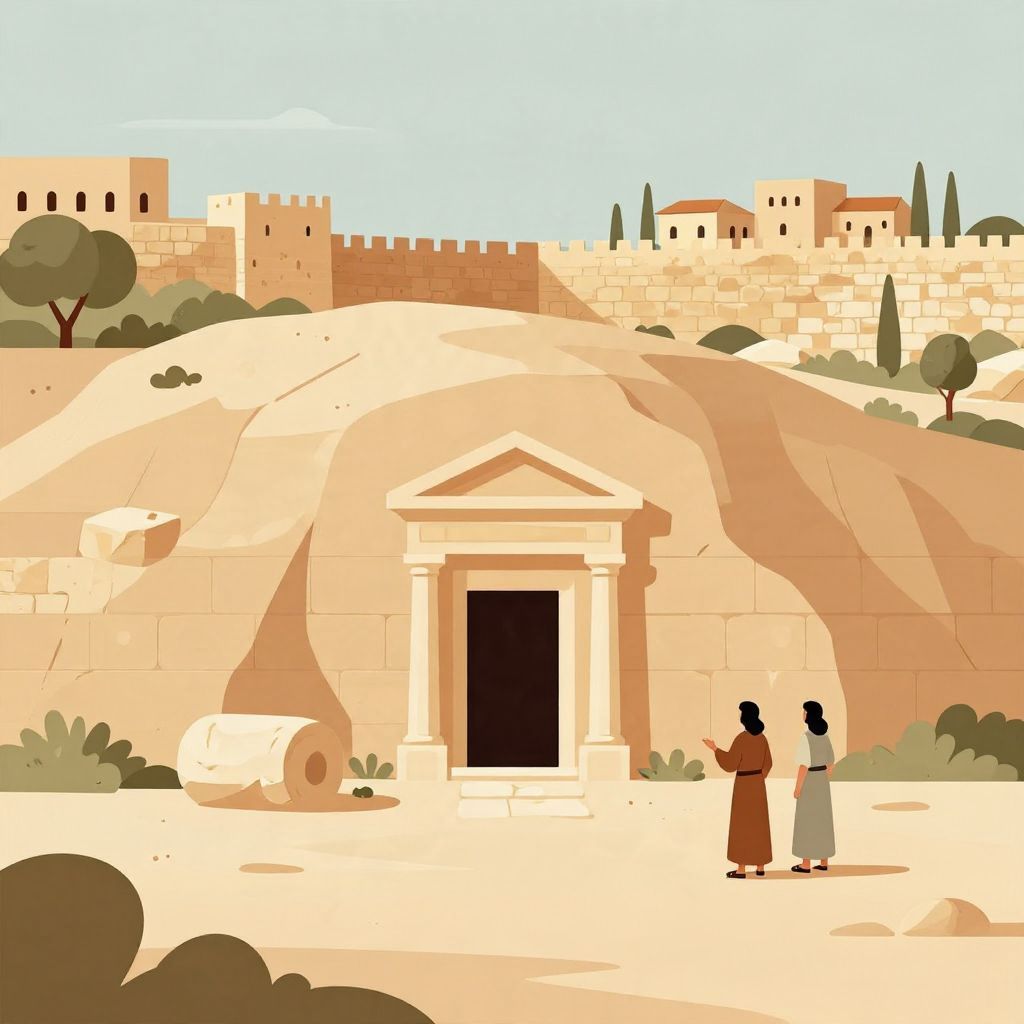
Where is Jesus tomb? The short historical answer is that the most widely accepted traditional site is the Church of the Holy Sepulchre in Jerusalem, but the exact burial place cannot be proven with absolute certainty. The question sits at the intersection of history, archaeology, and Christian tradition, and the evidence is strongest for the general location rather than for one undisputed tomb.
Because the burial happened in the early first century CE and the site was later rebuilt many times, historians rely on ancient texts, archaeology, and later memory. That makes this one of the best-known holy places in the world, but also one of the most debated.
Where Is Jesus Tomb?
The most accepted historical location of Jesus’ tomb is beneath or near the Church of the Holy Sepulchre in the Christian Quarter of Jerusalem. Many scholars and churches regard this as the site of Jesus’ burial and resurrection because it lies within an area that was outside the city walls in the time of Jesus and because early Christian tradition identified it very early. Still, the precise tomb cannot be confirmed beyond doubt.
The Historical Background of Jesus’ Burial
The burial story belongs to the final days of Jesus of Nazareth, around 30 CE or 33 CE, during the Roman occupation of Judea. According to the New Testament accounts, Jesus was crucified outside Jerusalem and then placed in a rock-cut tomb before the Sabbath. Historians treat these texts as important early sources, while also recognizing that they are theological narratives written by believers.
Why burial location matters historically
In Roman Judea, crucifixion was meant to humiliate and deter rebellion. A burial, especially in a tomb associated with a respected individual such as Joseph of Arimathea in the Gospel accounts, would have been significant. Whether every detail can be verified is uncertain, but the burial tradition is central to both Christian faith and the historical memory of Jerusalem.
The Church of the Holy Sepulchre and the Traditional Site
The Church of the Holy Sepulchre stands inside Jerusalem’s Old City and is the main traditional location associated with Jesus’ crucifixion, burial, and resurrection. The site includes areas identified as Golgotha and the tomb itself. The present church is a later structure, but it preserves a much older tradition that dates back to the fourth century.
How the site became identified
In the early fourth century, after Christianity gained imperial support, Emperor Constantine’s mother, Helena, was linked in tradition to the search for holy places in Jerusalem. The emperor ordered a church complex built over the site. Ancient Christian writers report that the area had been revered by local Christians, even though the city had changed dramatically since the first century.
Why scholars take the site seriously
Archaeologists and historians note that the area of the Holy Sepulchre was outside the city walls during Jesus’ lifetime, which fits the Gospel description of a burial place outside Jerusalem. In the first century, the location was part of a quarry and burial zone, not the dense urban center it became later. That geographic fit is one reason the traditional site remains persuasive.
What Archaeology Can and Cannot Prove
Archaeology can help establish whether a place was used as a tomb in the right period, but it cannot prove with certainty that a particular tomb belonged to Jesus. The tomb under the Holy Sepulchre is associated with a first-century Jewish burial cave, and the wider area has evidence of ancient quarrying and burial use. That supports the tradition, but it does not produce absolute identification.
Key archaeological realities
- The site was outside the city walls in the first century.
- It was an area where burial caves existed in antiquity.
- Later Roman and Byzantine construction altered the landscape heavily.
- Repeated destruction and rebuilding make direct verification difficult.
In other words, archaeology strengthens the case for the Holy Sepulchre as the traditional location, but history here is about probability, not certainty.
Why the Exact Tomb Cannot Be Confirmed
The main reason for uncertainty is the long time gap between the burial event and the surviving physical evidence. Jerusalem was destroyed in 70 CE during the First Jewish Revolt, and the city was later rebuilt under Roman rule. By the time Christians began publicly marking holy sites in the fourth century, the landscape had already changed substantially.
Factors that complicate identification
- Urban change: Jerusalem’s walls, streets, and buildings shifted over centuries.
- Destruction: Wars damaged or erased earlier landmarks.
- Religious development: Holy places were identified through tradition as well as archaeology.
- Limited first-century records: No surviving Roman or Jewish document names the tomb directly.
For that reason, historians usually speak of the “traditional tomb” rather than a definitively proven tomb.
Other Proposed Locations for Jesus’ Tomb
Not everyone accepts the Holy Sepulchre as the burial site. A few alternative proposals have appeared over time, especially in modern popular culture, but they are much less supported by historical evidence. The most famous alternative is the so-called Garden Tomb, north of the Old City.
The Garden Tomb
The Garden Tomb became popular among some Protestants in the nineteenth century because it seemed peaceful, accessible, and visually evocative. However, most scholars date the tomb to an earlier period than the first century CE, making it unlikely to be Jesus’ burial place. It remains an important devotional site, but historically it is not the strongest candidate.
Why alternatives gained attention
Alternative sites often appealed because they were easier to visit, less tied to older church traditions, or felt more in line with certain interpretations of the Gospel narrative. Yet popularity is not the same as historical evidence. The Holy Sepulchre remains the leading candidate because of its early and continuous tradition.
How Early Christians Remembered the Site
Christian memory played a major role in preserving the location. By the fourth century, believers in Jerusalem appear to have associated the area with Jesus’ death and burial. That does not make the tradition automatically correct, but it does show that the identification was not a late medieval invention. It emerged relatively early in Christian history.
Tradition and memory in ancient Jerusalem
Ancient holy sites were often preserved through local memory, pilgrimage, and liturgical use rather than through modern-style documentation. In a city repeatedly rebuilt, oral tradition could preserve a place even when the physical setting changed. This is one reason historians take early Christian testimony seriously, while still distinguishing it from proof.
The Holy Sepulchre Today
Today, the Church of the Holy Sepulchre is shared by several Christian communities, including Greek Orthodox, Roman Catholic, Armenian Apostolic, Coptic, Syriac, and Ethiopian traditions. The building is itself a layered historical monument, reflecting centuries of rebuilding after fires, earthquakes, and conquest. It is both a sacred site and a historical archive in stone.
Why the site remains significant
For Christians, the tomb is tied to the resurrection, making it one of the most important places in the faith. For historians, it offers a rare example of a site where tradition, archaeology, and long religious continuity intersect. Even without absolute certainty, the site has extraordinary historical weight.
So, Where Is Jesus Tomb?
Historically speaking, the best answer is that Jesus’ tomb is traditionally located at the Church of the Holy Sepulchre in Jerusalem. That identification is supported by early Christian tradition and by the site’s fit with the first-century geography of the city. At the same time, no surviving evidence can prove the tomb’s identity beyond all doubt.
The most careful conclusion is this: the Holy Sepulchre is the strongest historical candidate for Jesus’ tomb, while other proposed sites are less credible. The question remains important because it shows how ancient history is often reconstructed from layered evidence, not from a single definitive record. For related context, you may also want to read about who was emperor when Jesus died and the original language of the Bible.