
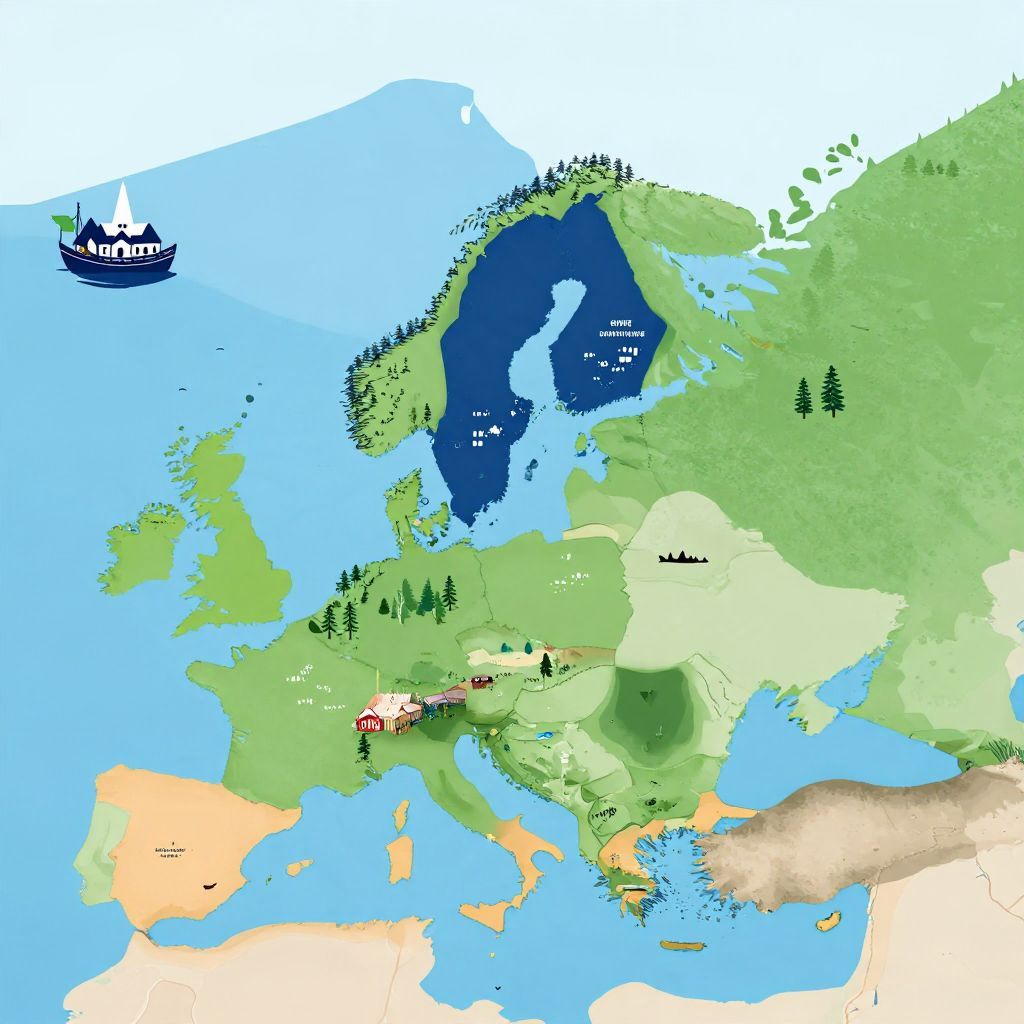
Is Finland part of Scandinavia? The short answer is: not usually, at least not in the strict geographic and historical sense. Finland is generally grouped with the Nordic countries, but most definitions of Scandinavia include only Norway, Sweden, and Denmark.
The confusion is understandable because Finland shares deep historical ties with Sweden and the wider Nordic world. Its language, political history, and modern institutions connect it closely to its neighbors, even though its geography and linguistic background set it apart.
Is Finland Part of Scandinavia?
Usually, no. In the narrowest and most common definition, Scandinavia means Norway, Sweden, and Denmark. Finland is typically classified as a Nordic country rather than a Scandinavian one. Some people use “Scandinavia” more loosely to mean the whole northern region, but that broader usage is informal, not standard.
Why the Answer Depends on Definition
The word Scandinavia has never had only one fixed meaning. In geography and history, it often refers to the Scandinavian Peninsula and the closely linked kingdoms of Norway and Sweden, with Denmark included because of its cultural and political ties. Finland sits outside the peninsula, so it is usually excluded from the strictest definition.
Geographic meaning
From a geographic standpoint, Finland is not on the Scandinavian Peninsula. It lies east of Sweden and north of the Baltic Sea, bordered by Sweden, Norway, and Russia. That physical separation is one reason many maps and reference works distinguish Finland from Scandinavia.
Cultural and political meaning
In everyday speech, especially outside northern Europe, people sometimes use “Scandinavia” as a shorthand for the broader Nordic region. In that looser sense, Finland may be included. But historians and geographers usually prefer clearer terms: Scandinavia for the three core countries, and the Nordic countries for Norway, Sweden, Denmark, Finland, and Iceland, plus related territories.
Finland’s Historical Ties to Scandinavia
Finland’s close association with Scandinavia comes above all from its long period under Swedish rule. From the medieval era until 1809, Finland was part of the Swedish realm. That shared political history linked Finland deeply to Swedish law, administration, religion, and elite culture.
Medieval and early modern Finland under Sweden
Swedish influence expanded into Finnish-speaking areas during the Middle Ages, through a mix of trade, settlement, church organization, and political consolidation. By the late medieval period, Finland was integrated into the Swedish kingdom. For centuries, the governing language of administration and the upper classes was Swedish, while most of the population spoke Finnish.
This long union shaped Finland in lasting ways. Lutheran Christianity spread under Swedish rule after the Reformation in the 16th century, and Swedish legal and governmental traditions became embedded in Finnish society. Even after Finland left Sweden, those institutions remained important.
The 1809 break and Russian rule
Finland’s position changed dramatically in 1809, when Sweden lost the territory to Russia after the Finnish War. Finland became the Grand Duchy of Finland under the Russian Empire. This was a major political shift, but it did not erase the earlier Scandinavian connection. Instead, it created a new historical path in which Finland developed increasing autonomy while still preserving many Swedish-era structures.
Why Finland Is Usually Classified as Nordic, Not Scandinavian
The modern distinction between Scandinavia and the Nordic region matters because it reflects language, history, and identity. Finland is Nordic, but not Scandinavian in the strict sense, mainly because its majority language belongs to a different language family than the Scandinavian languages.
Language is the key difference
Norwegian, Swedish, and Danish are North Germanic languages and are closely related to one another. Finnish, by contrast, is a Finno-Ugric language, part of the Uralic language family. This difference is one of the clearest reasons Finland is usually separated from Scandinavia as a linguistic and cultural category.
That said, Finland is not linguistically isolated from the region. Swedish remains an official language of Finland today, and a Swedish-speaking minority has long been part of Finnish society. So while Finnish is distinct, the country is still deeply bilingual and historically connected to the Scandinavian language sphere.
Shared institutions and modern cooperation
In the 20th and 21st centuries, Finland has participated in Nordic cooperation through shared labor markets, cultural exchange, and political collaboration. The Nordic Council and related institutions have reinforced the idea of a common northern community. This modern cooperation sometimes encourages people to use “Scandinavia” broadly, but that is more a habit of speech than a precise classification.
The Historical Roots of the Confusion
The question “Is Finland part of Scandinavia?” persists because historical experience and modern terminology do not line up neatly. Finland was ruled from Stockholm for centuries, yet it was never part of the Scandinavian Peninsula. It shares Nordic political culture, but its language and eastern geography make it distinct.
Swedish rule created a shared historical memory
Because Finland was part of Sweden for so long, many aspects of its history are inseparable from Scandinavian history. Finnish towns, churches, laws, and aristocratic families developed within the Swedish kingdom. In older historical writing, Finland was often treated as an eastern extension of Sweden rather than as a separate national unit.
National identity changed in the 19th century
During the 19th century, Finnish national identity grew stronger. Intellectuals and political leaders increasingly emphasized the Finnish language and distinct national culture. This was part of a broader European age of nationalism, when peoples across the continent redefined themselves through language, folklore, and history. Finland’s national revival made it less likely to be seen simply as Scandinavian in the older Swedish-centered sense.
Finland in the Broader Nordic World
Although Finland is not usually called Scandinavian, it is firmly part of the Nordic world. That broader category is often the most useful one for understanding Finland’s history and present-day identity.
Nordic countries compared
- Norway, Sweden, and Denmark are the core Scandinavian countries in the strict sense.
- Finland is Nordic, with strong Scandinavian historical ties but a distinct language and geography.
- Iceland is also Nordic, though it is not usually included in Scandinavia.
This distinction helps explain why Finland is often included in discussions of Nordic welfare states, education systems, and regional diplomacy, while still being treated separately in discussions of Scandinavian language and geography.
Shared modern values, different historical paths
Finland’s modern political culture resembles that of its Nordic neighbors in many ways: strong public institutions, a high level of social trust, and close regional cooperation. Yet its historical path included Swedish rule, Russian imperial rule, and a later struggle for independence. Finland declared independence in 1917, after the Russian Revolution, and fought a civil war in 1918. Those events gave it a national trajectory distinct from the older Scandinavian kingdoms.
What Historians Usually Mean by Scandinavia
When historians use the term carefully, they usually mean one of three things:
- Geographic Scandinavia: the Scandinavian Peninsula, mainly Norway and Sweden.
- Historical Scandinavia: the kingdoms of Norway, Sweden, and Denmark and their intertwined medieval and early modern histories.
- Informal Scandinavia: a looser popular term that may include Finland, Iceland, and sometimes other northern territories.
In scholarly writing, the first two meanings are the most precise. Finland fits awkwardly into them because it is neither on the peninsula nor one of the original Scandinavian kingdoms. But in broader cultural conversation, especially where “Scandinavia” is used as a synonym for Northern Europe, Finland may be included without much objection.
So, Is Finland Part of Scandinavia?
Finland is best described as Nordic, not strictly Scandinavian. Historically, it was deeply tied to Sweden and therefore to Scandinavian political and cultural life, but geographically it lies outside Scandinavia, and linguistically it belongs to a different tradition. The answer depends on whether you mean geography, history, or everyday speech.
That is why the most accurate answer is also the most nuanced one: Finland is not usually considered part of Scandinavia, but it is closely connected to it through centuries of shared history. For readers interested in related northern European history, it can also be useful to explore what Vikings looked like and the wider background of the Nordic region.