
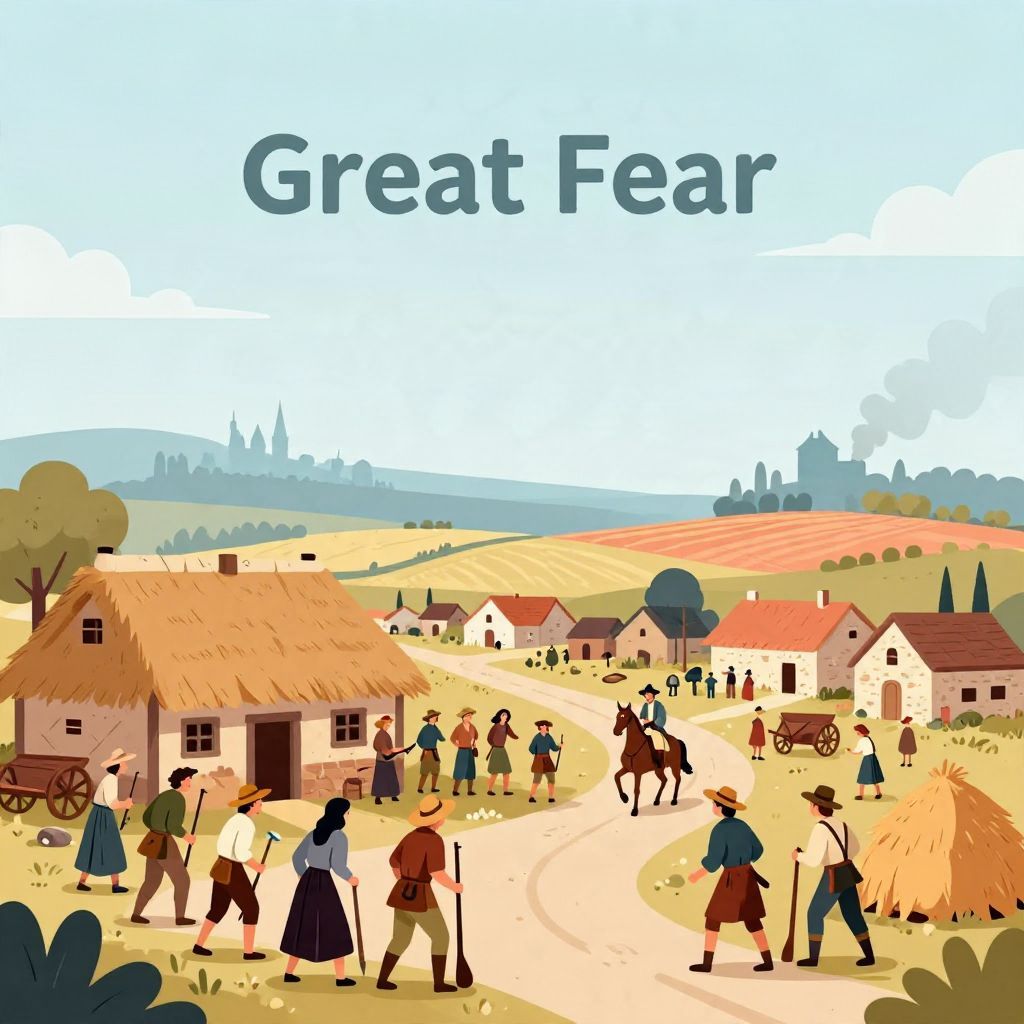
What was the Great Fear? In the summer of 1789, it was a wave of panic that swept through the French countryside during the early French Revolution. Rumors of aristocratic plots, brigands, and grain shortages spread rapidly, pushing peasants to arm themselves and attack manor houses, records, and symbols of feudal privilege.
The Great Fear mattered because it helped transform a political revolution in Paris into a social revolution across rural France. It exposed deep anxiety about food, power, and survival, and it helped drive the National Assembly to abolish many feudal rights in August 1789.
What Was The Great Fear?
The Great Fear was a period of mass panic in rural France from late July to early August 1789, when peasants believed that armed bands or nobles were coming to destroy crops and punish the poor. The rumors were false or exaggerated, but the fear was real and triggered unrest, attacks on property, and demands for change.
Background: Why France Was So Unstable in 1789
To understand the Great Fear, it helps to see the crisis France faced in 1789. The kingdom was under severe financial strain, harvests had been poor, bread prices were high, and political authority was weakening. The calling of the Estates-General in May 1789 opened the door to revolutionary politics, but it also created uncertainty in towns and villages.
Most peasants lived under a system of feudal obligations that required them to pay dues, rents, and taxes to nobles, the Church, or the state. These burdens varied by region, but many rural people felt trapped by old privileges that no longer seemed legitimate. When news from Paris began to spread, it mixed with local grievances and fear of disorder.
Food shortages and rumor
In the summer of 1789, grain shortages and rising bread prices made daily life precarious. In preindustrial France, bread was the basic staple, so any disruption could cause panic. Villagers were highly sensitive to rumors about hoarding, profiteering, or plots to starve the poor. That atmosphere made the countryside especially vulnerable to alarm.
How Did the Great Fear Begin?
The Great Fear began in late July 1789, after the storming of the Bastille on 14 July had already shaken royal authority. News traveled slowly and often inaccurately. In many regions, people heard stories that aristocrats were hiring brigands to attack villages, burn crops, or crush the revolutionary movement. Communities responded by sounding alarms, gathering militias, and spreading the panic further.
Historians generally describe the Great Fear as a chain reaction of rumor rather than a single coordinated event. Different regions experienced different versions of the panic, but the pattern was similar: fear of violence led to defensive mobilization, which then produced actual violence against symbols of seigneurial power.
Why rumors spread so fast
Several factors made rumor powerful in 1789:
- Weak central control in the countryside
- Uncertainty after the political upheaval in Paris
- Memories of past hunger crises and local violence
- Limited reliable news networks
- Deep distrust of landlords, officials, and armed men
In some places, people believed that foreign troops or “brigands” were on the way. In others, they feared that nobles would retaliate against peasants who had supported revolutionary change. The exact rumor changed from place to place, but the underlying anxiety was the same: rural communities felt threatened and abandoned.
What Happened During the Great Fear?
During the Great Fear, peasants armed themselves, organized local defense, and sometimes attacked manor houses, châteaux, and archives. One of the most important targets was the records that documented feudal dues and obligations. Destroying these documents was a practical and symbolic act: it could erase claims that tied peasants to old burdens.
Not every village turned violent, and not every region reacted in the same way. Some communities focused on self-defense, while others moved quickly from fear to direct action. The violence was often aimed less at people than at the system of privilege represented by estates, rents, and legal records.
Typical actions taken by villagers
- Forming local militias or patrols
- Ringing church bells or sounding alarms
- Searching roads for supposed brigands
- Attacking manor houses or seigneurial offices
- Burning feudal title deeds and tax records
These actions were not random. They reflected a rural world in which written records mattered enormously. If a lord could prove a peasant owed dues, the obligation could continue. If the records were destroyed, the claim might be harder to enforce. That is why archives became such important targets.
Why Did the Great Fear Matter?
The Great Fear mattered because it showed that revolutionary change was not confined to Paris. It revealed that rural France was ready to challenge the old social order. The panic and the peasant response helped convince many deputies in the National Assembly that the countryside could not be stabilized without major reform.
In practical terms, the Great Fear accelerated the collapse of feudal privilege. On the night of 4 August 1789, members of the National Assembly voted to abolish many feudal rights and exemptions. This was one of the most dramatic early acts of the French Revolution. The Great Fear did not cause that decision alone, but it strongly influenced the urgency behind it.
The August Decrees
The August Decrees of 1789 marked a turning point. They announced the end of many feudal privileges, including certain dues and noble exemptions. In reality, some obligations remained complicated or were only gradually removed, but the symbolic impact was enormous. For many contemporaries, it seemed that the old order had been broken.
Was the Great Fear a Revolution from Below?
Many historians see the Great Fear as a “revolution from below,” meaning a movement driven by ordinary people rather than elites. That phrase captures an important truth: peasants were not simply passive recipients of events in Paris. They acted on their own fears and interests, and their actions helped reshape revolutionary politics.
At the same time, the Great Fear was not a coordinated peasant uprising with a single leader or manifesto. It was a series of local reactions to rumor, insecurity, and opportunity. Some historians emphasize its spontaneous character; others stress the broader social tensions that made it possible. Both views help explain why the event spread so widely.
Not just blind panic
Although the name suggests irrational fear, the Great Fear had a political logic. Peasants were defending themselves against a social system they believed was unfair and perhaps about to become more violent. Burning records and attacking estates were ways of resisting exploitation, even if the initial spark came from false rumors.
Where Did the Great Fear Happen?
The Great Fear affected much of rural France, though not every region was touched equally. It was especially significant in parts of the countryside where tensions over land, dues, and food were already high. The panic moved through different provinces in waves, showing how quickly fear could travel in a society linked by roads, market towns, and word of mouth.
Because communication was uneven and local conditions varied, the Great Fear did not unfold identically everywhere. Some villages heard of unrest elsewhere and prepared for attack. Others experienced direct incidents that spread alarm to neighboring communities. This patchwork pattern is one reason historians study it as a national crisis made up of many local crises.
What Were the Consequences of the Great Fear?
The immediate consequence was a burst of rural unrest and the destruction of many feudal records. The larger consequence was political. By intensifying pressure on the National Assembly, the Great Fear helped push the revolution toward the dismantling of the old regime’s social hierarchy. It also deepened the sense that the revolution was now affecting all of France, not just the capital.
In the longer term, the Great Fear became part of the revolutionary memory of 1789. It illustrated how fear, rumor, and material hardship can combine to produce major historical change. It also showed that revolutions are often shaped by ordinary people acting in response to immediate dangers, not only by speeches and laws.
Lasting significance
- Helped end many feudal privileges in France
- Expanded the Revolution into the countryside
- Showed the power of rumor in unstable societies
- Revealed peasant agency in a major political transformation
How Historians Interpret the Great Fear
Historians generally agree on the basic outline: in late July and early August 1789, rumor and fear spread through rural France, leading to defensive mobilization and attacks on feudal property. The main debates concern emphasis. Was the Great Fear primarily a spontaneous panic, a rational response to insecurity, or a political uprising disguised as fear?
The best answer is that it was all three in different ways. The panic was real, the rumors were often false, and the actions taken by peasants were shaped by long-standing grievances. The Great Fear cannot be reduced to irrational hysteria, because it emerged from a society under pressure and from a population that understood how power worked in their daily lives.
Great Fear Key Facts
- When: Late July to early August 1789
- Where: Rural France
- What caused it: Rumors of brigands, aristocratic plots, food shortages, and political instability
- What happened: Peasants armed themselves, attacked manor houses, and destroyed feudal records
- Why it matters: It helped lead to the abolition of feudal privileges in August 1789
Conclusion: What the Great Fear Tells Us About the French Revolution
The Great Fear was a wave of panic and action in the French countryside that helped turn the French Revolution into a nationwide upheaval. It began with rumor, but it ended by changing politics, property, and power. If you want to place it in the wider revolutionary story, you can also read about why Marie Antoinette was executed and the broader context of the revolutionary crisis that followed the Great Fear.