
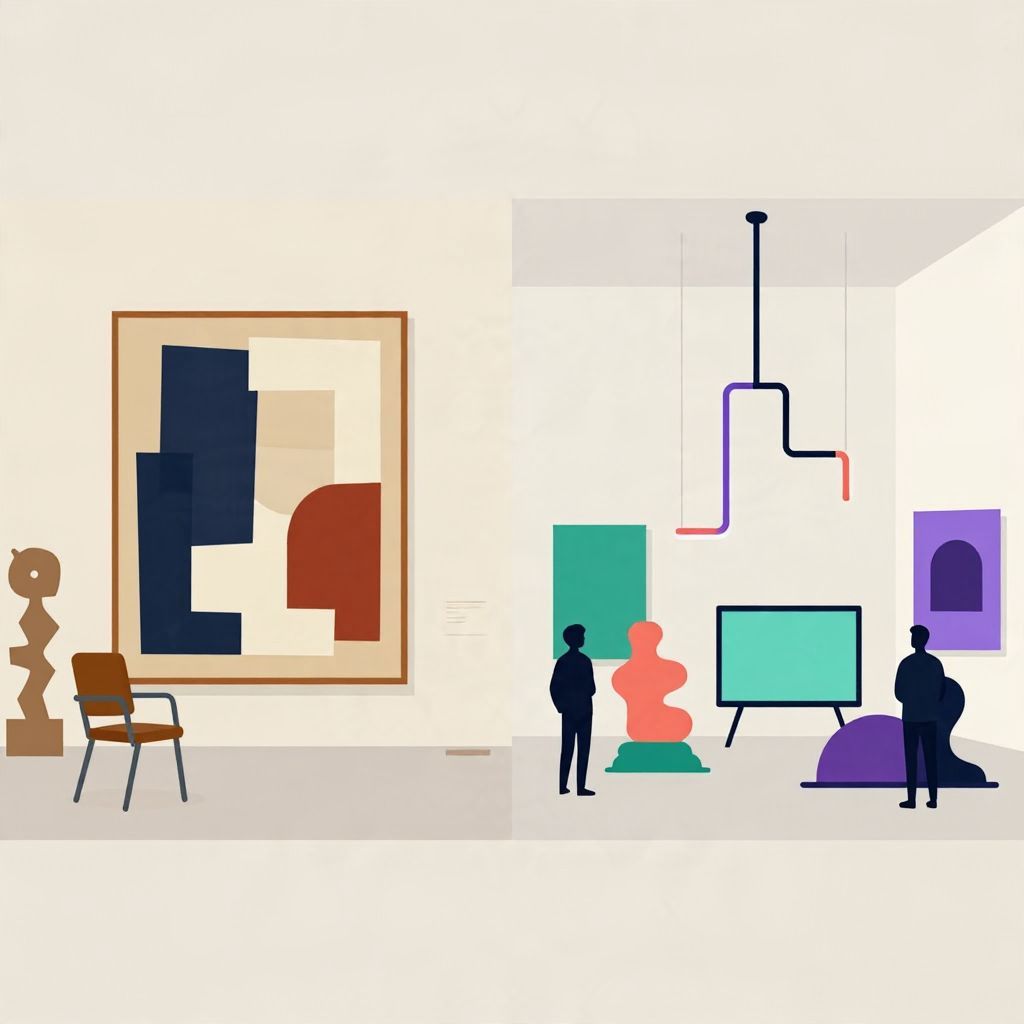
When people ask what is the difference between modern and contemporary art, they are usually asking about more than style. They want to know when each movement began, what historical problems shaped it, and why museums and critics use these labels differently.
The short answer is that modern art generally refers to a broad artistic movement from the late 19th century through the mid-20th century, while contemporary art usually means art made from the late 20th century to the present. The two overlap in time, but they grew out of different historical conditions and artistic goals.
What Is The Difference Between Modern And Contemporary Art?
Modern art is usually associated with experimentation, abstraction, and a break from academic tradition, especially from the 1860s to about the 1970s. Contemporary art refers to art made in the present era, often from the 1970s onward, and is defined less by a single style than by diversity, global exchange, concept-driven work, and new media.
Modern Art and Contemporary Art: A Side-by-Side Historical Comparison
1. Time period
- Modern art: roughly from the 1860s to the 1970s, though some historians extend its beginning earlier or its ending later.
- Contemporary art: generally from the 1970s or 1980s to today.
This dating is not perfectly fixed. In everyday museum language, “modern” and “contemporary” are sometimes used as if they simply mean “new,” but art history treats them as different periods. The boundary often depends on whether a museum or scholar emphasizes style, chronology, or cultural context.
2. Historical setting
- Modern art emerged during industrialization, urban growth, photography, world fairs, and rapid social change.
- Contemporary art developed in a world shaped by globalization, digital technology, postcolonial critique, mass media, and expanded art markets.
Modern artists responded to the upheavals of the 19th and early 20th centuries: mechanized life, new science, changing cities, and the shock of world war. Contemporary artists, by contrast, work in a world of satellites, screens, migration, environmental anxiety, and debates about identity, power, and representation.
3. Main artistic goals
- Modern art: to break with academic realism and invent new visual languages.
- Contemporary art: to question systems, explore ideas, and often challenge the very definition of art.
Modern art often focused on how to represent reality in new ways. Impressionists studied light and perception; Cubists broke objects into geometric planes; Abstract artists moved toward non-representational form. Contemporary art is more likely to ask what art can do socially, politically, or conceptually, even when it uses painting, sculpture, performance, or installation.
4. Style and form
- Modern art: recognizable movements such as Impressionism, Fauvism, Cubism, Surrealism, Futurism, Constructivism, and Abstract Expressionism.
- Contemporary art: no single dominant style; includes installation, video, performance, conceptual art, digital art, photography, social practice, and mixed media.
Modern art is often easier to group into named movements because artists shared visible formal concerns. Contemporary art is more fragmented. One artist may work in painting, another in performance, another in internet-based media, and another in community activism. That variety is one reason the term “contemporary” is broader and harder to pin down.
5. Relationship to tradition
- Modern art: challenged academic rules, perspective, realism, and historical subject matter.
- Contemporary art: often revisits history, archives, and older traditions while also critiquing institutions and power structures.
Modern artists were often rebels against academies and salons that valued polished realism and classical themes. Contemporary artists are just as likely to quote, remix, or reinterpret the past. Rather than rejecting tradition outright, many contemporary works examine how history is remembered, who gets represented, and how cultural heritage is preserved or erased.
6. Audience and institutions
- Modern art: gained visibility through avant-garde circles, galleries, critics, and major museums.
- Contemporary art: is shaped by biennials, global museums, art fairs, residencies, and online platforms.
The institutional world of art changed dramatically after World War II. Modern art became canonized in museums as a history of innovation, while contemporary art developed alongside a much larger international network. Today, contemporary art is often discussed in real time, as critics, curators, and audiences respond to current events and current debates.
How Modern Art Developed
Modern art did not appear overnight. It grew out of 19th-century changes in society, technology, and visual culture, especially in Europe and later the United States. Its history is tied to the collapse of older artistic hierarchies and the rise of the modern city.
The break from academic art
In the 1800s, many official art academies favored historical scenes, religious subjects, and idealized bodies. As photography, industrial production, and urban life transformed society, artists increasingly felt that old formulas no longer fit modern experience. Impressionism, beginning in France in the 1860s and 1870s, is often treated as a key starting point because it emphasized fleeting light, everyday scenes, and visible brushwork.
Experimentation and abstraction
By the early 20th century, artists pushed further. Cubism fragmented form and perspective; Futurism celebrated speed and machines; Surrealism explored dreams and the unconscious; abstraction moved away from recognizable subjects altogether. These movements were not identical, but they shared a conviction that modern life demanded new artistic methods.
War and disillusionment
The First World War and later the Second World War deeply affected modern art. Many artists saw traditional culture as inadequate in the face of mass violence and political collapse. Some turned to abstraction, others to irony, absurdity, or radical social ideas. After 1945, Abstract Expressionism in the United States became one of the best-known late modern movements, often associated with large-scale gesture and emotional intensity.
How Contemporary Art Emerged
Contemporary art is usually linked to the decades after modernism’s high point, especially from the 1960s and 1970s onward. It did not replace modern art all at once; rather, it emerged as artists began to question the limits of modernist ideals such as originality, purity of form, and the autonomous art object.
From object to idea
Conceptual art was especially important in this shift. In conceptual work, the idea may matter more than the finished object. This helped expand art beyond painting and sculpture into language, instruction, documentation, performance, and ephemeral action. The change reflected broader cultural skepticism about fixed meanings and grand artistic narratives.
Globalization and pluralism
Contemporary art became increasingly international. Artists from Latin America, Africa, Asia, the Middle East, and Indigenous communities gained stronger visibility in global exhibitions and museums, challenging older Euro-American-centered histories. This period also saw greater attention to colonial legacies, migration, gender, race, and local identity within a global art world.
New media and new publics
Video, photography, installation, digital tools, and internet-based work expanded what art could be. Contemporary artists often engage directly with social issues, public space, archives, and participatory projects. Some works are temporary, site-specific, or collaborative, making the experience of art more important than a permanent object alone.
Why the Difference Matters
Knowing the difference between modern and contemporary art helps place artworks in their historical context. A painting by Claude Monet, Pablo Picasso, or Jackson Pollock belongs to a different intellectual world than a video installation by a living artist responding to climate change or social media culture.
The distinction also matters because the two terms carry different assumptions. Modern art is often understood as a story of innovation, formal experimentation, and the rise of the avant-garde. Contemporary art is more often understood as open-ended, critical, and globally diverse. In other words, modern art asks how art became new; contemporary art asks what art can still do now.
Common Confusions About the Terms
“Modern” does not always mean “recent”
In everyday speech, modern can mean current or up to date. In art history, however, modern usually refers to a specific historical period. A “modern art museum” often displays works from the late 19th and 20th centuries, not necessarily art made today.
“Contemporary” does not always mean “fashionable”
Contemporary means made in the present era, but not every living artist is automatically a contemporary artist in the art-historical sense. The term is tied to the post-1970s art world, where conceptual concerns, global networks, and institutional critique became especially influential.
The boundary is not absolute
Some artists complicate the divide. Late works by modernist artists may overlap with contemporary concerns, and some contemporary artists deliberately revive modernist styles. Museums, textbooks, and curators may also use the labels differently depending on their collections and interpretive goals.
A Simple Way to Remember the Difference
- Modern art = the break with tradition, from the late 19th century into the mid-20th century.
- Contemporary art = art of the recent and present era, especially from the 1970s onward.
- Modern art often emphasizes formal innovation.
- Contemporary art often emphasizes ideas, context, identity, and new media.
This shorthand is useful, but it should not hide the complexity of art history. Both periods include disagreement, experimentation, and many overlapping concerns. The difference is less about “old versus new” than about two distinct historical moments with different cultural pressures and artistic ambitions.
In historical terms, the difference between modern and contemporary art is a difference between eras: one shaped by industrial modernity and the invention of avant-garde form, the other by globalization, conceptual thinking, and media-rich present-day culture. If you want to explore related visual traditions, you may also find what cultural preservation means in architecture and the themes prevalent in Romanesque art useful for understanding how artistic style changes across history.