
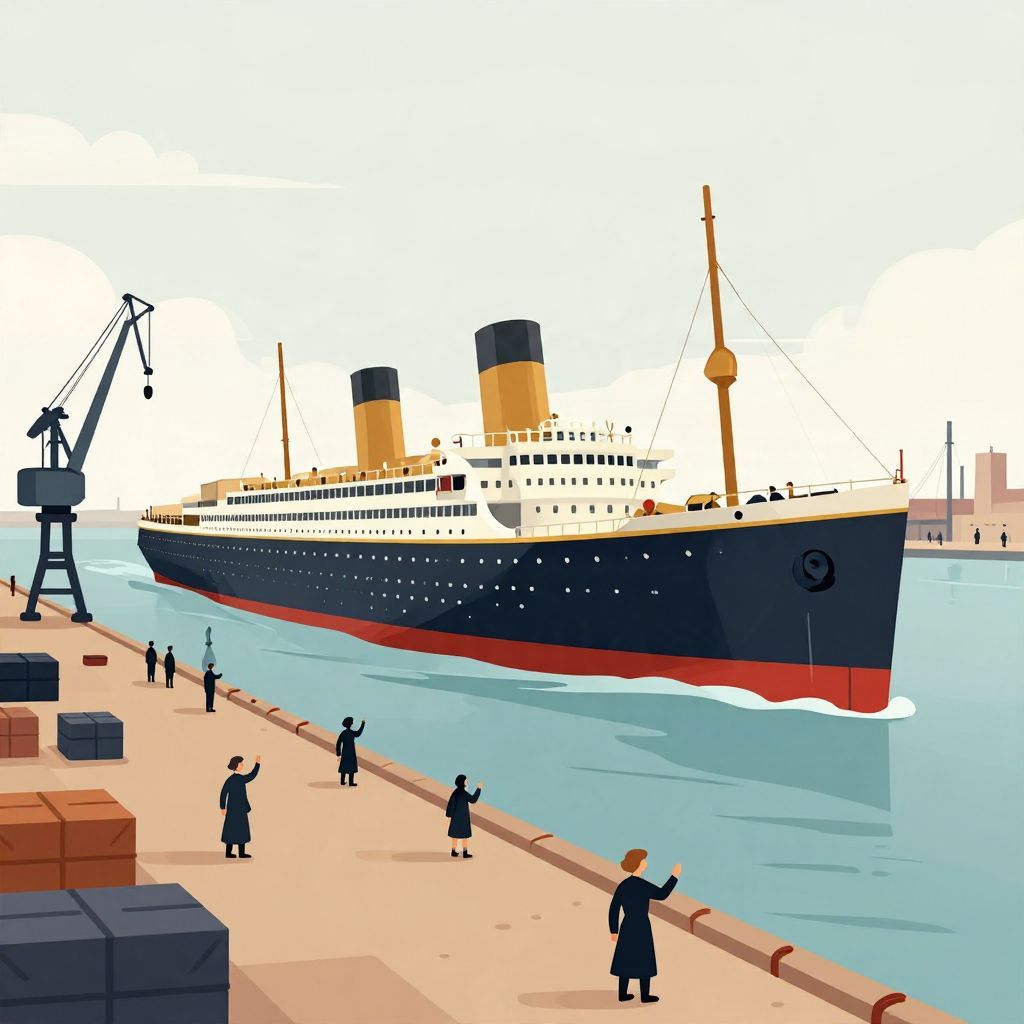
When people ask where the Titanic left from, they are usually asking about the ship’s first departure on its fateful voyage in April 1912. The answer is straightforward: the RMS Titanic departed from Southampton, England, on 10 April 1912.
That departure was only the beginning of a planned transatlantic journey to New York City. But the story is more than a single port of call. The Titanic’s route, the ports it visited, and the reasons it began in Southampton all help explain how the disaster unfolded.
Where did the Titanic leave from?
The Titanic left from Southampton, on England’s south coast, on 10 April 1912. It sailed from the White Star Line’s berth at Southampton Water, beginning its maiden voyage to New York. Before crossing the Atlantic, however, the ship also called at Cherbourg in France and Queenstown, now Cobh, in Ireland.
Why Southampton was the Titanic’s starting point
Southampton was one of Britain’s busiest passenger ports in the early 20th century. The White Star Line used it as a major home port because it offered good rail connections, dock facilities, and access to a large pool of passengers and crew. For a ship the size of the Titanic, Southampton made practical sense as the main departure point.
A major port for Atlantic travel
By 1912, Southampton had become a key gateway for ocean liners bound for North America. Passengers from London and other parts of Britain could reach the port by train, and the harbor had the infrastructure needed to handle large vessels. The Titanic was built for the transatlantic market, so starting from Southampton fit the shipping company’s commercial strategy.
The White Star Line’s operating base
The Titanic belonged to the White Star Line, one of the best-known British shipping companies of the era. White Star had invested heavily in huge luxury liners designed to compete with rival companies. Southampton served as a regular base for many of its ships, so the Titanic’s departure there was consistent with the company’s established operations.
The Titanic’s departure on 10 April 1912
On the morning of 10 April 1912, the Titanic left Southampton and began what was intended to be a routine maiden voyage. The ship was under the command of Captain Edward Smith, one of the most experienced captains in the White Star fleet. Crowds gathered to watch the liner depart, as was common for major passenger ships of the day.
A difficult maneuver in port
The Titanic’s departure was not entirely simple. Large ships required careful handling in narrow or busy harbor waters. As the Titanic pulled away, its movement created pressure changes in the water that affected nearby vessels. One famous consequence was the near-collision with the SS New York, a smaller ship whose moorings were strained as the Titanic passed. Tugboats and quick action prevented a serious accident.
The first leg of the voyage
The ship’s first leg took it across the English Channel toward France. This was not unusual for North Atlantic liners. Many such voyages began with a short European route to collect additional passengers before heading west across the ocean. The Titanic’s itinerary reflected the international nature of early 20th-century passenger travel.
The full route: Southampton to Cherbourg to Queenstown
Although Southampton was the Titanic’s departure point, it was not the only port on its outward journey. The ship made two additional stops before entering the Atlantic. These stops were part of the standard pattern for many transatlantic sailings, especially for liners carrying passengers from several countries.
- Southampton, England — departed 10 April 1912
- Cherbourg, France — called later the same day to take on passengers
- Queenstown, Ireland — called on 11 April 1912, the final European stop
- Atlantic crossing — headed toward New York after leaving Queenstown
Cherbourg and Queenstown
Cherbourg allowed the Titanic to pick up passengers from continental Europe without entering a full harbor. Queenstown, in Ireland, was the final stop before the long Atlantic crossing. Many third-class passengers boarded there, and mail and cargo were also taken on. After leaving Queenstown, the Titanic was committed to the open ocean.
Why the departure point matters in Titanic history
The question of where the Titanic left from is important because it places the disaster in its proper historical and geographic context. The ship was not simply “an American-bound vessel”; it was a British liner beginning a carefully planned international voyage from a major European port. Southampton was the starting point of the journey that ended in tragedy on 15 April 1912.
Southampton and the human story of the voyage
Many of the Titanic’s crew were recruited in or around Southampton, and the city suffered heavily after the sinking. The departure point matters because it shows how local the disaster became for a British port community even though the ship’s destination was New York. For many families, the Titanic’s voyage began as a familiar departure from a home port and ended as a global catastrophe.
The port’s role in the wider disaster
Because Southampton was the Titanic’s base, the city was closely tied to the ship’s operations, staffing, and aftermath. The port’s importance also helps explain why the Titanic was so quickly and efficiently loaded and dispatched. The same commercial efficiency that made the voyage possible was part of the system that sent the liner into the Atlantic on a tight schedule.
Common confusion about the Titanic’s departure
People sometimes confuse the Titanic’s departure point with its destination or with one of its intermediate stops. Others assume it left from Ireland because Queenstown was the last port where passengers boarded. In fact, the ship’s maiden voyage began in Southampton, even though it later stopped in France and Ireland before crossing the Atlantic.
Not New York, not Ireland
The Titanic was built to sail to New York, but that was the destination, not the departure point. Likewise, Queenstown was the final European stop, not the place the voyage began. Understanding this distinction helps clarify the route and the sequence of events on the Titanic’s first and only voyage.
The historical significance of the Titanic’s first departure
The Titanic’s departure from Southampton marked the beginning of one of the most famous voyages in modern history. At the time, the ship represented technological ambition, luxury, and confidence in modern engineering. Its departure was celebrated as the launch of a marvel of the age. Within days, that confidence would be shattered by the sinking in the North Atlantic.
A symbol of Edwardian travel
The Titanic’s sailing reflected the scale and optimism of Edwardian-era ocean travel. Large liners connected Europe and North America, carrying migrants, tourists, business travelers, and mail. Southampton stood at the center of that network, and the Titanic’s departure from the port showed how global travel had become by the early 1900s.
From routine departure to historic memory
What began as a standard departure from a busy British port became one of the most remembered moments in maritime history. The fact that the Titanic left from Southampton is not just a geographic detail; it is part of the larger story of how a modern passenger liner entered service, gathered passengers across Europe, and then met disaster at sea.
So, the direct answer is simple: the Titanic left from Southampton, England. But the fuller history includes its stops at Cherbourg and Queenstown, the role of the White Star Line, and the significance of Southampton as a major Atlantic port. For related Titanic history, you may also want to read about how the Titanic broke in half and when the last Titanic survivor died.