
When people ask, “What was the biggest empire in history?” they usually mean the largest empire by land area at its height. By that measure, the answer is the British Empire, which controlled roughly a quarter of the world’s land and population in the early 20th century.
But the question is more complicated than it first appears. “Biggest” can mean total territory, population, duration, or influence, and different empires lead depending on the standard used. The British Empire is the largest in recorded history by area, yet other empires, especially the Mongol and Roman empires, were enormous and historically transformative in different ways.
What Was the Biggest Empire in History?
The British Empire was the biggest empire in history by land area. At its height around the early 1920s, it ruled about 35.5 million square kilometers, spanning North America, the Caribbean, Africa, Asia, the Middle East, Oceania, and the British Isles. It was the largest imperial system the world has ever seen.
Why the British Empire Became the Largest
The British Empire grew through a combination of naval power, trade, colonization, warfare, and industrial strength. Britain’s island geography encouraged investment in ships and ports, while the expansion of global commerce in the 17th and 18th centuries gave it a major advantage over rivals such as Spain, France, and the Netherlands.
Maritime power and trade
Britain’s navy became a decisive instrument of expansion. Control of sea routes allowed Britain to protect colonies, seize strategic ports, and dominate trade networks. Commercial companies such as the East India Company helped extend British influence in Asia long before direct imperial rule became common.
Industrialization and military reach
The Industrial Revolution strengthened Britain’s empire further. Factories, steamships, railways, and modern weapons made it easier to move goods, troops, and administrators across long distances. Industrial power did not create the empire by itself, but it made British control more durable and more profitable.
How the British Empire Expanded Over Time
The British Empire did not appear all at once. It developed in stages, beginning with overseas settlements and trading outposts, then expanding into conquest and formal colonial rule. Its growth was uneven, shaped by wars, alliances, rebellions, and changing economic priorities.
A brief chronology
- 16th–17th centuries: Early exploration, privateering, and the first settlements in North America and the Caribbean.
- 18th century: Expansion through war, trade, and colonial competition with France and Spain.
- 19th century: Rapid growth in India, Africa, and the Pacific; the empire becomes truly global.
- Early 20th century: The empire reaches its greatest territorial extent after World War I.
- Mid-20th century onward: Decolonization sharply reduces British imperial rule.
India as the imperial center
India became the most important possession in the British Empire. After the East India Company expanded its influence in the 1700s, the British Crown took direct control in 1858 following the Indian Rebellion. India supplied raw materials, markets, soldiers, and prestige, and it was often called the “jewel in the crown” of the empire.
How the British Empire Compares with Other Major Empires
Although the British Empire was the largest by area, several other empires were among the greatest in history. The Mongol Empire was the largest contiguous land empire, while the Roman Empire shaped law, language, and government across Europe and the Mediterranean. Each empire was “biggest” in a different sense.
The Mongol Empire
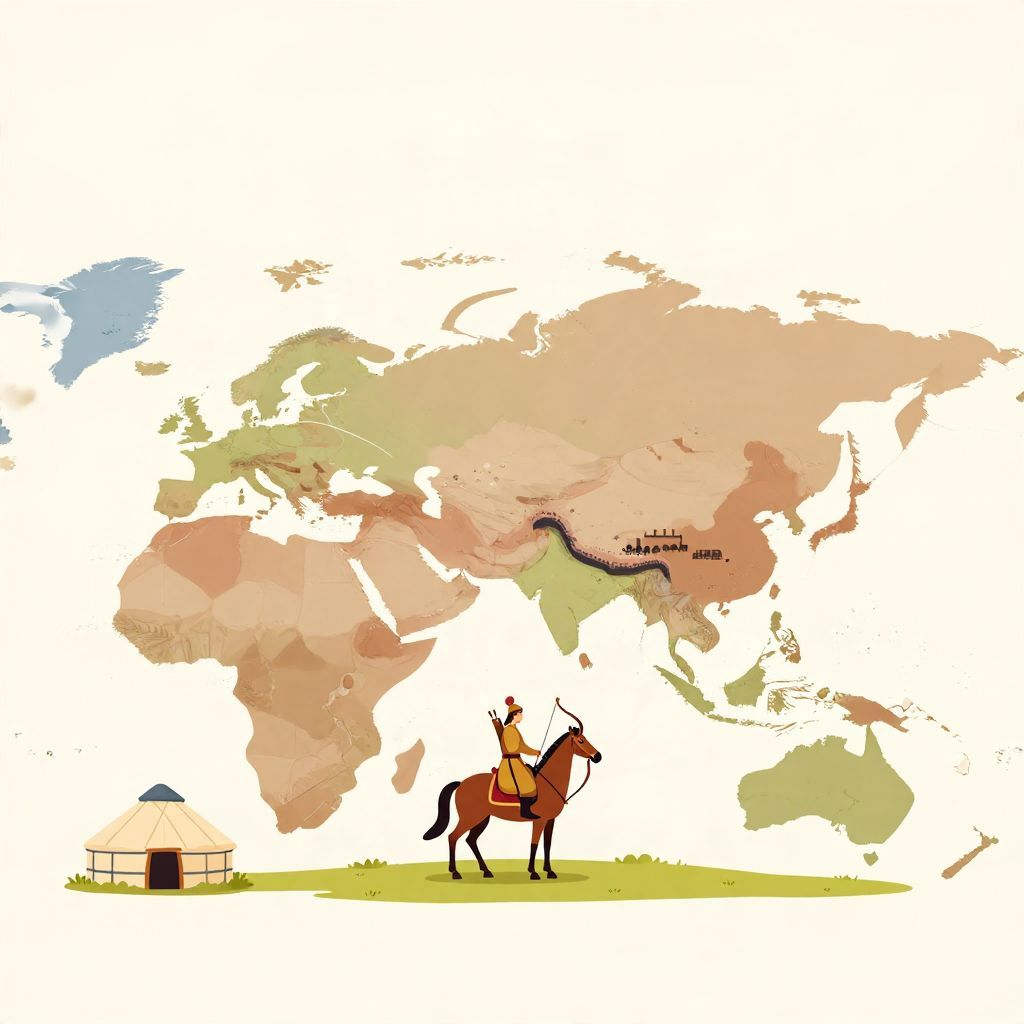
The Mongol Empire, founded by Genghis Khan in the early 13th century, became the largest contiguous empire in history. At its height, it stretched across much of Eurasia. It was not larger than the British Empire in total area, but it was unmatched as a single overland empire joined together across one vast landmass.
The Roman Empire
The Roman Empire never approached the British Empire’s global size, but it was one of the most influential empires ever created. At its height in the 2nd century CE, Rome controlled the Mediterranean world, much of Europe, North Africa, and the Near East. Its legal, political, and cultural legacy lasted far beyond its borders.
Other imperial powers
Spain, France, Portugal, the Ottoman Empire, and Russia all built huge empires in different periods. Spain’s American empire was especially important in the 16th and 17th centuries, while Russia built the largest land empire by continuous expansion across Eurasia. None, however, surpassed the British Empire in total global area.
What “Biggest” Means in Historical Debate
Historians often qualify the answer because empires can be measured in several ways. The British Empire is the biggest by land area, but it was not the most populous at every moment, nor the most culturally unified, nor the longest lasting. The “largest empire” depends on the question being asked.
Area versus population
Land area is the most common way to measure empire size, and by that standard Britain is the clear answer. Population is harder to compare because censuses were uneven, borders changed frequently, and imperial control did not always mean direct administration. At certain moments, the Qing Empire in China or the Mughal Empire in India held enormous populations under centralized rule.
Contiguous versus global empire
Another distinction is between contiguous and overseas empires. The Mongol Empire was vast but mostly connected by land. The British Empire was global, linking territories across oceans. That worldwide spread made Britain unique: it was the first empire to operate on a truly planetary scale.
The Human Cost of Empire
Any account of the biggest empire in history must also recognize the costs of imperial rule. Expansion often relied on conquest, forced labor, unequal trade, land seizure, and political domination. Many colonized societies resisted British rule, sometimes through diplomacy and reform, and sometimes through rebellion and war.
Resistance and reform
Colonial rule was never accepted everywhere. In India, Ireland, Africa, the Caribbean, and elsewhere, people resisted imperial control in many forms. Some movements sought independence, while others demanded rights within the empire. These struggles helped shape modern nationalism and anti-colonial politics in the 19th and 20th centuries.
Legacies that outlasted the empire
The British Empire left behind English as a global language, legal and parliamentary institutions, railways, port cities, and deep economic inequalities. It also left painful legacies of displacement, racial hierarchy, and political division. In many former colonies, the effects of empire are still visible in borders, institutions, and memory.
When Did the British Empire End?
The British Empire did not collapse in a single year. It declined gradually after World War I and especially after World War II, when anti-colonial movements gained strength and Britain’s global power weakened. India’s independence in 1947 marked a turning point, followed by the rapid loss of colonies across Asia and Africa.
From empire to Commonwealth
In place of direct imperial rule, Britain helped create the modern Commonwealth, a voluntary association of independent states. This shift reflected the end of empire as a governing system, even though historical ties, trade links, and cultural connections remained. The transition was uneven and often contested, but it marked a major change in world history.
So, What Was the Biggest Empire in History?
The biggest empire in history, by land area, was the British Empire. At its height, it was the largest political entity the world had ever seen, spanning every inhabited continent and ruling a vast share of the global population. If you want to compare it with other imperial giants, it is worth exploring how big the Roman Empire was and what happened to Babylon to see how empires rise, endure, and decline in different ways.