
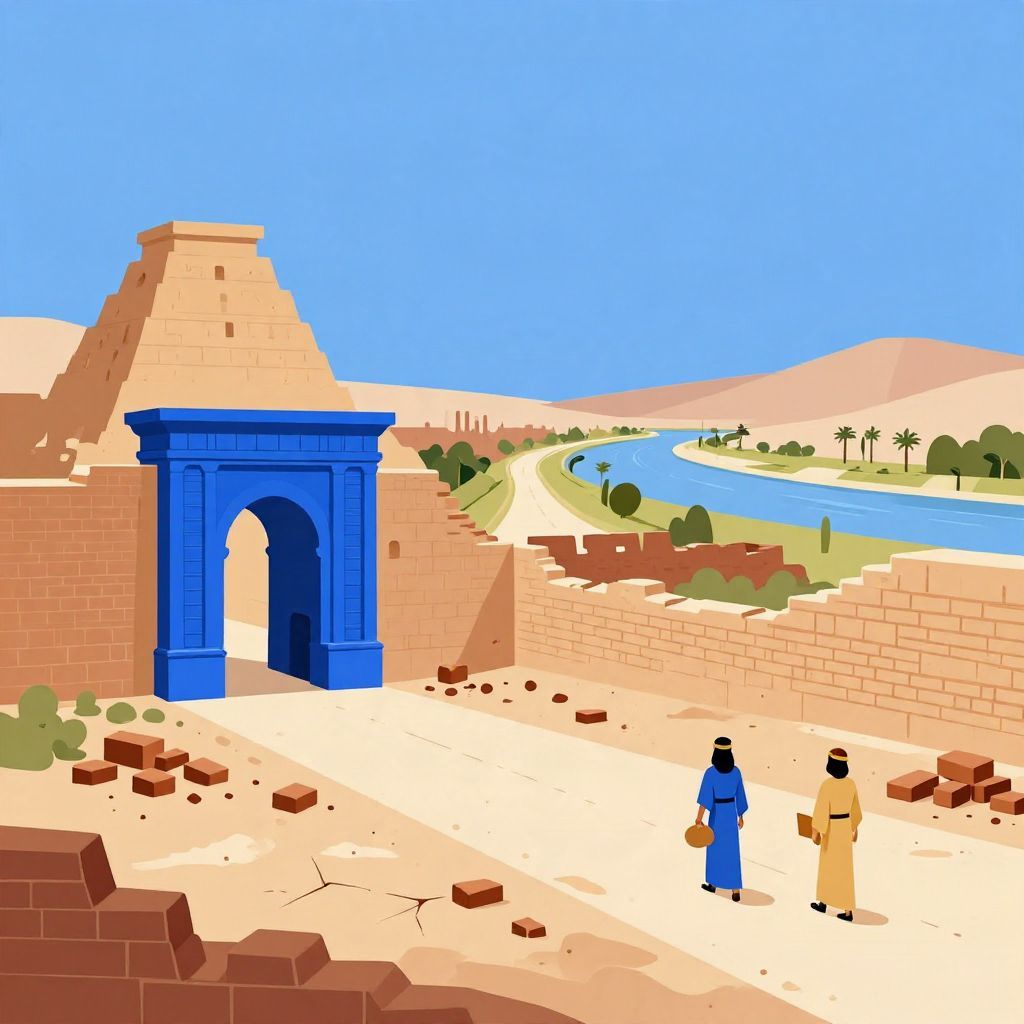
What happened to Babylon is a story of rise, conquest, decline, and survival in altered form. Once one of the most famous cities of the ancient world, Babylon became a political prize for empires, a symbol in religious memory, and eventually a ruin near modern Hillah in Iraq.
The city did not disappear in a single moment. It was conquered, damaged, reused, and slowly abandoned over centuries, with its most famous turning point being the Persian capture of Babylon in 539 BCE.
What happened to Babylon?
Babylon was conquered by the Persian king Cyrus the Great in 539 BCE, ending its role as an independent imperial capital. It remained inhabited for centuries afterward, but political power shifted elsewhere, the city gradually declined, and by the medieval period it was largely abandoned, leaving ruins that survive in modern Iraq.
Babylon before its fall
Babylon was an ancient Mesopotamian city on the Euphrates River, in today’s Iraq. It rose to major power under Hammurabi in the 18th century BCE, but its most famous phase came much later, during the Neo-Babylonian Empire in the 7th and 6th centuries BCE. That was the era of Nebuchadnezzar II, when Babylon became a vast, wealthy, and heavily fortified capital.
In this period, Babylon was not just a city but the center of an empire that controlled much of Mesopotamia and influenced the Levant. It was admired for its monumental architecture, temples, and city walls. Ancient writers later turned Babylon into a symbol of grandeur, luxury, and, in some traditions, excess.
The city’s political importance
Babylon’s importance came from geography as much as ambition. It sat in a fertile river valley and controlled trade routes and agricultural wealth. Rulers who controlled Babylon could project power across the Near East, which is why the city so often became the target of conquest.
The Persian conquest in 539 BCE
The most important answer to “what happened to Babylon” is that it fell to the Achaemenid Persian Empire in 539 BCE. Cyrus the Great captured the city and incorporated it into his expanding empire. This event ended Babylon’s independence, though not its existence as a city.
Ancient sources describe the conquest in different ways. Some accounts emphasize a relatively peaceful takeover, while others present it as a dramatic military capture. Modern historians generally agree that Babylon was taken by the Persians in a context of internal weakness, political dissatisfaction, and imperial pressure, but the exact details remain debated.
Why Babylon fell
- Imperial overreach: Babylon had expanded far, but large empires were difficult to hold together.
- Political instability: The last Neo-Babylonian ruler, Nabonidus, was controversial and may have alienated important religious and political groups.
- Persian expansion: Cyrus was rapidly building a powerful empire and had already defeated other major rivals.
- Local support or neutrality: Some groups may have preferred Persian rule to Babylonian leadership, helping the transition.
Babylon’s fall was therefore not simply the collapse of a city under siege. It was the transfer of power from one empire to another, with the Persians presenting themselves as legitimate rulers who restored order.
What happened after Cyrus took Babylon?
After 539 BCE, Babylon became an important city within the Persian Empire rather than an independent capital. Cyrus and his successors used Babylon as a major administrative and cultural center. The city retained prestige, temples continued to function, and Babylonian scribal traditions remained influential.
In other words, the city did not vanish after conquest. It continued to matter economically and religiously. What changed was sovereignty: Babylon was now ruled by a foreign imperial dynasty headquartered elsewhere.
Babylon under Persian rule
The Persians were often pragmatic rulers. They allowed local customs and religious institutions to continue when it suited imperial stability. Babylon’s temples, especially those tied to the city’s traditional gods, remained significant. This helped preserve continuity even as political control shifted.
Still, Babylon’s status as a capital weakened over time. The Persian Empire relied on multiple centers of power, and Babylon was no longer the sole heart of an empire. That change mattered in the long run.
Did Babylon fall more than once?
Yes. Babylon experienced several major conquests and periods of decline, which is one reason the question can be confusing. The city was not destroyed in one single event and then instantly abandoned. Its history is marked by repeated rises and falls.
- Early rise: Babylon became a major city in the early second millennium BCE.
- Assyrian domination: It was at times controlled by Assyrian rulers, who also fought to manage Babylonian resistance.
- Neo-Babylonian revival: The city regained power in the late 7th century BCE.
- Persian conquest: Cyrus captured Babylon in 539 BCE.
- Hellenistic period: Under the successors of Alexander the Great, Babylon remained important for a time but lost ground to new cities.
- Gradual abandonment: Over centuries, population and importance declined until the site was largely deserted.
Babylon under Alexander and the Hellenistic kings
Babylon briefly regained prominence after Alexander the Great conquered the Persian Empire in 331 BCE. Alexander used Babylon as one of his major eastern centers and died there in 323 BCE. For a moment, the city seemed poised to remain important in the new Greek-ruled world.
But that did not last. The Seleucid rulers founded and favored new cities, especially Seleucia on the Tigris, which drew people and administration away from Babylon. This shift was crucial: cities survive not only through history and memory, but through political investment. When rulers move their courts and institutions, urban life often follows.
Why new cities mattered
Babylon was ancient and prestigious, but newer foundations could be better placed for trade, military control, and administration. Over time, these choices drained Babylon of influence. The city remained inhabited, but it was no longer the dominant urban center of Mesopotamia.
Why did Babylon decline?
Babylon declined for several reasons, and no single cause explains the whole process. Its fall from greatness was gradual, shaped by political change, economic shifts, and environmental pressures.
- Changing imperial centers: Persian and later Hellenistic rulers favored other capitals.
- River and landscape changes: Mesopotamian waterways could shift, affecting agriculture and transport.
- War and neglect: Repeated conflicts damaged the city and its infrastructure.
- Religious and administrative change: Institutions that had supported Babylonian identity lost influence.
By the early centuries of the Common Era, Babylon had become far less significant than it once was. It was still known, but increasingly as an old city rather than a living imperial center.
What happened to Babylon in later antiquity and the medieval period?
By the time of the Parthians and later the Sasanian Empire, Babylon had already declined sharply. Nearby settlements mattered more than the old urban core. As centuries passed, the ancient city was increasingly abandoned, and its buildings fell into ruin.
By the Islamic period, Babylon’s exact identity had faded in everyday life, though the site remained part of the historical landscape of Iraq. Stones and bricks from ancient Babylon were reused in later construction, a common fate for ruined cities in the ancient Near East.
From city to ruin
The transition from inhabited city to archaeological site happened slowly. Ancient walls collapsed, canals silted up, and monumental structures crumbled. What survived was not the living city of Nebuchadnezzar, but the memory of Babylon preserved in texts, traditions, and later scholarship.
Babylon in religion and cultural memory
Babylon’s story did not end with its political decline. In Jewish, Christian, and later Islamic traditions, Babylon became a powerful symbol. In the Hebrew Bible, it is associated with exile and imperial oppression, especially after the Babylonian conquest of Judah in the 6th century BCE. That memory gave Babylon a lasting place in religious history.
Later writers often used “Babylon” as a symbol of worldly pride, corruption, or domination. This symbolic life sometimes overshadowed the historical city itself. As a result, many people know Babylon more as an idea than as a place.
History versus legend
It is important to separate the real city from later legend. Babylon was indeed a major imperial capital, but some popular images of it are exaggerated or anachronistic. Ancient accounts sometimes blended fact, propaganda, and moral judgment. Modern archaeology helps correct those distortions while confirming the city’s extraordinary scale and importance.
What do archaeologists know today?
Archaeologists have identified the remains of Babylon near modern Hillah in Iraq. Excavations have revealed city walls, gates, temples, palaces, and street layouts. The site has suffered from time, rebuilding, and modern damage, but it remains one of the most important archaeological places in the ancient world.
These remains show that Babylon was not a myth. It was a real metropolis with a long history, repeatedly rebuilt and reimagined by different rulers. The archaeological record also confirms that the city’s decline was gradual rather than instantaneous.
The short answer: what happened to Babylon?
Babylon was conquered by the Persians in 539 BCE, lost its independence, and gradually declined as political power shifted to other cities and empires. It remained inhabited for centuries, but it slowly became a ruin. Its legacy survived far longer than its political power, shaping religion, literature, and historical memory.
If you want to explore the turning point in more detail, see when Babylon fell and the wider imperial context in what Persia was and where it stood in history.