
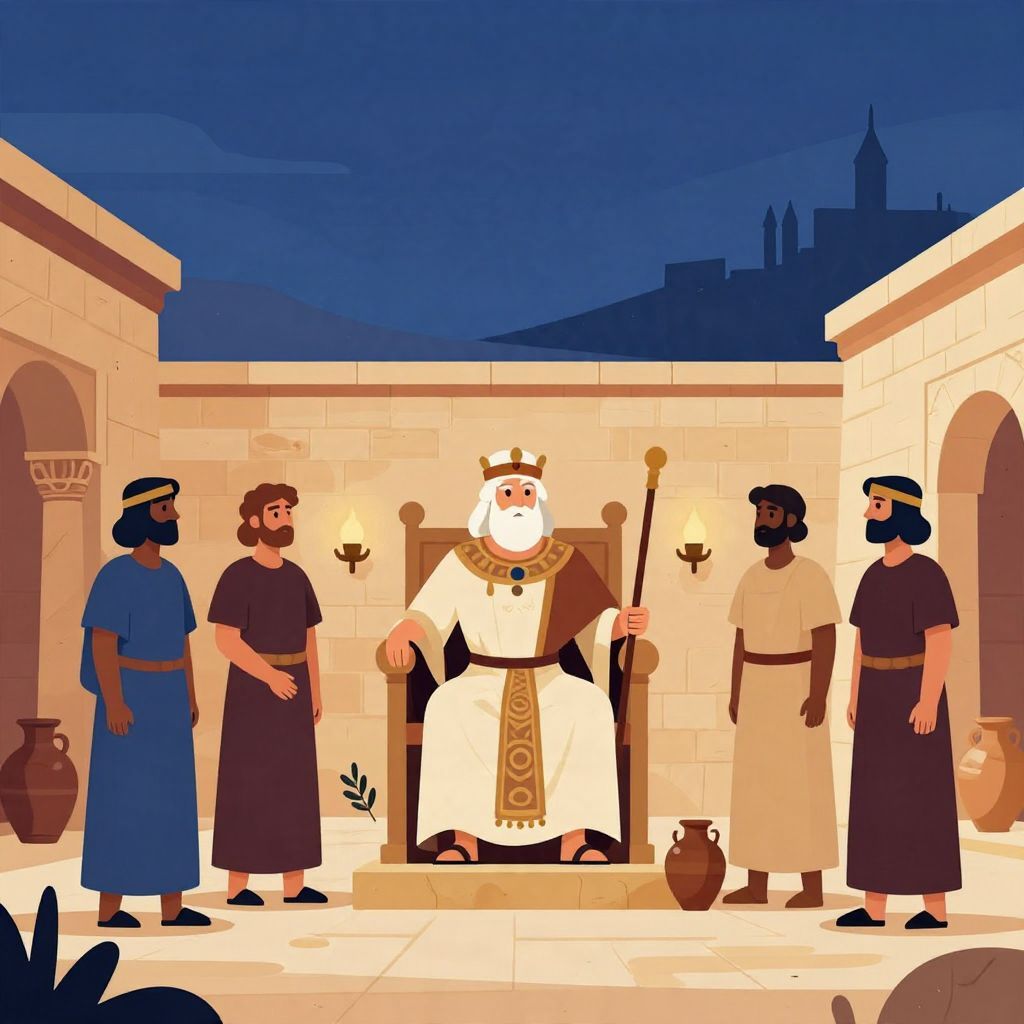
How did Solomon die? The short answer is that the Bible does not describe Solomon’s death in detail. In the historical and religious traditions that preserve his story, Solomon is said to have died after a long reign, probably in old age, and to have been buried in Jerusalem. There is no reliable evidence for a dramatic cause of death, and later legends about his final moments are not part of the earliest historical record.
Because Solomon stands at the crossroads of history, scripture, and tradition, the question matters for more than curiosity. His death marked the end of the united monarchy in Israel and Judah and set the stage for political division, religious debate, and centuries of memory about an idealized “golden age.”
How did Solomon die?
Solomon most likely died of natural causes after a long reign, probably in old age, around the late 10th century BCE. The biblical books that tell his story do not name an illness, accident, or assassination. Instead, they simply report that he reigned in Jerusalem and then “slept with his fathers,” a standard ancient phrase for death and burial. The exact date and circumstances are not historically certain.
What the historical sources actually say
The main ancient source for Solomon’s life and death is the Hebrew Bible, especially 1 Kings 1–11 and 2 Chronicles 1–9. These texts focus on his accession, achievements, foreign alliances, building projects, wisdom, and later religious unfaithfulness. When Solomon’s reign ends, the narrative moves quickly to the succession of his son Rehoboam. It does not describe a terminal illness or a violent end.
The biblical formula for death
In ancient Near Eastern royal writing, “slept with his fathers” is a conventional way of saying a king died and was laid to rest with his ancestors. That wording strongly suggests an ordinary death rather than a special or suspicious one. It is also consistent with the fact that Solomon’s reign is portrayed as long and stable enough for him to complete major projects, including the Temple in Jerusalem.
What is missing from the record
What we do not have is equally important. There is no contemporary inscription, royal tomb identification, or archaeological evidence that confirms how Solomon died. There is also no early historical account describing a murder, battlefield death, or sudden disaster. For historians, that silence usually means we should avoid speculation and stick to the most cautious conclusion: Solomon died naturally, and later tradition preserved only the broad outline of his end.
When did Solomon die?
Solomon is traditionally placed in the 10th century BCE, but the exact chronology is debated. Many reconstructions place his reign roughly between the mid-10th century BCE and about 930 BCE, though scholars differ on how much confidence can be placed in those dates. The uncertainty reflects the difficulty of aligning biblical chronology with the broader archaeological and textual record.
Why the date is uncertain
Ancient Israelite chronology is not preserved in a modern calendar system. Biblical regnal numbers, later editorial shaping, and the lack of direct external records make precise dating difficult. Some historians think the biblical account preserves a memory of a real monarch whose reign was later expanded into a larger national story. Others argue that parts of the Solomon narrative were written or edited much later, which complicates efforts to date his death exactly.
Was Solomon murdered or overthrown?
There is no solid historical evidence that Solomon was murdered or deposed. Popular retellings sometimes imagine palace intrigue because his reign ends just as the kingdom fractures under Rehoboam, but the sources do not say that Solomon was killed or removed from power. The split of the kingdom happened after his death, not as the cause of it.
Why people suspect foul play
Solomon’s later years are described in the Bible as troubled by political tensions, heavy taxation, labor demands, and religious controversy. Those conditions make his reign look unstable in retrospect, so it is easy to imagine a violent ending. But historians must distinguish between a ruler’s difficult final years and evidence of an actual assassination. In Solomon’s case, the evidence for murder simply is not there.
What the succession story shows
The Bible presents the transition to Rehoboam as a dynastic succession, not a coup. The crisis comes when Rehoboam rejects the grievances of the northern tribes, leading to the division of the kingdom. That political break is one of the most important consequences of Solomon’s death, but it does not tell us that Solomon himself died violently.
How the Bible portrays Solomon’s final years
Although the text gives no deathbed scene, it does suggest a moral and political decline late in Solomon’s reign. According to 1 Kings, he accumulated wealth, wives, and alliances, and these relationships drew him toward foreign cults and away from exclusive devotion to the God of Israel. In the biblical framework, that spiritual failure helps explain the troubles that followed his death.
Religious interpretation versus historical reconstruction
For religious readers, Solomon’s death is often understood as the end of a reign marked by both greatness and warning. For historians, the key point is that the biblical authors were not writing neutral biography. They were interpreting Israel’s past to explain why the kingdom later divided and why national disaster eventually came. Solomon’s death therefore functions as a turning point in the story, even if the exact medical or physical cause remains unknown.
What happened after Solomon died?
Solomon’s death mattered because it immediately led into the reign of Rehoboam and the breakup of the united monarchy. The northern tribes rebelled against the burdens associated with Solomon’s administration, and the kingdom split into two political entities: Israel in the north and Judah in the south. This division shaped the rest of biblical history.
The political consequences
- End of the united monarchy: Solomon’s death closed the era when Israel and Judah were ruled from a single royal center in Jerusalem.
- Division of the kingdom: Rehoboam’s harsh response accelerated secession in the north.
- Long-term instability: The split weakened both successor kingdoms in the face of later regional powers.
- Religious memory: Solomon became a symbol of both wisdom and decline in later Jewish, Christian, and Islamic tradition.
Why the aftermath matters historically
The division after Solomon’s death was not just a family dispute. It changed the political map of the southern Levant and helped determine the course of Israelite history for centuries. Later writers looked back on Solomon’s reign as a high point of unity, wealth, and international prestige, but also as the moment when the seeds of fragmentation were planted.
Did Solomon really exist?
Most historians think Solomon is rooted in historical memory, but the scale and details of his reign are debated. The biblical portrait may combine genuine recollection, later national tradition, and theological interpretation. Archaeology has not produced a direct inscription naming Solomon as king, and scholars disagree about how large or centralized his kingdom really was.
Why this affects the death question
If the evidence for Solomon’s life is partly historical and partly literary, then the evidence for his death is also limited. That does not mean he did not exist; it means that the surviving sources are not the kind that would preserve a precise cause of death. The safest historical answer is therefore modest: Solomon died, probably naturally, and the record does not preserve more than that.
Legends and later traditions about Solomon’s death
Over time, Solomon became a figure of legend across Judaism, Christianity, and Islam. Later stories expanded his wisdom, his control over spirits, and his relationship to extraordinary knowledge. Some traditions describe his death in highly symbolic ways, but these accounts belong to later folklore and religious imagination rather than the earliest historical sources.
How to read those traditions
These stories are valuable because they show how different communities remembered Solomon, but they should not be confused with documented history. In historical writing, the presence of a legend usually tells us more about later beliefs than about the actual event itself. For Solomon’s death, the earliest and most reliable tradition remains simple and restrained.
Why Solomon’s death still matters
Solomon’s death matters because it marks the end of an era that later generations treated as foundational. Whether one reads the story as sacred history, national memory, or political tradition, his passing opens the door to division, reinterpretation, and the long struggle over what Israel’s past meant. The lack of detail is itself revealing: ancient writers cared less about medical explanation than about the moral and political consequences of a king’s life.
In the end, the best historical answer to How did Solomon die is that we do not know the exact cause, but the evidence points to a normal death after a long reign rather than violence or scandal. If you want more background on the world of Solomon, see where Canaan was and when Proverbs was written, both of which help place Solomon in his broader historical and literary setting.