
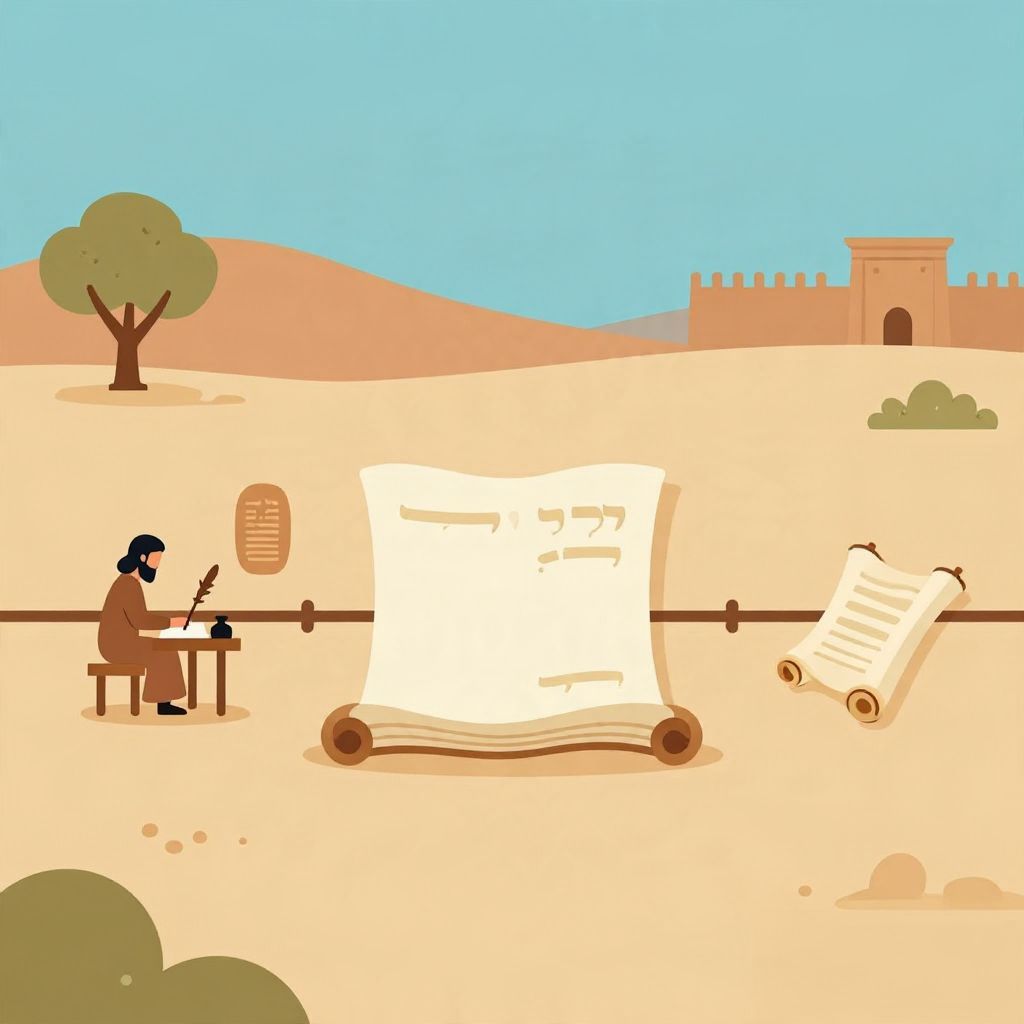
The Bible was not written all at once. Its books were composed over many centuries, beginning in the ancient Near East and ending in the early Christian era. The oldest material may date back more than 2,500 years, while the latest New Testament writings were likely completed around the end of the first century CE.
So, if you ask how long ago the Bible was written, the answer depends on which part you mean. The Bible is a library of texts, not a single book, and its age ranges from roughly 2,700 years old for some Hebrew Bible writings to about 1,900 years old for the newest Christian writings.
How long ago was the Bible written?
The Bible was written over a long period, roughly from the 10th century BCE to the late 1st century CE. That means its earliest layers are about 2,900 to 3,000 years old, while its latest books are about 1,900 years old. Scholars date many texts approximately because the books were edited and compiled over time.
The Bible is a collection, not one book
To understand the Bible’s age, it helps to know that “the Bible” refers to a collection of writings. Different religious traditions include different books, and those books were produced in different historical settings. Some began as oral traditions long before they were written down, then were revised by later scribes and editors.
Two major parts of the Bible
- Hebrew Bible / Old Testament: mostly rooted in ancient Israelite and Jewish history.
- New Testament: written by early Christians in the first century CE.
Because of that, there is no single date when “the Bible” was written. Instead, there is a timeline of composition, editing, and canonization, with different books entering the collection at different times.
When were the oldest biblical texts written?
The oldest biblical traditions likely began as oral stories and poems in the Iron Age, roughly between the 12th and 8th centuries BCE. The earliest written forms of some texts may date to the 10th through 7th centuries BCE, though many scholars believe the final versions we have today were shaped later, especially during and after the Babylonian exile in the 6th century BCE.
Approximate early timeline
- c. 1200–1000 BCE: oral traditions and early Israelite culture develop.
- c. 1000–700 BCE: some traditions are likely first written down.
- c. 600–500 BCE: major editing and compilation during exile and restoration.
- c. 300–100 BCE: many later Hebrew Bible books reach final forms.
Books such as Genesis, Exodus, and the Psalms preserve very old traditions, but their final literary shape is the result of long transmission. For this reason, historians and biblical scholars usually speak of “composition” and “redaction” rather than a single moment of writing.
How old is the Old Testament?
The Old Testament, or Hebrew Bible, is generally much older than the New Testament. Some of its traditions may be nearly 3,000 years old, while many of its books were finalized between the 6th and 2nd centuries BCE. In other words, the Old Testament is not one-era literature; it spans several centuries of ancient Jewish history.
Important historical context
The kingdoms of Israel and Judah, the Assyrian and Babylonian empires, the exile in Babylon, and the Persian period all shaped these texts. Events such as conquest, displacement, return, and religious reform influenced what was written, copied, and preserved. The Bible reflects those historical pressures as much as it reflects theology.
Some books are easier to date than others. For example, scholars often place parts of the prophetic books in the 8th to 6th centuries BCE because they refer to identifiable historical crises. Other books, such as Job or some Psalms, are harder to date precisely because they contain poetic or wisdom material that may have circulated for a long time before being written in their final form.
When was the New Testament written?
The New Testament was written in the 1st century CE, mostly between about 50 and 100 CE. That makes it roughly 1,900 to 2,000 years old. The earliest Christian writings are the letters of Paul, while the Gospels and other books were written later as the early Christian movement spread across the Roman world.
Common scholarly dating
- c. 50–60 CE: Paul’s letters, among the earliest Christian texts.
- c. 70 CE: Mark, often considered the earliest Gospel.
- c. 80–90 CE: Matthew and Luke, usually dated after Mark.
- c. 90–100 CE: John and several later writings, though exact dates remain debated.
The New Testament emerged from a living religious community rather than from a single author with a master plan. Its books were written in Greek, addressed to specific communities, and shaped by debates about Jesus, Jewish law, mission, persecution, and church organization.
Why scholars do not give one exact date
Dating biblical books is difficult because ancient writers rarely dated their work the way modern authors do. Manuscripts survive in copies, not originals, and many books were edited over generations. Scholars therefore use language style, historical references, manuscript evidence, and comparison with known events to estimate when texts were composed.
What makes dating uncertain?
- Some books were edited by multiple hands over time.
- Oral tradition may have existed long before writing.
- Later copyists preserved texts that had already changed.
- Some books are anonymous, making authorship uncertain.
This means a single biblical book may have a long history: an early oral stage, an initial written form, later additions, and a final edited version. That is why historians often distinguish between the origin of a tradition and the final form of the text.
How the Bible was preserved and compiled
The Bible did not become a fixed collection immediately after the books were written. Instead, communities preserved sacred writings, copied them by hand, and gradually recognized certain books as authoritative. This process of canon formation took centuries and differed among Jewish and Christian traditions.
From scrolls to canon
In the ancient world, texts were copied on scrolls by scribes. Accuracy mattered, but copying was still a human process, so small variations entered the manuscript tradition. Over time, communities selected certain texts for public reading and teaching. The result was not just a set of old writings, but a canon: an accepted body of scripture.
For Judaism, the Hebrew Bible reached its broad shape over time, with debates continuing about some books. For Christianity, the New Testament canon was recognized gradually, especially during the first few centuries CE. So the Bible’s age includes both the age of its writings and the age of its collection as scripture.
What does “how long ago” mean in modern years?
If you want a simple modern answer, the Bible’s oldest material is around 2,700 to 3,000 years old, and its newest material is around 1,900 years old. That range is the best historical summary because the Bible was written in stages across a very long period.
Put another way, the Bible is older than classical Greece in some of its traditions, contemporary with the Persian and Hellenistic worlds in much of its development, and roughly the same age as the early Roman Empire in its newest books. Its long timeline is one reason it remains so historically important.
Why the Bible’s timeline matters
Knowing when the Bible was written helps readers understand it as history, literature, and religion. The texts reflect the societies that produced them: ancient kingdoms, exile, empire, diaspora, and the rise of Christianity. They are not timeless documents dropped into history all at once, but writings shaped by changing communities and events.
This historical perspective does not settle theological questions, but it does clarify how the Bible came to be. It explains why some passages sound ancient and others feel later, why different books have different styles, and why the Bible contains both continuity and change.
Quick summary
The Bible was written over many centuries rather than at one time. Its earliest traditions may go back nearly 3,000 years, its main Old Testament books were shaped over the first millennium BCE, and its New Testament books were written in the 1st century CE. The Bible’s age is therefore best understood as a historical timeline, not a single date.
If you want to explore the Bible’s history further, you may also find related questions useful, such as when Galatians was written and what language the first Bible was written in.