
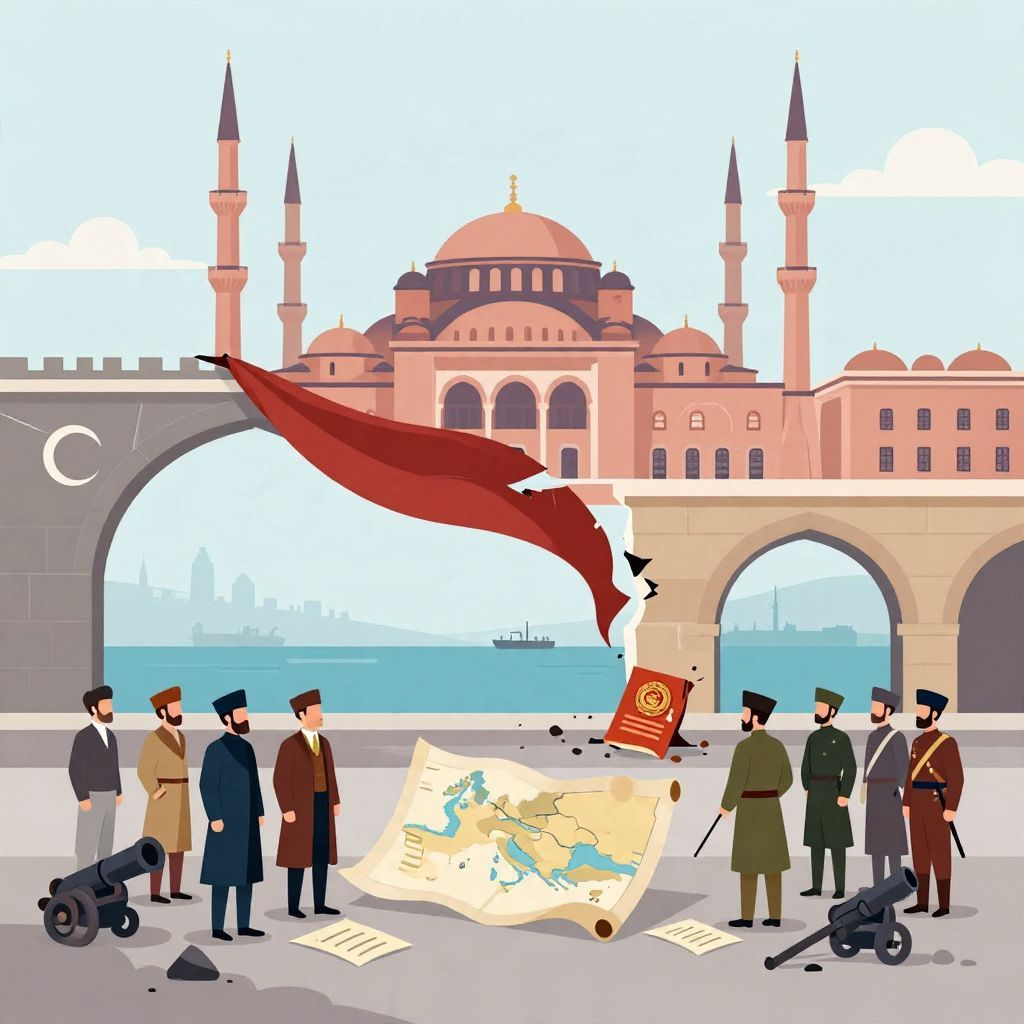
The Ottoman Empire did not collapse in a single moment. It weakened over centuries, lost territory through wars and revolts, and was finally dismantled after World War I. The empire’s formal end came in stages: the sultanate was abolished in 1922, and the Republic of Turkey was proclaimed in 1923.
So, how did the Ottoman Empire fall? The short answer is that military defeats, economic strain, nationalist movements, political instability, and the upheaval of World War I combined to break an empire that had once ruled much of Southeast Europe, the Middle East, and North Africa.
How Did the Ottoman Empire Fall?
The Ottoman Empire fell through a long process of decline, not a sudden collapse. By the 19th century it was losing wars, territory, and control over its diverse populations. World War I delivered the final blow, and after defeat the empire was partitioned by the Allied powers, while Turkish nationalists built a new state in Anatolia.
The Long Decline Before the Final Collapse
Historians often describe the Ottoman Empire as “declining” long before it disappeared, but that decline was uneven. The empire remained powerful in many regions well into the 18th century, and it still mattered greatly in global politics in the 19th century. What changed was its ability to compete with industrialized European powers and to hold together a vast, multiethnic realm.
Military setbacks and lost territory
For centuries, Ottoman strength rested on military expansion and control of strategic trade routes. As European states modernized their armies and navies, the Ottomans increasingly struggled to keep pace. Major defeats in wars against Russia, Austria, and later the Balkan states reduced Ottoman authority in Europe and the Caucasus. By the late 1800s, the empire had already lost much of its European holdings.
Economic pressure and foreign dependence
The Ottoman economy came under severe strain in the 19th century. Industrial Europe produced cheaper manufactured goods, undercutting local industries and increasing dependence on foreign imports. The empire also borrowed heavily from European lenders, especially after costly wars and modernization efforts. Debt and foreign financial control weakened Ottoman sovereignty and made reform more difficult.
Nationalism and separatist movements
One of the most important forces behind the empire’s fall was nationalism. Peoples within the empire—Greeks, Serbs, Bulgarians, Armenians, Arabs, and others—began demanding autonomy or independence, often inspired by ideas spreading from Europe. Some movements succeeded through revolt and foreign support; others were suppressed, sometimes violently. As these nationalist pressures grew, the Ottoman state found it harder to govern a diverse population through older imperial methods.
Why World War I Was the Turning Point
World War I transformed a struggling empire into a defeated one. The Ottoman leadership entered the war on the side of Germany and Austria-Hungary in 1914, hoping to regain strength and protect the empire from further losses. Instead, the war exhausted Ottoman resources, exposed military weaknesses, and opened the door to occupation and partition after defeat in 1918.
Why the Ottomans joined the war
Ottoman leaders believed alliance with Germany might help preserve the empire against Russia and the Entente powers. They also hoped to reverse territorial losses and strengthen central authority. But the war widened internal tensions and brought disaster on multiple fronts, including the Caucasus, Mesopotamia, Palestine, and the Dardanelles.
Major wartime crises
The war years were marked by severe hardship. The empire faced military defeats, famine in some regions, population displacement, and administrative breakdown. One of the darkest episodes was the mass violence against Armenians in 1915, which many historians and governments recognize as genocide. This tragedy was part of the wider wartime collapse of order and remains central to understanding the empire’s final years.
Defeat and occupation
When the Ottoman Empire signed the Armistice of Mudros in October 1918, the war was effectively over for the Ottomans. Allied forces occupied strategic areas, and the empire was left politically vulnerable. The postwar settlement was not just a military defeat; it was a struggle over who would control the lands the empire had ruled for centuries.
What Happened After the Ottoman Defeat?
After World War I, the empire was not simply “ended” in one treaty. Its lands were divided through occupation, diplomacy, and war. The surviving Ottoman government in Istanbul was increasingly powerless, while a nationalist movement led by Mustafa Kemal, later known as Atatürk, organized resistance in Anatolia.
The Treaty of Sèvres and partition plans
The Treaty of Sèvres in 1920 proposed a harsh settlement that would have broken up most of the Ottoman Empire. It envisioned large territorial losses and foreign influence over remaining areas. Although Sèvres was never fully implemented, it symbolized the near-total dismantling of Ottoman power and the ambitions of the victorious Allied states.
The Turkish War of Independence
Turkish nationalists rejected the postwar settlement and fought to defend Anatolia and parts of Thrace. This conflict, usually dated from 1919 to 1922, reshaped the political future of the region. The nationalist movement defeated rival forces and established control over the core Turkish heartland.
Abolition of the sultanate and the birth of Turkey
In 1922, the Ottoman sultanate was abolished, ending the dynasty’s political rule. The last sultan, Mehmed VI, left Istanbul. In 1923, the Republic of Turkey was proclaimed, with Ankara as its capital. The Treaty of Lausanne later recognized the new state and replaced the failed postwar settlement with a more stable international agreement.
Key Reasons the Ottoman Empire Fell
The empire’s fall had multiple causes, and no single explanation is enough on its own. The most important factors worked together over time:
- Military decline against better-equipped European powers.
- Economic weakness, including debt and dependence on foreign capital.
- Nationalist revolts and demands for self-rule among subject peoples.
- Administrative strain in governing a huge, diverse empire.
- World War I defeat, which accelerated collapse and occupation.
- Postwar nationalist resistance that replaced the empire with a new nation-state.
Was the Ottoman Empire Already “Sick” Before World War I?
Scholars sometimes use the phrase “the sick man of Europe,” a 19th-century expression used by diplomats to describe the empire’s weakness. The phrase is useful as shorthand, but it can oversimplify history. The Ottoman state was certainly under pressure, yet it also adapted through reforms, military modernization, and administrative change. Its fall came not because it was static, but because reform was too slow, too contested, and too vulnerable to outside intervention and war.
Reform efforts and their limits
Ottoman rulers and officials tried to strengthen the state through the Tanzimat reforms in the 19th century, which aimed to modernize law, taxation, the army, and administration. These reforms achieved some successes, but they also created tensions. Centralization could provoke resistance, while modernization often relied on borrowing and foreign expertise. Reform helped the empire survive longer, but it did not solve the deeper problem of competing national loyalties and external pressure.
Why the Fall of the Ottoman Empire Matters
The fall of the Ottoman Empire reshaped the modern Middle East, Southeast Europe, and the eastern Mediterranean. New borders, new states, and new political conflicts emerged from the ruins of empire. The collapse also marked a broader historical shift: the decline of old multiethnic empires and the rise of nation-states in the 20th century.
Lasting consequences
Many modern issues in Turkey, the Balkans, and the Arab world are tied to the Ottoman collapse and the settlements that followed it. Border disputes, minority questions, and competing national narratives often trace back to this era. The end of the empire was not just the disappearance of one dynasty; it was the beginning of a new political order whose effects are still felt today.
In the end, the Ottoman Empire fell because it could not survive the combined pressure of military defeat, economic weakness, nationalist revolt, and World War I. Its final years show how empires can endure for a long time, then unravel quickly when long-term problems meet a decisive crisis. For related reading, see when the Holy Roman Empire fell and what happened to Babylon.