
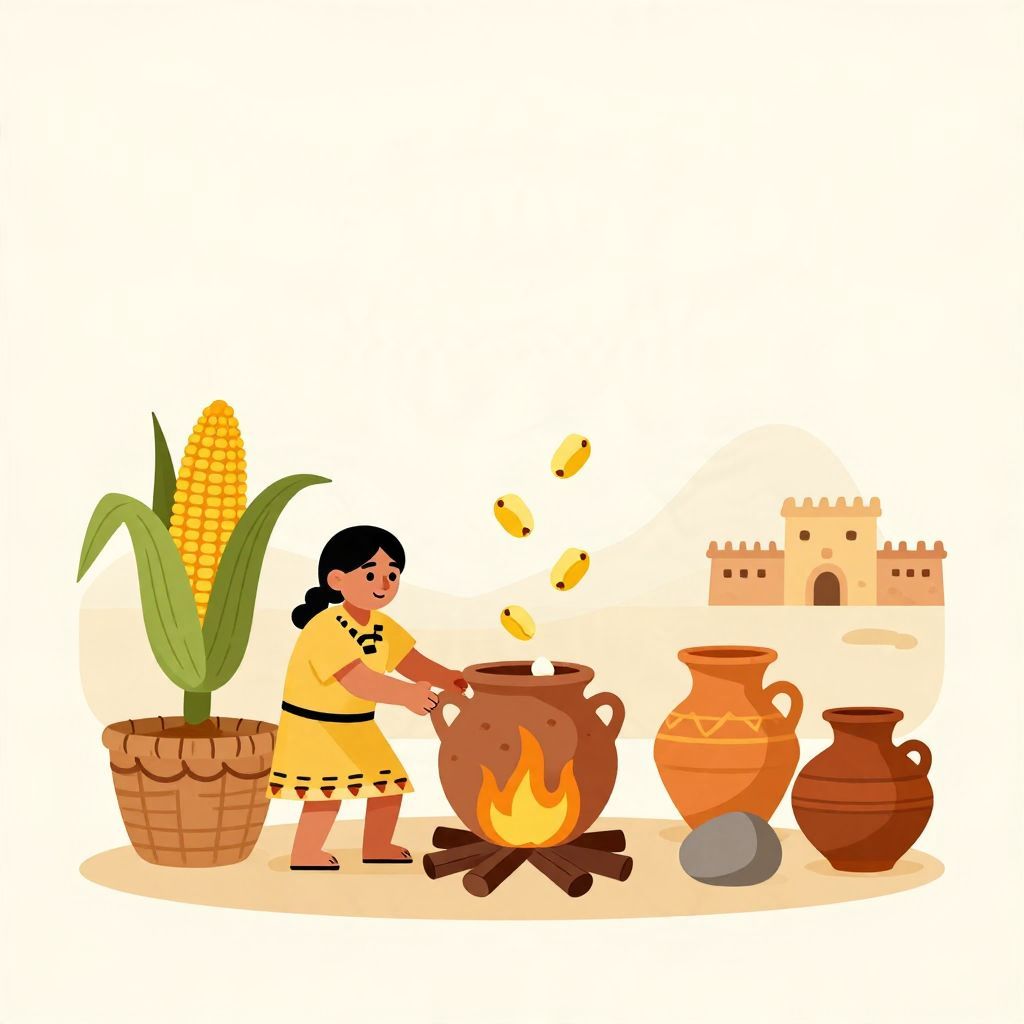
How was popcorn discovered? The short answer is that no single person “invented” it. Popcorn emerged when Indigenous peoples in the Americas learned that certain corn kernels burst open when heated. Archaeology shows that this knowledge is very old, and it became part of food, ceremony, and daily life long before Europeans arrived.
Its story matters because popcorn is not just a snack. It is evidence of early agricultural knowledge, Indigenous innovation, and the long history of maize in the Americas. What we call a movie snack today began as a food with deep cultural roots.
How was popcorn discovered?
Popcorn was discovered through experimentation with maize: people noticed that some dried kernels would pop when exposed to heat. Archaeological evidence suggests this happened in the Americas thousands of years ago, likely among Indigenous communities in what is now Mexico and other parts of the Americas. The “discovery” was gradual, practical, and collective rather than the work of one inventor.
The ancient origins of popcorn
Popcorn begins with maize, or corn, a crop domesticated in Mesoamerica from a wild grass called teosinte. Over many generations, Indigenous farmers selected plants with useful traits, creating the many forms of corn known today. Popcorn is one of those forms, distinguished by a hard outer shell and a starchy interior that expands dramatically when heated.
Because popcorn depends on this special kernel structure, it could only appear after long agricultural development. In other words, popcorn was not a random accident of nature; it was the result of people cultivating and understanding maize over time.
What makes a kernel pop?
Inside each popcorn kernel is a small amount of moisture trapped within starch. When heated, the moisture turns to steam and pressure builds until the hull bursts. The starch then expands and cools into the white shape we recognize as popcorn. Ancient cooks did not need modern science to understand the result, but repeated use would have made the pattern obvious.
Archaeological evidence for early popcorn
Archaeologists have found popcorn remains in the Americas that are thousands of years old. Some of the best-known evidence comes from sites in Peru and Mexico, where preserved kernels and cobs show that popcorn was being used long before the colonial era. Exact dates can vary by site and method, but the evidence places popcorn firmly in pre-Columbian history.
One important point is that archaeology does not show a single “first pop.” Instead, it shows a long tradition of maize use in which popping kernels became part of a broader food culture. That makes popcorn a product of Indigenous agricultural knowledge, not a modern novelty.
Who discovered popcorn?
There is no named historical figure who can be credited with discovering popcorn. The most accurate answer is that Indigenous peoples of the Americas discovered it collectively, over generations. Different communities likely learned about popping kernels independently, especially as maize spread across regions and took on many forms and uses.
This matters because popular history often looks for one inventor, but many important foods emerged through shared knowledge. Popcorn is a good example of a discovery that belongs to a culture, not a single person.
Why no single inventor is known
- Popcorn arose before written records in many regions.
- Maize cultivation spread across diverse Indigenous societies.
- Food knowledge was transmitted orally and through practice.
- Archaeological evidence can show use, but not always the first moment of discovery.
How Indigenous peoples used popcorn
Popcorn was not merely a snack food. Indigenous communities used it in multiple ways: as food, decoration, and in ceremonial settings. In some cultures, popped kernels were strung into garlands or used in ritual contexts. In others, popcorn was eaten plain or flavored with herbs, spices, or fats available locally.
Because maize was central to life in many Indigenous societies, popcorn fit into a larger world of farming, cooking, and ceremony. It was one form among many, but its portability and long shelf life made it especially useful.
Food, ceremony, and daily life
Popcorn’s value came from both its practical and symbolic qualities. It was easy to store, quick to prepare, and visually striking. Those features helped it move between everyday eating and special uses. Like many traditional foods, it carried meaning beyond nutrition alone.
How popcorn spread across the Americas
As maize spread through trade, migration, and cultural exchange, popcorn spread with it. Different Indigenous groups adapted corn to local environments and preferences, producing a wide range of varieties. Popcorn was one of the forms that traveled well because its kernels remained stable until heated.
By the time Europeans arrived in the Americas, popcorn was already well established in several regions. Spanish chroniclers and later observers described Indigenous peoples using popped maize, which confirms that popcorn was not a post-contact invention.
From local food to wider recognition
The spread of popcorn reflects the broader history of maize itself. Corn became one of the most important crops in the Americas because it could be adapted to many climates and uses. Popcorn’s history is therefore tied to the agricultural creativity of Indigenous farmers, who developed not just one crop but a whole system of food knowledge.
How popcorn entered global history
After European contact, maize traveled around the world. Popcorn did not immediately become a global staple, but it gradually entered new food cultures. In Europe and elsewhere, corn was often treated first as a curiosity or animal feed, then as a useful crop. Popcorn’s wider popularity came much later, especially in North America.
By the 19th century, popcorn was appearing more visibly in the United States, where street vendors, fairs, and home cooks embraced it. Its rise was helped by improvements in cookware, the growth of urban leisure, and later the invention of commercial popcorn machines.
The 19th century and beyond
- Early 1800s: popcorn becomes more common in North American households and public markets.
- Late 1800s: street vending and fairground sales help popularize it.
- 20th century: movie theaters and packaged snacks make popcorn a mass-market food.
None of this changed the fact that popcorn’s origin was much older. Modern popularity can obscure ancient roots, but the food itself was already centuries, perhaps millennia, old.
Why popcorn mattered historically
Popcorn matters because it reveals how much knowledge Indigenous societies developed about plants, farming, and food preparation. It also shows how everyday foods can carry deep historical significance. A simple snack can preserve evidence of migration, agriculture, trade, and cultural continuity.
Historians and archaeologists often use foods like popcorn to understand larger patterns. If a crop survives across centuries and regions, it suggests not just taste, but adaptation and social value. Popcorn is therefore part of the history of maize, and maize is one of the great agricultural achievements of the Americas.
What popcorn tells us about history
Popcorn reminds us that discovery is often collective. It also shows that innovation in history does not always look like a dramatic invention. Sometimes it is the slow recognition that a plant can do something remarkable when prepared in a certain way.
Popcorn in modern memory
Today, popcorn is strongly associated with entertainment, especially movies. That modern identity can make it seem like a recent invention or a purely commercial product. In reality, the snack’s modern popularity sits on top of a very old Indigenous history.
Understanding that history changes how we see the food. Popcorn is not just a symbol of leisure; it is also a surviving link to ancient American agriculture and the ingenuity of the people who first made maize into many different foods.
So, how was popcorn discovered? It was discovered gradually by Indigenous peoples in the Americas who learned that certain maize kernels puffed up when heated. That ancient knowledge spread, endured, and eventually became a global snack, but its deepest history belongs to the agricultural cultures that first cultivated corn and understood its possibilities.