
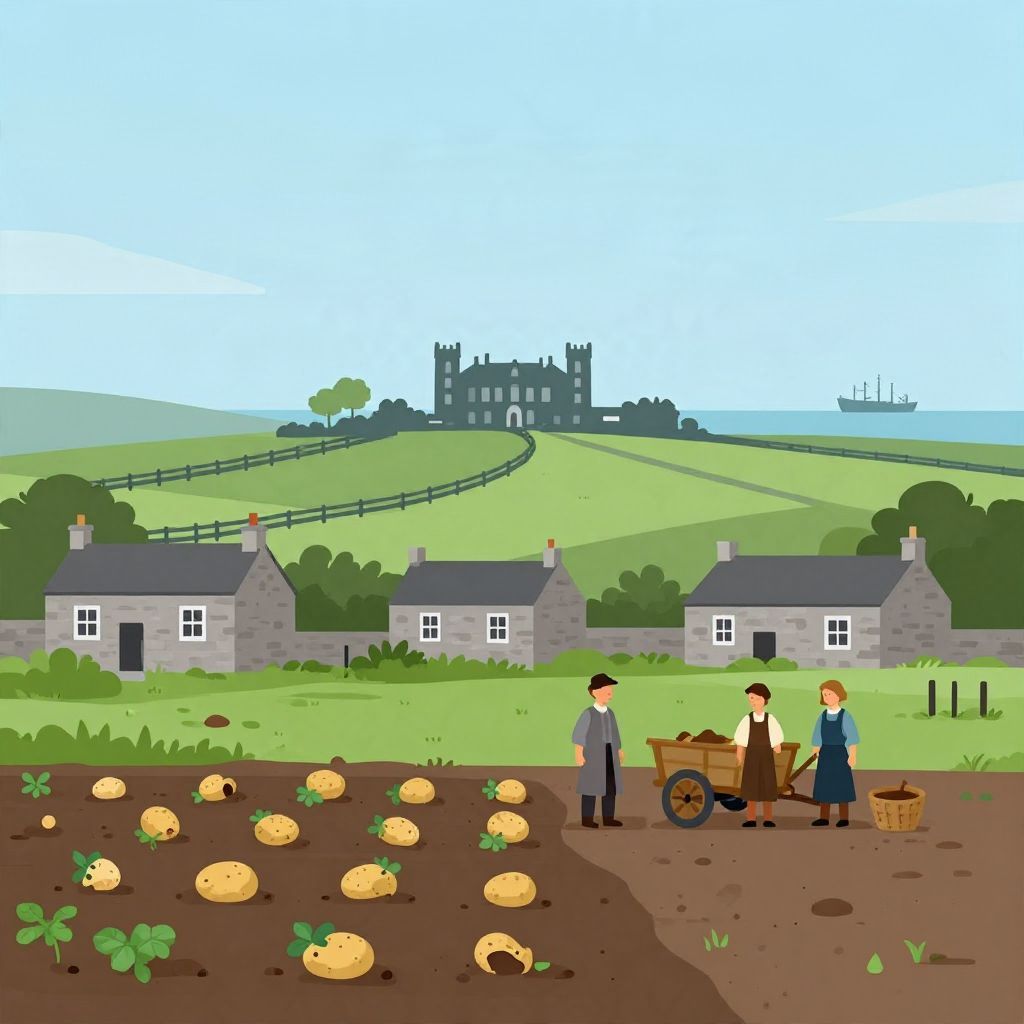
What caused the Irish Potato Famine? The short answer is that a devastating potato disease struck a society that had become dangerously dependent on one crop. But the disaster was not caused by blight alone. British land policies, poverty, tenant farming, and weak relief measures turned a crop failure into mass starvation, disease, and emigration.
To understand the famine, it is necessary to look at both the immediate trigger and the deeper historical conditions in Ireland during the 1840s. The catastrophe unfolded in a country already marked by inequality, population pressure, and an agricultural system that left millions vulnerable to any serious harvest failure.
What caused the Irish Potato Famine?
The Irish Potato Famine was caused by potato blight arriving in 1845, but the scale of the disaster came from Ireland’s social and economic structure. Poor tenant farmers depended heavily on potatoes for food and rent, while land ownership, export agriculture, and inadequate government relief meant that when the crop failed, many people had no real protection.
The immediate cause: potato blight
The immediate trigger was a plant disease known as late blight, caused by the pathogen Phytophthora infestans. It spread rapidly through potato crops in Ireland beginning in 1845, destroying tubers in the ground and making stored potatoes rot. Because potatoes were the staple food for millions, the loss was catastrophic.
Why the potato mattered so much
By the early 19th century, many rural Irish families survived on small plots of land and grew potatoes because they produced a lot of food on limited acreage. The potato was nutritious, filling, and suited to poor soil. For the poorest tenants and laborers, it was often the main or only reliable food source.
This dependence meant that a disease affecting potatoes was not just an agricultural problem. It was a direct threat to survival. When blight destroyed the crop, families lost both food and, in many cases, the means to pay rent or buy alternatives.
Why the blight became a famine
Blight alone does not explain the scale of suffering. Crop disease can cause hardship, but famine becomes mass death when people lack reserves, access to other foods, or effective relief. In Ireland, several long-term conditions made the population exceptionally vulnerable before blight ever appeared.
1. Land ownership and tenant insecurity
Most Irish rural families did not own the land they worked. Large estates were controlled by landlords, many of whom lived elsewhere and rented plots to tenants through layers of intermediaries. Smallholders often had insecure leases and were under constant pressure to pay rent. To survive on tiny plots, many families relied on the potato because it yielded more calories than grain on the same land.
This system encouraged subdivision of land among growing families. Over time, holdings became smaller and more precarious. A family might have enough land for potatoes, but not enough for diversified farming or a buffer against bad harvests.
2. Poverty and population pressure
On the eve of the famine, Ireland had a very large rural population, especially in the west and south. Many people lived at or near subsistence level. They had little savings and few alternatives if the potato crop failed. In such a context, even a single bad year could be disastrous; several bad years in a row were ruinous.
3. Export of food from Ireland
One of the most debated features of the famine is that Ireland continued to export food during the crisis, including grain, livestock, and dairy products. This did not mean there was no food in Ireland at all, but it did mean that food was moving through a market system that did not prioritize starving tenants. Those who had money could buy food; those who did not often could not.
Historians generally agree that the continued export of food did not by itself “cause” the famine, but it worsened it by showing how little access the poorest people had to supplies that remained in the country.
4. Weak and inconsistent relief
British government relief efforts existed, but they were often too limited, too slow, or based on assumptions that the market would correct the crisis. Officials debated how much aid should be given and whether government intervention would create dependency. Some relief works were established, but they were poorly managed and physically exhausting for starving laborers.
Relief policy also shifted over time, with responsibility moving between central government and local institutions. This inconsistency made it difficult to respond effectively as hunger deepened.
The historical context of Ireland before 1845
The famine did not emerge from nowhere. It developed within a long history of conquest, colonization, religious division, and economic inequality. These forces shaped land ownership and rural life in Ireland for generations.
British rule and the land system
By the 19th century, Ireland was part of the United Kingdom, but political power and landownership were heavily influenced by a Protestant Ascendancy that controlled much of the land and administration. Catholic emancipation had improved some political rights, but most rural Catholics remained poor tenants rather than landowners.
The structure of landholding mattered because it limited resilience. A system that rewarded rent collection over local security made it difficult for poor farmers to diversify crops, improve holdings, or build reserves.
Dependence on a single staple crop
The potato had become central to the diet of the rural poor because it was efficient and productive. That efficiency, however, created vulnerability. A population that relies heavily on one crop is exposed to any disease, weather shock, or market disruption affecting that crop.
In that sense, the famine was not simply a natural disaster. It was a disaster shaped by agricultural specialization under conditions of poverty.
The course of the famine
The blight first appeared in 1845 and returned with devastating force in 1846, then continued to affect crops in later years. The worst years were 1846 and 1847, when hunger, disease, eviction, and emigration surged. The crisis did not end quickly; its consequences lasted for years and reshaped Irish society permanently.
- 1845: The first major blight outbreak damages the potato crop.
- 1846: Blight returns more severely, causing widespread failure and deepening hunger.
- 1847: Known as “Black ’47,” this becomes one of the worst years for death and displacement.
- 1848–1852: The crisis continues, with recurring hardship, disease, and migration.
Disease and death
Many famine victims did not die directly from starvation alone. They died from diseases such as typhus, dysentery, and fever, which spread in overcrowded and weakened communities. Malnutrition made people more susceptible to infection, and poor sanitation worsened conditions in workhouses, cabins, and temporary shelters.
Evictions and migration
As tenants could not pay rent, many were evicted from their homes. Landlords in some areas cleared properties, sometimes to consolidate holdings or reduce their own financial losses. Others were unable or unwilling to support tenants through the crisis. Large numbers of people emigrated, especially to Britain, North America, and elsewhere, though many died during or after the journey.
Was the famine caused by British policy?
This is one of the most important historical debates. The famine was not created by a single government decision, but British policy clearly shaped how severe it became. Many historians argue that laissez-faire economic thinking, slow response, and an overreliance on market forces made the crisis worse. Others stress that officials faced real logistical and political limits, though those limits do not erase the consequences of policy failure.
It is more accurate to say that British rule did not invent the blight, but it helped create the conditions in which blight became mass catastrophe. The state’s response was inadequate for the scale of the emergency.
Misconceptions to avoid
- The famine was not caused only by bad weather.
- The famine was not caused only by potato blight.
- The famine was not simply a lack of food in Ireland.
- The famine was not an unavoidable natural disaster in the modern sense.
Instead, it was the result of a biological shock hitting an unequal society with little protection for the poor.
The lasting consequences of the Irish Potato Famine
The famine transformed Ireland. Its population fell dramatically through death and emigration, and many communities never recovered their pre-famine size. The event also changed land use, politics, memory, and migration patterns. It became a central part of Irish national identity and of the Irish diaspora abroad.
In the decades that followed, the famine influenced demands for land reform, self-government, and greater political autonomy. It also left a deep cultural memory of loss, displacement, and distrust of state institutions. For Irish communities around the world, the famine became a defining historical trauma.
Conclusion
The Irish Potato Famine was caused by potato blight, but it became a catastrophe because Irish society was built on fragile foundations: tenant farming, extreme poverty, dependence on one crop, and inadequate relief. Understanding the famine means seeing both the disease and the human systems that turned crop failure into mass suffering. For related background, you may also want to read about where Irish people are from and the cultural context behind Irish identity and heritage.