
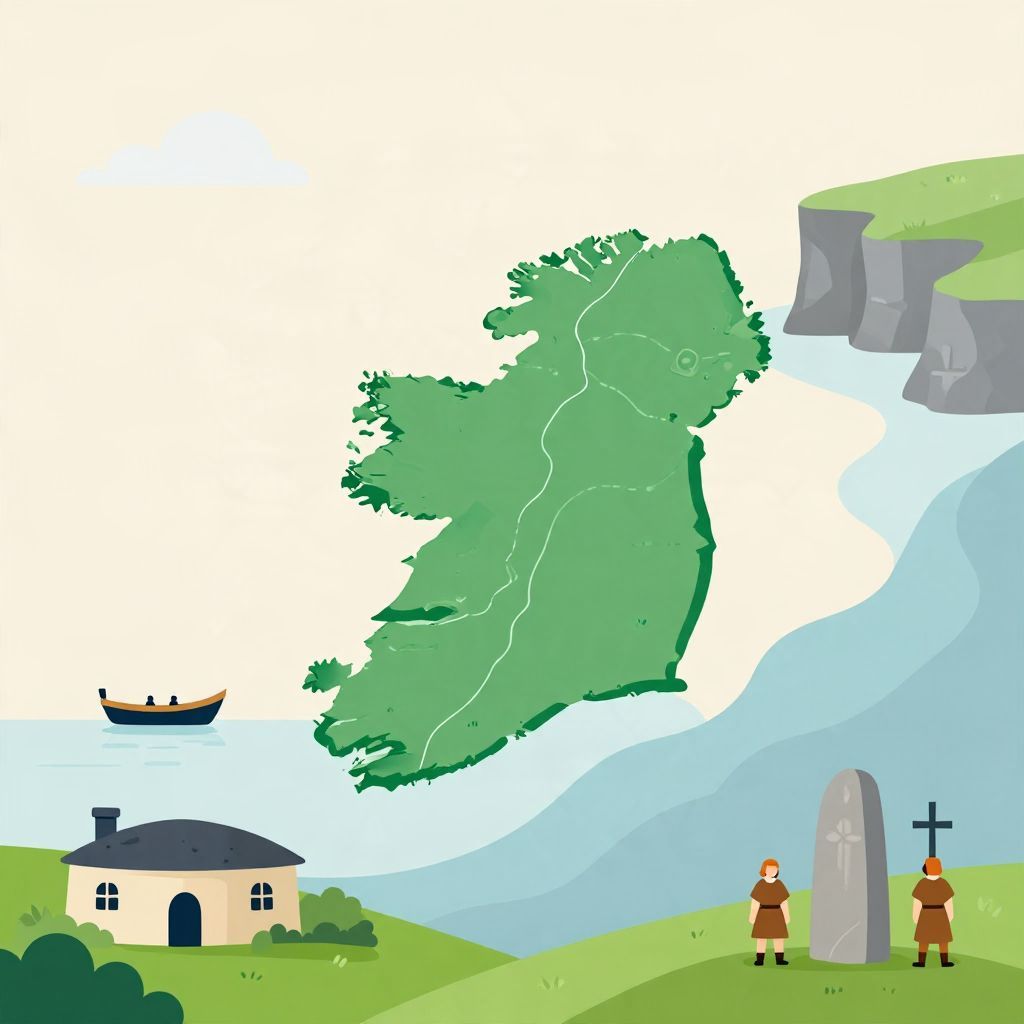
When people ask, “Where are Irish people from?” they may mean where the Irish nation began, where the ancestors of Irish people first came from, or why Irish identity looks the way it does today. The short answer is that Irish people are from Ireland, but the deeper history reaches back thousands of years, through prehistoric settlement, Celtic cultural change, Viking and Norman influence, and centuries of migration.
Irish identity is therefore both ancient and layered. It was shaped on the island of Ireland itself, but it also reflects contact with Britain, continental Europe, and later the wider world through emigration.
Where are Irish people from?
Irish people are from the island of Ireland, especially the historic Gaelic communities that developed there over many centuries. Their deeper ancestry comes from prehistoric settlers who arrived after the last Ice Age, later Bronze Age migrations, and cultural changes that helped form the Irish language and identity associated with the island.
The earliest people in Ireland
Human settlement in Ireland goes back to the Mesolithic period, roughly around 8000 BCE or earlier. These were hunter-gatherer communities who arrived after the retreat of the glaciers. They were not “Irish” in the modern national sense, but they were the earliest known inhabitants of the island.
Neolithic farmers and new ways of life
Around 4000 BCE, farming communities reached Ireland and transformed daily life. They cleared land, built permanent settlements, and created major ceremonial sites such as Newgrange. This was a major turning point: the island’s population, economy, and landscape all changed, and many of the cultural foundations of later Ireland began in this era.
Bronze Age movements and ancestry
By the Bronze Age, around 2500 BCE onward, new people and technologies arrived in Ireland, including metalworking and new burial practices. Modern genetic research suggests that later prehistoric migrations contributed significantly to the ancestry of people in Ireland, but history is not a simple story of one “original” people. The population changed over time through movement, mixing, and continuity.
How the Irish people became a distinct culture
The Irish people as a distinct historical and cultural community developed over many centuries on the island of Ireland. Language, kinship, law, religion, and local power structures mattered as much as ancestry. The key identity-forming process was not a single arrival, but the gradual emergence of Gaelic Ireland.
The arrival of Celtic culture
It is often said that the Irish are “Celtic,” but that word needs care. “Celtic” can mean language, art, or broad cultural connections, not one single ancient race. The Irish language belongs to the Goidelic branch of Celtic languages, and by the early centuries CE, Gaelic culture had become central in Ireland. Scholars debate the exact timing and mechanism of Celticization, but the result was the growth of a shared linguistic and cultural identity.
Gaelic Ireland
By the early medieval period, Ireland was organized around kin-based kingdoms ruled by local kings and overkings. Irish society was shaped by Gaelic law, poetry, learning, and Christianity after the fifth century. This was the world that most strongly formed the historical Irish identity recognized in later centuries.
Vikings, Normans, and outside influence
Irish history was never isolated. From the late eighth century, Viking raiders and settlers established towns such as Dublin, Waterford, and Limerick. They were outsiders at first, but many became integrated into Irish life. Their presence added trade, urban development, and new political competition.
The Norman invasion and its legacy
In 1169, Anglo-Norman forces entered Ireland, beginning a long period of English and later British involvement. The Norman invasion did not replace the Irish population, but it created a new ruling layer and altered landholding, politics, and culture. Over time, some Norman families became “more Irish than the Irish,” adopting local customs and language, while others remained tied to English power.
What does “Irish” mean historically?
The meaning of “Irish” has changed over time. In early medieval Ireland, identity was often local, tied to kin groups, kingdoms, and language. Later, especially under English rule, “Irish” became more clearly a political and national identity. Today it can refer to citizenship, ancestry, culture, language, or a combination of all four.
Language and identity
The Irish language, or Gaeilge, is one of the strongest markers of historical Irish identity. Even though English became dominant in many parts of Ireland over time, the Irish language remained central to literature, folklore, and national revival movements. For many people, being Irish has never depended only on bloodline; it has also meant participation in a shared culture.
Religion and community
Christianity became part of Irish life in late antiquity and the early medieval period. Later, the Reformation and the long history of conflict between Protestant and Catholic communities affected how identity was understood, especially in the early modern and modern periods. Religion did not define all Irish people, but it deeply influenced politics, settlement, and communal belonging.
Irish migration and the diaspora
One reason people ask where Irish people are from is that millions of people with Irish ancestry now live outside Ireland. The Great Famine of the 1840s accelerated mass emigration, but Irish migration had begun long before that and continued afterward. Large Irish communities formed in Britain, the United States, Canada, Australia, and elsewhere.
Why the Irish diaspora matters
The diaspora changed the meaning of Irish identity. Many people abroad kept strong family, religious, and cultural ties to Ireland, even when they were several generations removed from the island. As a result, “Irish” can describe both people living in Ireland and people whose ancestors left Ireland long ago.
Modern Irish identity
Today, Irish identity is shaped by the Republic of Ireland, Northern Ireland, and global diaspora communities. Some people emphasize ancestry, others citizenship, and others cultural practice. This variety reflects Ireland’s long history of migration, conquest, adaptation, and survival.
So, where are Irish people from in the deepest historical sense?
In the deepest historical sense, Irish people are from the island of Ireland, but their roots come from many layers of settlement and change. The earliest inhabitants were prehistoric settlers after the Ice Age, later communities brought farming and new ancestry, and centuries of cultural development produced the Gaelic society that became recognizably Irish.
That is why there is no single moment when “the Irish” suddenly appeared. Irish identity grew over thousands of years, shaped by the land, by language, and by contact with many other peoples. If you want to explore how cultures change over time, you may also enjoy reading about cultural divergence and broader historical context at My Life is History.