
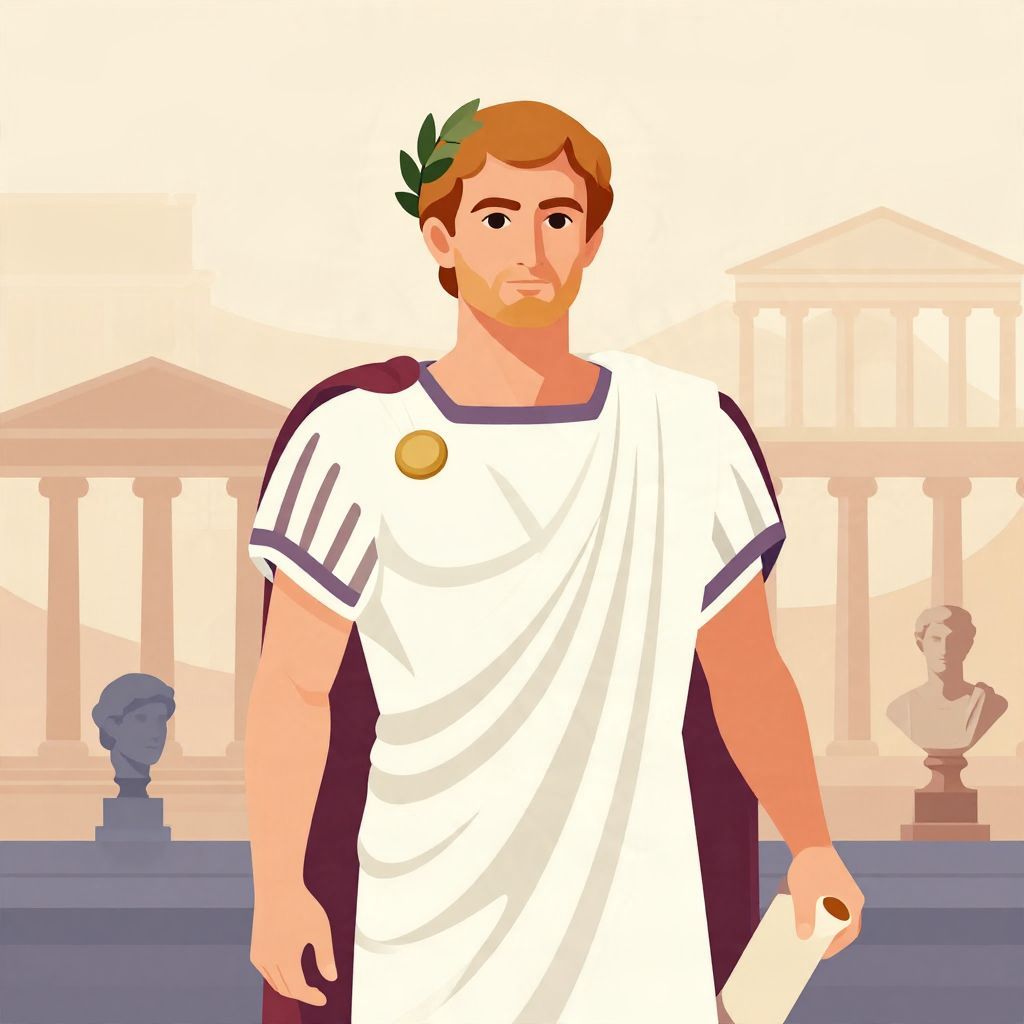
What did Julius Caesar look like? The short answer is that he was probably a lean, balding Roman aristocrat with a long face, a prominent forehead, and sharp, alert features. That image comes mostly from coins, busts, and ancient writers, though none of these sources gives us a perfect photographic likeness.
Because Caesar became one of the most famous men in Roman history, later generations tried to pin down his appearance with unusual intensity. The result is a portrait built from evidence, interpretation, and a little myth-making.
What Did Julius Caesar Look Like?
Julius Caesar likely had a narrow face, receding hairline, and thinning hair, with a somewhat gaunt or angular build rather than a bulky one. Ancient coins and later busts suggest a serious, mature man with a long neck and strong nose. He was not idealized as especially handsome, but as commanding and recognizable.
The Best Evidence for Caesar’s Appearance
We do not have a modern portrait of Caesar, but we do have several ancient clues. The most important are coins minted during or shortly after his lifetime, a few sculpted busts traditionally identified as Caesar, and written descriptions from ancient authors. Together, they give a broad but imperfect picture.
Coins minted in Caesar’s lifetime
One of the strongest pieces of evidence is the coinage issued in 44 BCE, the year of Caesar’s assassination. These coins show a realistic, aging face rather than an idealized hero. He appears lean, with a long neck, a lined face, and a thinning hairline. Because Roman coin portraits often aimed to show political authority and recognizable features, this is a valuable source.
Roman busts and sculptures
Several marble busts have been associated with Caesar, though not all identifications are certain. The most famous is the so-called Tusculum portrait, which many scholars consider one of the best surviving likenesses. It shows a bald or nearly bald man with a deeply lined face and a stern expression. Even so, scholars remain cautious: ancient portrait labels were not always preserved, and some busts may represent other Roman elites.
Ancient literary descriptions
Ancient writers were more interested in Caesar’s character and power than in detailed physical description. Still, they occasionally mention his appearance. He is often presented as elegant, carefully dressed, and physically active, but not as a giant or a warrior hero in the later legendary sense. The sources emphasize his presence, grooming, and self-presentation more than his exact facial structure.
Caesar’s Face: Baldness, Features, and Style
One detail appears repeatedly in both art and later tradition: Caesar was balding. His hair loss mattered enough that it became part of his public image. Roman elites cared deeply about appearance, and Caesar seems to have been conscious of this. He reportedly wore the laurel wreath in part to conceal his thinning hair, which would have been both a political symbol and a practical cover.
Baldness in Roman politics
In Roman society, physical appearance could signal dignity, maturity, and authority, but baldness could also invite ridicule. Caesar’s enemies sometimes mocked him, as political insult was common in the late Republic. Yet his baldness did not weaken his image; instead, it became part of the familiar, recognizable Caesar who dominated public life.
Facial structure and expression
The surviving portraits suggest a long, narrow face with pronounced features. He seems to have had a sharp nose, a strong jawline, and a serious, somewhat unsmiling expression. This was not unusual in Roman portraiture, which often favored realism and gravitas over youthful beauty. Caesar’s face, as represented in art, projects discipline and authority rather than softness.
Build and posture
Caesar does not appear to have been especially muscular or imposing in the modern sense. Ancient evidence suggests a man who was active and physically capable, but not one whose fame rested on brute strength. Roman political culture valued command, intelligence, and self-control more than athletic bulk. His public image was therefore more about poise and confidence than physical size.
How Reliable Are the Surviving Images?
Any answer to “What did Julius Caesar look like?” must include a warning: ancient portraits are not always exact. Roman portraiture could be realistic, but it was also shaped by politics, symbolism, and artistic convention. Some images of Caesar may have been copied later, altered, or influenced by idealization.
Why ancient portraits can mislead
Artists sometimes emphasized age, wisdom, or command rather than exact anatomy. A portrait could also be updated to reflect how a ruler wanted to be seen. In Caesar’s case, the late-Republican style tends toward realism, but that does not guarantee precision. Features such as wrinkles, baldness, and a stern expression may be accurate, exaggerated, or both.
Different busts, different Caesar?
Not every portrait labeled “Caesar” is equally trustworthy. Some busts may have been identified by later collectors or historians without secure archaeological context. Others may depict men who simply resemble Caesar. This is why scholars often compare several images rather than relying on one famous bust alone.
What Ancient Romans Thought Caesar Looked Like
To Romans, Caesar’s appearance was part of his public persona. He was not remembered primarily as a beautiful man, but as a brilliant, energetic leader whose physical presence matched his political ambition. His grooming, clothing, and bearing mattered because they reinforced his status.
Dress and presentation
Caesar was known for dressing with care. Roman elites used clothing as a language of rank, and Caesar understood that language well. His appearance would have been polished and deliberate, especially in public settings where every detail communicated power. This likely included a well-maintained toga and the controlled dignity expected of a leading statesman.
Why his look became politically important
By the final years of the Roman Republic, Caesar was not just a man but a symbol. His face appeared on coins, an extraordinary honor for a living Roman. That decision made his likeness part of state politics. People across the Roman world could recognize him visually, which helped turn his appearance into a political statement.
Did Caesar Look Like the Famous Hollywood Version?
Modern films and paintings often show Caesar as a handsome, powerful figure with a full head of hair and a heroic profile. That image is understandable, but it is probably not accurate. The historical Caesar was more likely older-looking, balder, and more severe than many popular depictions suggest.
Why later art made him more idealized
Artists in later centuries often transformed Caesar into a timeless hero, emperor, or tragic genius. They gave him fuller hair, smoother skin, and a more classically attractive face. This was less about evidence and more about storytelling. A legendary Caesar needed to look monumental, not merely human.
The gap between history and legend
The real Caesar was a political actor in a violent and unstable republic. His appearance would have reflected that world: practical, elite, and aging, not polished like a Renaissance prince. The gap between the historical man and the iconic image is one reason the question remains so fascinating.
What We Can Say with Confidence
Although no surviving image can give us absolute certainty, historians can say several things with reasonable confidence. Caesar was probably middle-aged in appearance by the end of his life, balding, lean-faced, and distinctive rather than conventionally handsome. His portraits emphasize realism, authority, and age.
- Hair: thinning or nearly bald by the end of his life
- Face: long, narrow, and angular
- Expression: serious, controlled, and unsmiling in most portraits
- Build: likely lean rather than heavily built
- Public image: carefully managed, politically powerful, and widely recognizable
Why Caesar’s Appearance Still Matters
Caesar’s look matters because it helps us understand how Romans used image and identity. In the late Republic, appearance was not superficial. It was part of politics, status, and memory. Caesar’s face on coinage and sculpture helped create one of history’s most enduring personal brands.
It also reminds us that famous historical figures were real people, not just symbols. Julius Caesar was not a marble ideal or a movie character. He was a living Roman aristocrat whose actual appearance—balding, aging, and sharply featured—helped shape how others saw him and how later generations remembered him.
If you want to go further, you can also explore what Julius Caesar did and compare that with more details on Julius Caesar’s appearance. In the end, the best historical answer is simple: Caesar looked like a powerful Roman statesman, not a modern hero, and that realism is part of what makes him so memorable.