
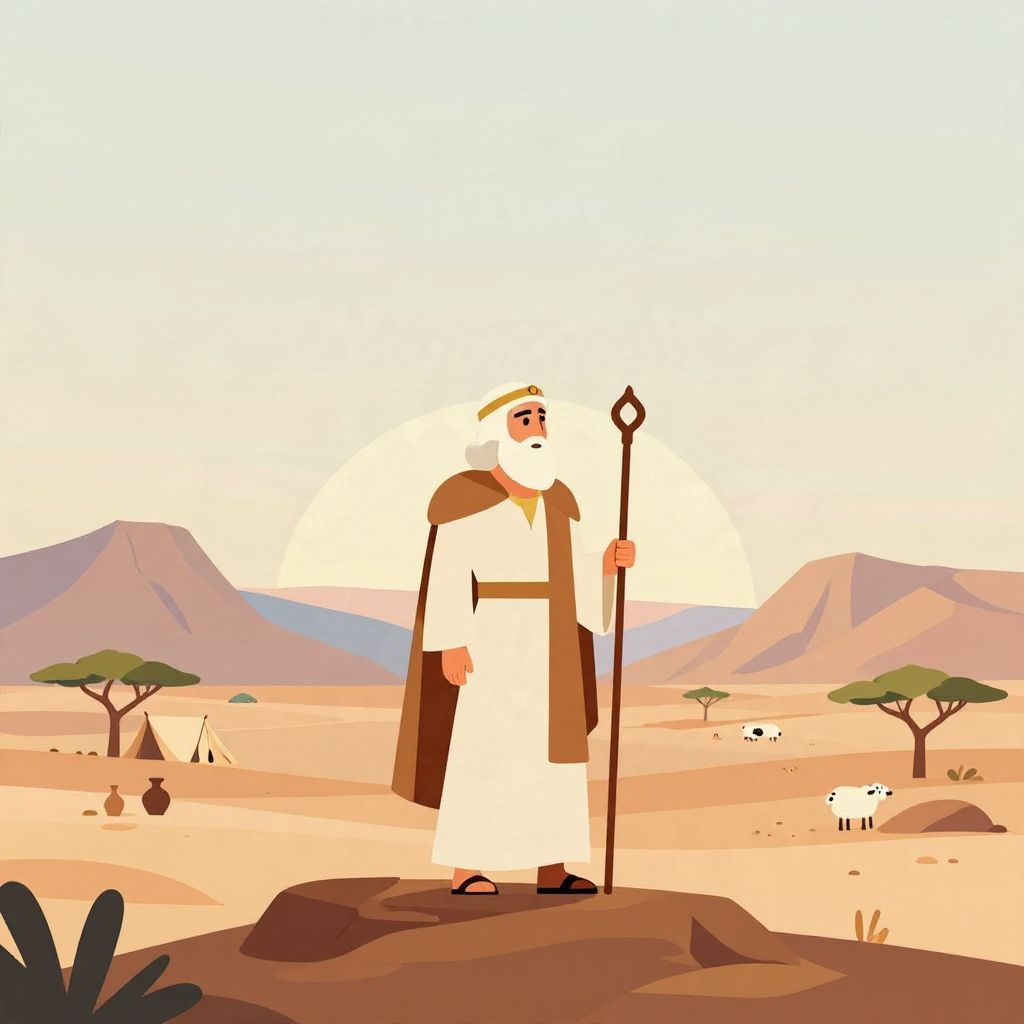
How long did Moses live? In the biblical tradition, Moses lived to be 120 years old. That is the standard answer most readers are looking for, and it comes from the Hebrew Bible, especially the book of Deuteronomy. Historically, however, Moses is a figure known through religious texts and later tradition rather than through independent contemporary records, so his exact lifespan cannot be verified in the way a modern biography might be.
What can be said with confidence is that Moses occupies a central place in Jewish, Christian, and Islamic history and memory. His age, death, and leadership are part of a larger sacred narrative about liberation, law, and covenant, not a securely documented chronology in the modern historical sense.
How long did Moses live?
Moses is said to have lived 120 years. According to Deuteronomy 34:7, he was 120 when he died, “his eye was not dim, nor his natural force abated.” In the biblical framework, that age marks the end of a long life divided into three 40-year periods: life in Egypt, life in Midian, and leadership of the Israelites in the wilderness.
The biblical age of 120
The number 120 is the clearest answer because it appears directly in the text. In ancient literature, numbers often carry symbolic meaning as well as literal meaning. For Moses, 120 suggests fullness of life, completeness, and divine purpose. Many readers therefore understand the figure both as a chronological statement and as a theological one.
Why the number matters
Moses’ lifespan is not just a biographical detail. In the biblical story, his long life frames the transition from slavery in Egypt to the giving of the law and the formation of a covenant people. His age underscores the idea that he lived long enough to complete a divinely assigned mission, even though he did not enter the Promised Land himself.
Where does the 120-year figure come from?
The age of Moses comes from the Hebrew Bible, especially Deuteronomy 34:7. That verse states that Moses was 120 years old when he died. Earlier biblical passages also divide his life into stages, which helped later readers interpret his story as a structured whole. The text is the primary source for the age, not an external historical record.
The three 40-year periods
Later Jewish and Christian interpretation often divides Moses’ life into three parts:
- 40 years in Egypt — traditionally associated with his upbringing in Pharaoh’s household.
- 40 years in Midian — the period after he fled Egypt and lived with Jethro’s family.
- 40 years leading Israel — the wilderness journey after the Exodus.
This pattern is important because the number 40 appears frequently in the Bible as a symbol of testing, transition, or preparation. Whether the division is meant literally or symbolically is debated, but it clearly shaped how the story was understood.
Symbolic numbers in ancient texts
Ancient Near Eastern and biblical writings often use numbers in ways that blend history, theology, and literary design. The figure 120 may therefore communicate more than a simple lifespan. In some traditions, it represents ideal completeness rather than a precise modern age calculation. That does not mean the number is meaningless; it means it belongs to an ancient style of storytelling.
Did Moses really live to be 120?
From a historical standpoint, Moses’ exact age cannot be confirmed. There is no independent archaeological or documentary evidence that allows historians to verify his birth date, death date, or even his lifetime with certainty. The 120-year figure is best understood as a traditional biblical claim rather than a fact established by modern historical methods.
Historical evidence and its limits
Historians studying Moses work with texts that were preserved and edited over time. The biblical account is foundational for religious history, but it is not the same as a contemporaneous royal inscription or administrative record. Because of that, scholars usually speak cautiously about Moses as a historical figure. Some consider him a figure rooted in real memory and tradition; others treat him primarily as a literary and religious ancestor.
Why scholars are cautious
The main reasons for caution are straightforward: the events associated with Moses are set in a very remote past, the sources were written and compiled long after the events they describe, and the narrative includes miraculous elements that lie outside what historical method can prove. As a result, historians can study the tradition, but they cannot confirm Moses’ lifespan the way they might confirm the reign of a later king.
Moses in the biblical timeline
Moses’ life is usually placed in the broad setting of Israel’s origins, though the exact historical date is disputed. Some scholars have proposed dates in the Late Bronze Age, while others argue that the Exodus tradition reflects a longer process of memory, migration, and identity formation rather than a single fixed event. The biblical timeline itself is more important than a precise modern calendar date.
From birth to leadership
In the biblical narrative, Moses is born under threat, placed in a basket on the Nile, and raised in Pharaoh’s household. After killing an Egyptian taskmaster, he flees to Midian, where he lives as a shepherd. Later, at the burning bush, he receives a divine call to confront Pharaoh and lead the Israelites out of Egypt. These episodes define his life more than any exact chronology.
The wilderness years
The most famous part of Moses’ life is the wilderness journey. He leads the people through hardship, complaint, rebellion, and covenant-making. The Torah presents him as lawgiver, prophet, and mediator. His death at 120 closes the narrative on the edge of the Promised Land, emphasizing that he guided the people to the threshold but did not complete the journey himself.
How Moses’ death is described
The Bible says Moses died in the land of Moab, opposite Jericho, after viewing the Promised Land from Mount Nebo. Deuteronomy presents his death as dignified and solitary, and it states that God buried him in an unknown place. This ending has shaped centuries of interpretation because it combines honor, mystery, and restraint.
Why the burial place is unknown
The text says no one knows Moses’ burial place to this day. That detail may have helped prevent the development of a shrine around his grave and may also reflect the special status of Moses as a prophet above ordinary memorialization. In religious tradition, the hidden burial reinforces his uniqueness and the sacred character of his mission.
What this means for his lifespan
The account of Moses’ death is tied directly to the claim that he lived 120 years. In the biblical narrative, the age is not presented as an isolated statistic. It marks the completion of a life of service, revelation, and leadership. The story’s emphasis is less on biological longevity than on fulfillment of purpose.
Moses’ age in Jewish, Christian, and Islamic tradition
Moses is honored in Judaism, Christianity, and Islam, though each tradition tells his story differently. The age of 120 is most directly associated with the biblical text and Jewish tradition, but Moses also appears as a major prophet in Christianity and Islam. His life is remembered as exemplary, whether the focus is law, prophecy, or submission to God.
In Judaism
In Jewish tradition, Moses is the greatest prophet and the giver of the Torah. His age of 120 is often cited as part of his idealized life story. Rabbinic interpretation frequently treats his death as a moment of profound dignity and spiritual completion. His life becomes a model of leadership, humility, and devotion.
In Christianity
Christian readers inherit the biblical account of Moses through the Old Testament. Moses is often seen as a precursor to later revelation, especially because he receives the law and points toward covenantal faithfulness. His 120-year life is usually accepted as part of Scripture’s narrative world, though Christian scholars also recognize the limits of historical verification.
In Islam
In Islam, Moses is known as Musa and is one of the most important prophets. The Qur’an emphasizes his mission, confrontation with Pharaoh, and role in guiding his people. The Qur’an does not focus on a detailed lifespan in the same way the Bible does, so the 120-year figure is primarily a biblical and later traditional detail rather than a central Qur’anic one.
What historians can and cannot say
For a question like “How long did Moses live?” the best historical answer has two parts. First, the traditional answer is 120 years. Second, historians cannot independently verify that number. This distinction matters because it separates the religious tradition from modern historical reconstruction without dismissing either one.
Established tradition versus historical proof
It is historically sound to say that the Hebrew Bible presents Moses as living 120 years and dying in Moab. It is not historically sound to claim that scholars can prove the exact age. The difference is important. One is a textual and religious fact; the other would require evidence that does not survive from such an early period.
Why the story endured
Moses’ lifespan has endured because it serves the larger meaning of his story. A long life, divided into purposeful stages, makes him the ideal mediator between slavery and freedom, chaos and law, human weakness and divine command. The age of 120 helps the narrative feel complete and authoritative, which is why it remains so widely remembered.
So, how long did Moses live?
Moses is traditionally said to have lived 120 years. That is the biblical answer and the one most readers seek. Historically, though, Moses belongs to the realm of ancient religious memory, where exact dates cannot be independently confirmed. His age is therefore best understood as part of a sacred narrative that shaped Jewish, Christian, and Islamic tradition.
If you want to explore the end of Moses’ story next, you may also find it helpful to read about how Moses died and how old Joshua was when Moses died.