
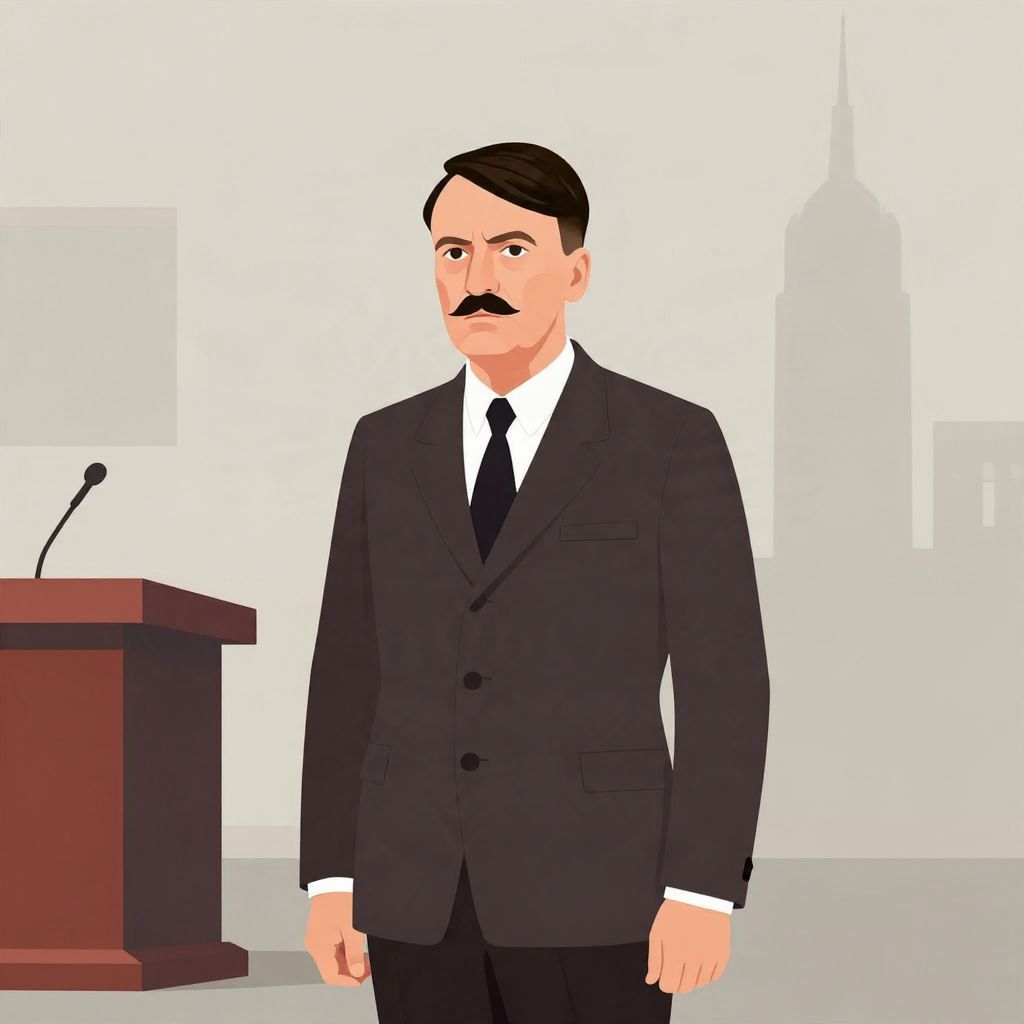
When people ask, “What did Hitler look like?” they are usually asking about more than a face. Adolf Hitler’s appearance became part of his public image, shaped by photographs, film, uniforms, and propaganda in Nazi Germany. His look was ordinary in some respects and highly staged in others, which helped make him instantly recognizable.
The historical record is clear enough to describe his physical appearance, but it is also important to separate the real man from the mythic image built around him. Hitler’s appearance changed over time, and the way he was presented to the public was carefully managed for political effect.
What did Hitler look like?
Adolf Hitler was a short-to-average-height man with a slim build, dark hair, a small square mustache, and sharp facial features. In photographs from the 1920s through the 1940s, he is usually seen in a side-parted hairstyle, military-style or civilian jackets, and later the Nazi uniform or tailored suits.
His facial features and build
Contemporary photographs and film show Hitler as pale-skinned, with brown eyes, a narrow face, and a noticeable nose. He was not physically imposing in the way later propaganda sometimes tried to suggest. Accounts from people who met him often describe him as more striking in manner and expression than in size or beauty.
He was commonly described as having a thin frame and a somewhat stiff posture. In public, he often held himself rigidly, which contributed to an image of intensity and control. His appearance could seem plain at first glance, but his face was made memorable by the small mustache and the way he used his eyes and expressions in speeches.
The mustache that became part of his image
Hitler’s square “toothbrush” mustache was one of the most distinctive parts of his appearance. It was not unique to him in the early 20th century; similar styles had been more common before the 1920s. By the time he became famous, however, the mustache was closely associated with him and later became one of the most recognizable political symbols in modern history.
That mustache mattered because it created a visual shorthand. Even when a photograph was blurred or cropped, the shape of his face and mustache could identify him immediately. After the Second World War, the style became so closely tied to him that it largely disappeared from everyday fashion.
How Hitler’s appearance changed over time
Hitler did not look exactly the same throughout his life. Like most people, he aged, but wartime stress, illness, and the pressures of leadership made the changes more visible. Early photographs show a younger man with a more open face; later images show a gaunter, more tired appearance.
From the 1920s to the rise to power
In the 1920s, Hitler was often photographed in modest clothing, including suits, coats, and the brown shirt of the Nazi Party. These images were meant to present him as a man of action and discipline rather than as a traditional aristocrat or general. His look was deliberately simple, which helped him appeal to different audiences.
During this period, his hair was dark and combed to one side, and his mustache was already fixed as part of his public identity. He was often shown in photographs speaking to crowds, standing with party members, or posing in controlled settings that emphasized seriousness rather than warmth.
In the 1930s and during the war
Once Hitler became chancellor in 1933 and later dictator of Nazi Germany, his appearance was increasingly tied to official state imagery. He was frequently shown in tailored jackets, military-style coats, or uniform. The look was meant to suggest authority, order, and national power.
By the war years, especially from the early 1940s onward, he appeared older and more worn. His face often looked more rigid, his posture more tense, and his hands sometimes trembled in later footage. These changes reflected age, stress, and deteriorating health, though historians are cautious about diagnosing him from images alone.
How reliable are descriptions of Hitler’s appearance?
Descriptions of Hitler’s appearance are fairly reliable because they come from photographs, film, and eyewitness accounts. Still, historians treat some claims with care. People who saw him in person were influenced by fear, admiration, disgust, or political loyalty, so their descriptions may reflect emotion as much as observation.
Photography and propaganda
Nazi propaganda was highly selective. Official photographs often aimed to make Hitler look determined, disciplined, and almost heroic. Camera angles, lighting, and posed settings were used to strengthen that impression. The regime also avoided images that might make him seem weak, awkward, or ordinary.
At the same time, informal or candid images sometimes show a less polished figure: a man with an unremarkable body, a tense face, and a carefully cultivated public persona. This contrast is important because it shows how much of Hitler’s image was manufactured.
Eyewitness accounts and their limits
People who met Hitler described his eyes as intense and his manner as controlled, though such descriptions are subjective. Some found him charismatic in person; others found him small, nervous, or unimpressive. These differences remind us that “what he looked like” included not only his physical features but also how he carried himself.
Historians therefore rely most heavily on visual evidence and cross-checked testimony rather than dramatic anecdotes. The safest conclusion is that Hitler was physically ordinary in many respects, but his appearance was made highly distinctive by his grooming, clothing, and political staging.
What made Hitler instantly recognizable?
Hitler was recognizable because of a combination of features rather than one single trait. His short mustache, dark side-parted hair, narrow face, and rigid posture created a memorable profile. Just as important, Nazi propaganda repeated the same visual cues until they became fixed in the public mind.
Key visual elements
- Mustache: the small square mustache became his most famous feature.
- Hair: dark hair combed to one side, usually neat and controlled.
- Face: narrow, angular features with a pale complexion in many photographs.
- Clothing: suits, military coats, and Nazi uniforms reinforced his image.
- Body language: stiff posture and dramatic gestures during speeches.
His gestures were especially important. In speeches, he often used sharp arm movements and intense facial expressions to project force. This performance helped transform an otherwise unremarkable physical appearance into a commanding public image.
Did Hitler look different in private than in public?
Yes, very likely. Public Hitler was a carefully managed political figure, while private Hitler was seen by a much smaller circle in more informal settings. In private photographs, he could appear more relaxed, less polished, and sometimes almost ordinary. The contrast reveals how much of his image was constructed for political theater.
The role of clothing and setting
Clothing mattered a great deal. Uniforms and formal jackets made him look official and authoritative, while casual settings could make him appear smaller and less imposing. Even his hairstyle and mustache were part of a fixed visual identity that helped maintain continuity across public appearances.
This was not accidental. Dictators often use appearance to communicate power, and Hitler understood that visual symbolism could reinforce political loyalty. His image was designed to be repeated in posters, newsreels, portraits, and photographs until it became inseparable from the regime itself.
Why does Hitler’s appearance still matter historically?
Hitler’s appearance matters because it shows how political power can be built through image as well as policy. His look was not just a personal detail; it became part of Nazi propaganda and mass politics. Studying it helps explain how modern leaders can use visual branding to shape public perception.
It also helps historians understand the difference between a real person and a historical icon. Hitler’s face is among the most recognizable in modern history, yet that recognition comes partly from repetition, propaganda, and later memory. The image is historical evidence, but it is also a constructed symbol.
Appearance, propaganda, and memory
After 1945, Hitler’s image took on a new meaning. It became a warning rather than a symbol of power. His mustache and facial features are now associated worldwide with genocide, dictatorship, and war. That legacy has changed how his appearance is seen, remembered, and represented.
In that sense, asking what Hitler looked like is also asking how history turns a human face into a political emblem. The answer is simple in physical terms, but complex in historical meaning.
In short, Hitler looked like a slim, dark-haired man with a small square mustache, a narrow face, and a tightly controlled public image. What made him historically significant was not his appearance alone, but how his appearance was used to project authority and power. For more on Hitler’s history, you may also want to read about why Hitler invaded the Soviet Union and, for a broader comparison of historical portraiture, what Joan of Arc looked like.