
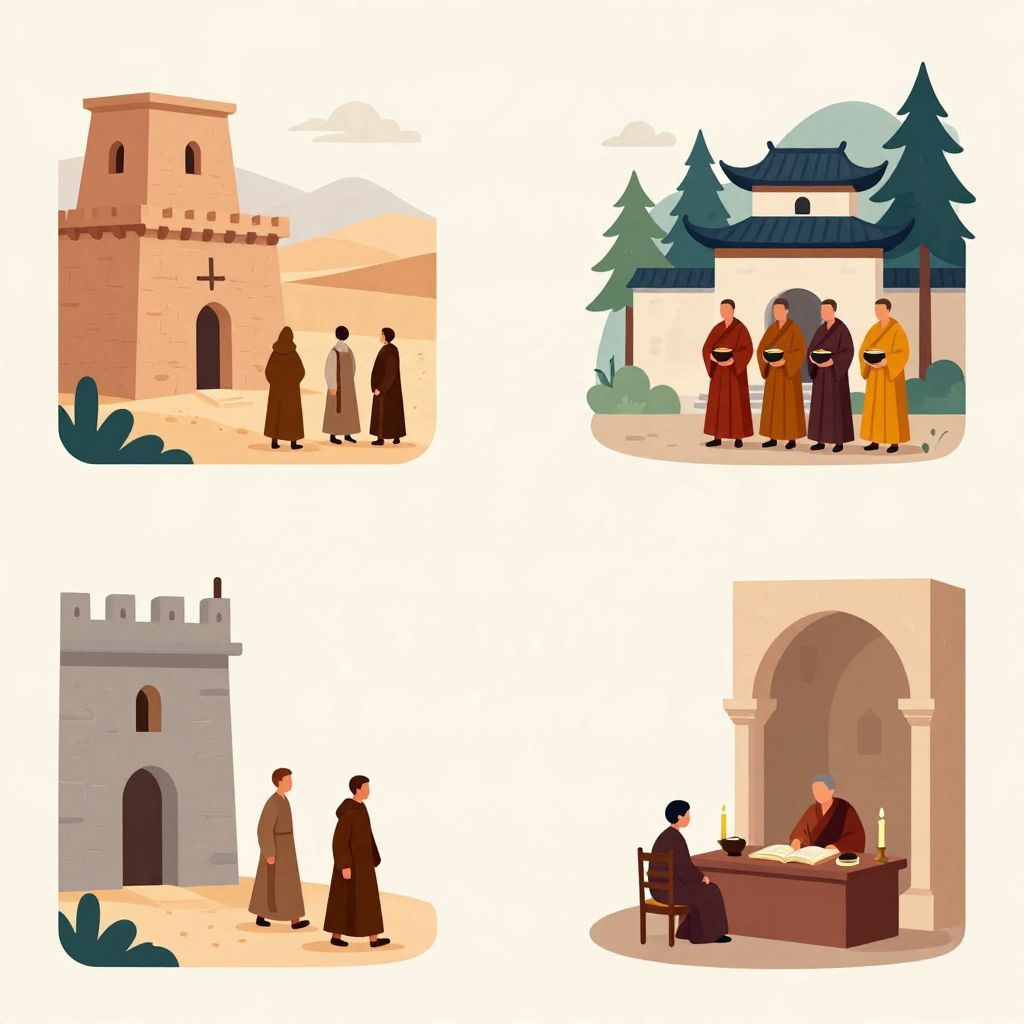
When people ask, “Where are monks from?” they are usually asking where monks first appeared in history and what traditions they belong to. The short answer is that monks are not from one single place. Monastic life developed independently in several religious traditions, especially in South Asia, the Mediterranean world, and East Asia.
Monks emerged as men and women who chose religious discipline, withdrawal, study, and service over ordinary household life. Their origins depend on which tradition you mean: Buddhist monks are tied to ancient India, Christian monasticism grew in the late Roman Empire, and similar ascetic communities also appeared in Hindu, Jain, and later Daoist and other settings.
Where Are Monks From?
Monks come from multiple historical and geographic origins, not one homeland. The earliest well-documented monastic communities arose in ancient India with Buddhism, Jainism, and ascetic Hindu traditions, while Christian monks first appeared in the Egyptian and Syrian deserts of the late Roman world. Monasticism is a recurring religious idea, not a single invention.
The earliest monks in history
The word “monk” is often used broadly today, but historically it refers to people who live under vows or disciplined rules, usually in a religious setting. The earliest monastic traditions developed in response to spiritual questions about renunciation, suffering, salvation, and the best way to live a holy life.
Ancient India and the rise of renunciation
In South Asia, the roots of monastic life go back to the first millennium BCE. Religious seekers in ancient India increasingly embraced renunciation, leaving family and property to pursue liberation from the cycle of rebirth. This environment produced early Buddhist and Jain communities, and later influenced Hindu ascetic traditions as well.
In Buddhism, the monastic community, or sangha, became central very early. Tradition places the Buddha’s lifetime in the 5th century BCE, though exact dates are debated by scholars. Buddhist monks and nuns lived by rules of conduct, relied on alms, and devoted themselves to meditation, teaching, and preserving the Buddha’s teachings.
Jainism also developed strong ascetic traditions in ancient India. Jain monks became famous for rigorous discipline, nonviolence, and detachment from material life. These communities were part of a wider religious culture in which spiritual authority was often linked to self-denial rather than wealth or political power.
Christian monasticism in the Roman world
Christian monks appeared later, especially in Egypt, Palestine, Syria, and Asia Minor, during the late Roman Empire. By the third and fourth centuries CE, some Christians sought a life of prayer and austerity away from cities and public life. The desert became a symbol of spiritual struggle and purification.
Early Christian monasticism is strongly associated with figures such as Anthony of Egypt and Pachomius. Anthony is often remembered as a pioneer of the solitary hermit life, while Pachomius helped organize communal monasticism. These developments were not sudden inventions; they grew from earlier Christian ideals of devotion, martyrdom, and self-denial.
From these beginnings, Christian monasticism spread across Europe and the eastern Mediterranean. Monasteries became centers of prayer, learning, manuscript copying, agriculture, and hospitality. In the medieval West, orders such as the Benedictines shaped much of religious and intellectual life. In the East, Orthodox monasticism developed its own traditions on Mount Athos and elsewhere.
Why did monasticism appear in different places?
Monasticism emerged in several regions because different societies asked similar religious questions. People wanted to understand suffering, control desire, seek enlightenment or salvation, and create communities devoted to spiritual goals. Monks were one answer to those questions, but not the only one. Their forms varied according to local beliefs and institutions.
Common reasons people became monks
- Renunciation: leaving ordinary family and economic life behind.
- Spiritual discipline: using fasting, prayer, meditation, or study.
- Religious authority: seeking holiness through a stricter way of life.
- Community: building disciplined groups with shared rules.
- Preservation of teaching: copying, memorizing, and transmitting sacred texts.
These motives could overlap. A monk might be seeking personal salvation, but the monastery could also serve society by educating novices, caring for the poor, or maintaining sacred learning. Over time, monasteries became institutions with economic and political influence as well as spiritual purpose.
Are monks only Buddhist?
No. Buddhist monks are the best-known example in many parts of the world, but monks also exist in Christianity, Hinduism, Jainism, and other traditions. The exact meaning of “monk” changes from one religion to another, so it is better to think of monasticism as a family of related religious lifestyles rather than a single institution.
Buddhist monks
Buddhist monks are traditionally associated with shaved heads, robes, celibacy, meditation, and dependence on alms. Their communities spread from India into Sri Lanka, Southeast Asia, Central Asia, China, Korea, Japan, and Tibet. Different schools developed different rules, but the ideal of disciplined withdrawal remained central.
Because Buddhism traveled widely, Buddhist monasticism adapted to local cultures. In some places monks became teachers and ritual specialists; in others they were scholars, translators, or guardians of sacred sites. Their history is inseparable from the spread of Buddhism across Asia.
Christian monks
Christian monks are usually linked to monasteries, abbeys, and hermitages. They live under vows that may include poverty, chastity, and obedience, depending on the order or tradition. Some Christian monks live in enclosed communities, while others combine prayer with labor, teaching, or hospitality.
Christian monasticism became especially important in the Middle Ages, when monasteries preserved texts, trained clergy, and shaped local economies. Monks were not isolated from history; they were often deeply involved in it.
Hindu and Jain ascetics
In Hindu traditions, the term “monk” is sometimes used loosely for renunciants, ascetics, or sannyasis, though the category is not identical to Buddhist monasticism. Hindu renunciation developed over a long period and is tied to ideas of liberation, detachment, and spiritual realization.
Jain monks are among the most rigorous ascetics in world history. Their discipline traditionally emphasizes nonviolence, truthfulness, non-attachment, and careful conduct. Like Buddhist monasticism, Jain monastic life emerged in ancient India and reflects the region’s deep ascetic culture.
How monks spread across the world
Monastic traditions spread through trade, pilgrimage, conquest, translation, and missionary activity. Once established, monasteries often became durable institutions that could survive political change. They also adapted to new languages and social systems, which helped monastic life take root far from its original birthplace.
- Ancient India: Buddhist, Jain, and ascetic traditions formed early monastic models.
- Late Roman Empire: Christian monasticism emerged in Egypt and the eastern Mediterranean.
- Medieval Eurasia: monasteries spread through Asia, Europe, and the Islamic borderlands in varied forms.
- Modern era: monastic communities continued, declined in some regions, and revived in others.
This spread did not mean all monks were the same. A Buddhist monk in Sri Lanka, a Benedictine monk in France, and a Jain monk in India lived under very different rules and served different spiritual purposes. The shared feature was disciplined religious life set apart from ordinary household existence.
Popular images versus historical reality
Modern culture often imagines monks as quiet, cloistered figures in robes, far removed from the world. That image is partly true, but incomplete. Historically, monks could be scholars, farmers, healers, teachers, scribes, missionaries, advisers to rulers, or leaders of large institutions. Some lived in solitude, while others lived in organized communities.
What the stereotype misses
- Monks were not always isolated; many lived in busy communal monasteries.
- They were not confined to Europe; monasticism is global.
- They were not always passive; monks often influenced politics, education, and art.
- They did not all follow the same rules; monastic vows differ by tradition.
It is also important not to confuse historical monks with modern fictional portrayals. Popular movies and novels often simplify monastic life into silence, mystery, or martial arts. Real monastic history is broader, more practical, and much older.
So, where are monks from in one sentence?
Monks are from several places, but the earliest major monastic traditions developed in ancient India and the late Roman eastern Mediterranean. If you mean Buddhist monks, their roots are in India; if you mean Christian monks, their origins are in Egypt and the surrounding Roman world. Other traditions developed monastic life in their own ways.
That is why the best historical answer is plural rather than singular. Monks are not from one country or one time period, but from a long history of religious renunciation that appeared independently in different civilizations. If you want to explore the broader background of monastic life, you may also find what monks are and where Hinduism began helpful next reads.