
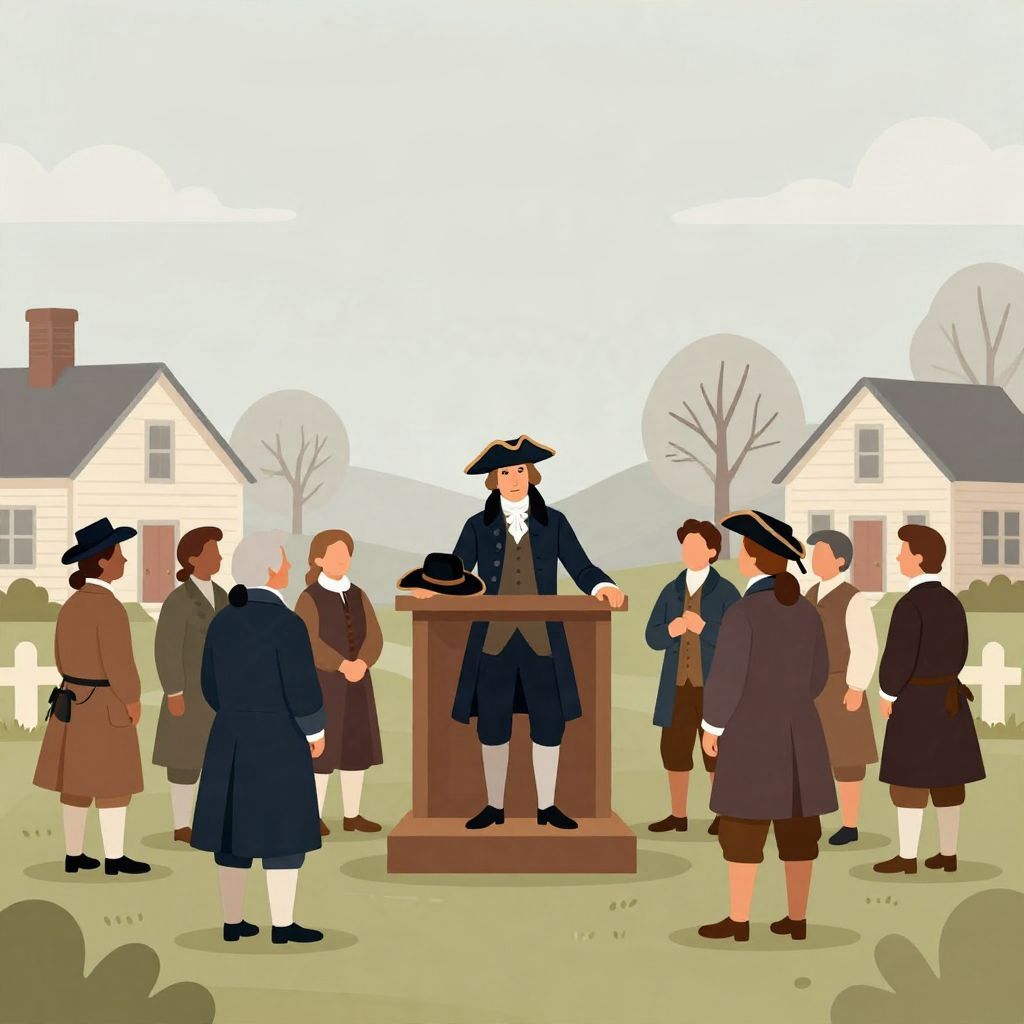
George Whitefield died on September 30, 1770, in Newburyport, Massachusetts, after collapsing from severe illness while traveling and preaching in colonial America. He was one of the most famous evangelical preachers of the 18th century, and his death came at the end of a life spent on exhausting transatlantic preaching tours.
What happened to him matters because Whitefield helped shape the Great Awakening, the religious revival that transformed Protestant life in Britain and North America. His death was not dramatic in the sense of violence or scandal; it was the result of long-term strain, repeated illness, and the physical demands of constant ministry.
How did George Whitefield die?
George Whitefield died of illness and exhaustion after a preaching tour in New England. He had suffered from chronic respiratory problems for years, and in late September 1770 he became seriously ill while traveling in Massachusetts. He died at the home of the Rev. Jonathan Parsons in Newburyport, likely from complications associated with asthma or a related chest ailment, worsened by overwork and travel.
The immediate circumstances of his death
Whitefield was still actively preaching when his health failed. In the days before his death, he had continued to address large crowds despite being visibly weak. By the time he reached Newburyport, he was gravely ill. Contemporary accounts agree that he died there on the morning of September 30, 1770, before he could recover enough to resume preaching.
Because 18th-century medicine could not diagnose or treat respiratory disease with modern precision, historians usually describe the cause of death broadly rather than with absolute certainty. The best-supported explanation is that Whitefield died from a severe chest illness, probably asthma or a similar chronic condition, made worse by fatigue and repeated physical strain.
What caused his death?
Whitefield’s death was the result of long-term health problems, not a single sudden event. He had endured years of punishing travel, crowded preaching schedules, and repeated bouts of illness. His voice, lungs, and general strength were central to his vocation, and those same demands likely shortened his life.
Chronic illness and overwork
Whitefield was famous for preaching outdoors to enormous audiences, often several times a day. He crossed the Atlantic many times and traveled constantly through Britain and the American colonies. That pace would have been exhausting for anyone, especially someone with recurring respiratory trouble. In the 18th century, there were no inhalers, antibiotics, or effective long-term treatments for chronic breathing disorders.
Many biographers note that Whitefield had a history of poor health from relatively early in life. He often preached while sick and treated his ministry as a calling that justified physical sacrifice. This pattern was common among revivalist preachers, but in Whitefield’s case it clearly took a toll.
Possible asthma or respiratory disease
Historians generally avoid claiming a precise modern diagnosis, but Whitefield’s symptoms are consistent with severe asthma or another chronic pulmonary condition. He was known for breathlessness and recurring attacks that affected his ability to preach. The records do not allow a definitive medical conclusion, but they do support the view that his lungs were a major factor in his final illness.
It is important to distinguish this evidence from later romanticized stories. Some accounts portray his death as almost saintly theater, as if he simply preached himself to death in a single moment. The truth is more ordinary and more historically grounded: a tireless preacher, already weakened by illness, finally collapsed under the pressure of travel and ministry.
Where and when did George Whitefield die?
George Whitefield died on September 30, 1770, in Newburyport, Massachusetts, then part of the British American colonies. He was 55 years old. His death occurred during one of his final preaching journeys in New England, where he remained a major religious celebrity and drew large crowds.
Why Newburyport was significant
Newburyport was one of the many colonial towns where Whitefield’s preaching attracted intense attention. By the end of his life, he was no longer just a revivalist visitor from abroad; he was a transatlantic religious figure whose presence could fill meetinghouses and open fields alike. Dying in New England underscored how deeply his ministry had become tied to the American colonies.
His body was buried in the basement of the Old South Presbyterian Church in Newburyport, where his tomb remains a place of historical memory. That burial location reflects both his popularity in the region and the respect he commanded among many Protestants, even those who did not share all his theological views.
Who was George Whitefield?
George Whitefield was an 18th-century Anglican evangelist and one of the leading voices of the Great Awakening. Born in Gloucester, England, in 1714, he became famous for his extraordinary speaking style, emotional sermons, and ability to attract huge audiences across Britain and North America. He helped popularize revivalist Christianity in the English-speaking world.
His role in the Great Awakening
Whitefield’s preaching emphasized personal conversion, repentance, and the need for a heartfelt religious experience. These themes resonated with many listeners who felt distant from formal church life. In the American colonies, his tours helped spread revivalism across denominational lines and encouraged a more emotionally expressive form of Protestant religion.
He was also a controversial figure. Some clergy admired his zeal, while others criticized his style as overly theatrical or divisive. Yet even his opponents recognized his influence. Whitefield was one of the most famous religious speakers of his age, and his death marked the end of an era in revival preaching.
Why did his death matter historically?
Whitefield’s death mattered because it symbolized the passing of a central figure in the evangelical revival movement. He had helped connect Britain and North America through preaching networks, print culture, and personal travel. When he died, the movement he helped energize did not disappear, but it entered a new phase shaped by other leaders and local congregations.
Impact on evangelical religion
Whitefield’s influence continued through the ministers, laypeople, and religious communities he inspired. His preaching style became a model for later evangelical revivalists. The emotional intensity, public gatherings, and emphasis on conversion that he popularized would remain important in Protestant history long after 1770.
At the same time, his death highlighted the limits of charismatic leadership. Whitefield had been a uniquely powerful public preacher, and no single successor could fully replace him. The revival movement became more decentralized, with different traditions developing in different regions.
His place in colonial America
Whitefield’s career also mattered beyond religion. His visits helped knit together a wider Atlantic public sphere in which ideas, sermons, pamphlets, and personal testimony moved across borders. He preached in a period when the British colonies were becoming increasingly connected, yet also increasingly restless. While Whitefield was not a political revolutionary, the habits of speech and public persuasion that surrounded revivalism formed part of the broader cultural world of the pre-Revolutionary era.
What do we know from historical sources?
The basic facts of Whitefield’s death are well established because they appear in contemporary reports, letters, and later biographies. Historians know the date, place, and broad medical circumstances with reasonable confidence. What remains less certain is the exact modern diagnosis, since 18th-century records do not provide the kind of clinical detail available today.
Separating fact from legend
Over time, Whitefield’s death acquired a devotional aura in some retellings. That is common for famous religious figures. But the historian’s task is to separate the documented event from the legend built around it. The documented event is straightforward: he became ill during a preaching tour, weakened further, and died in Newburyport at age 55.
The legend, by contrast, sometimes turns his death into a moral lesson about sacrifice or divine favor. While those interpretations may reveal how admirers remembered him, they should not be confused with the historical record itself.
George Whitefield’s final days in brief
- Late September 1770: Whitefield was traveling and preaching in Massachusetts.
- He became seriously ill: His long-standing health problems worsened.
- September 30, 1770: He died in Newburyport, Massachusetts.
- After death: He was buried beneath the Old South Presbyterian Church in Newburyport.
Why readers still ask how George Whitefield died
People continue to ask how George Whitefield died because his life was so public and so influential. He was not a king, general, or politician, but he was one of the most recognizable religious voices of the 18th century. His death invites questions about the human cost of revival preaching, the health risks of constant travel, and the way religious fame shaped early modern life.
In that sense, Whitefield’s death is more than a biographical detail. It is a window into the world of 18th-century religion, where faith, performance, mobility, and physical endurance were tightly linked. He died as he had lived: on the road, in the middle of his ministry, still trying to preach despite failing health.
For readers interested in other historical deaths, you may also want to explore how Marcus Garvey died or how Simon Peter died. Whitefield’s story remains a reminder that great historical movements are often carried by fragile human lives.