
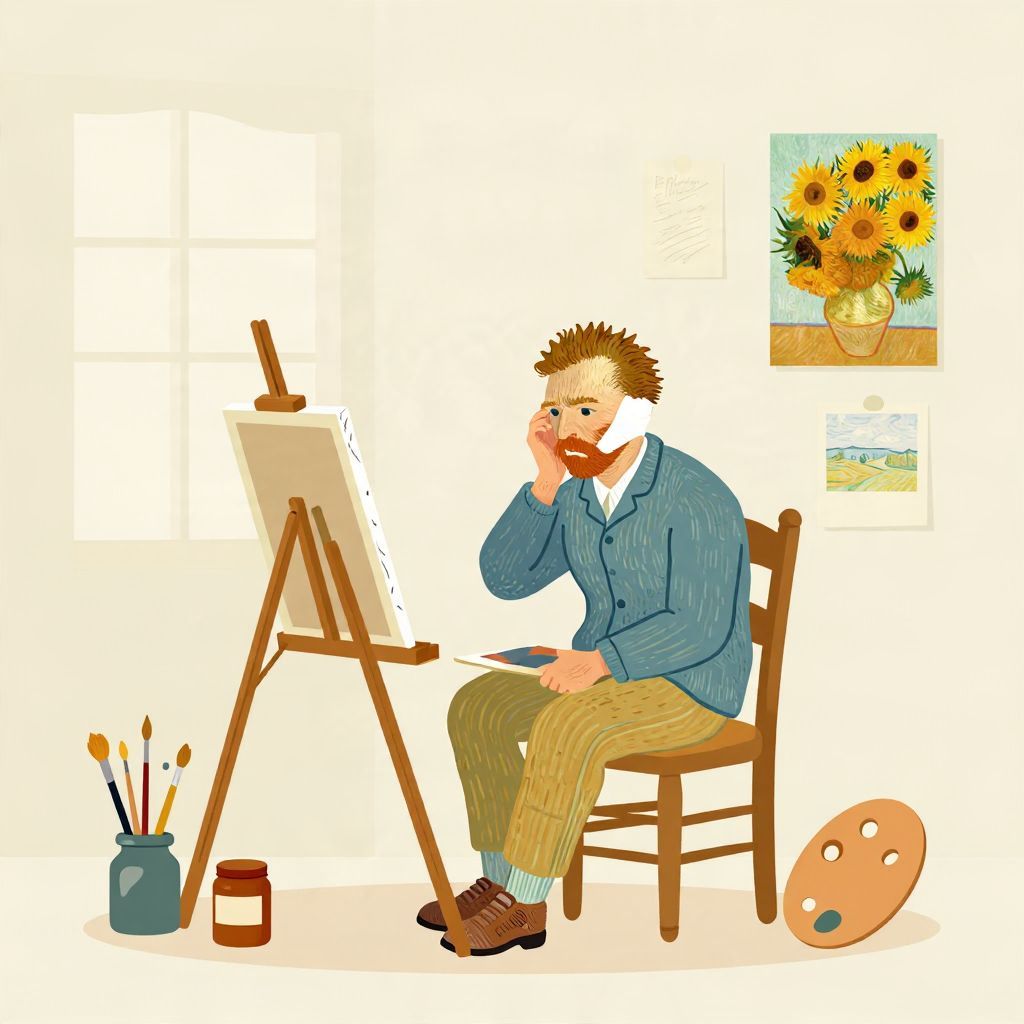
When people ask, “What artist cut off his ear?” they are usually thinking of one of the most famous episodes in modern art history. The artist was Vincent van Gogh, the Dutch Post-Impressionist painter. The incident took place in Arles, in southern France, in December 1888, and it has become a lasting part of his legend.
But the story is more complicated than the simple version often repeated in popular culture. Historians still debate the exact circumstances, and the event has often been exaggerated or oversimplified. What is clear is that van Gogh’s self-inflicted injury, or possibly an injury connected to a violent confrontation, became a defining moment in his troubled life and later reputation.
What artist cut off his ear? Vincent van Gogh is the answer
Vincent van Gogh is the artist most famously associated with cutting off his ear. The event occurred in late 1888 in Arles, France, during a period of intense emotional distress. He lost part of his left ear, not the entire ear, and the incident has since become one of the best-known episodes in art history.
What happened in Arles in 1888?
Van Gogh had moved to Arles in February 1888, hoping to build a creative life in the south of France. He dreamed of establishing an artists’ community and invited Paul Gauguin to stay with him. Their time together was productive but tense. By December, the relationship had deteriorated badly, and van Gogh was experiencing severe mental and emotional strain.
On the night of 23 December 1888, something happened that ended with van Gogh injuring his ear. The most familiar account says he cut off part of it himself after an argument with Gauguin. However, some historians have argued that Gauguin, who was a skilled fencer, may have wounded him during a confrontation and that both men later kept quiet about the details. The evidence is incomplete, so the exact sequence remains uncertain.
The traditional version of the story
According to the long-accepted narrative, van Gogh mutilated himself in a state of psychological crisis. Afterward, he wrapped the injured ear and took it to a woman at a local brothel, though the details of this episode are also debated. He was then hospitalized. This version became widely known because it fit the image of van Gogh as a tormented genius.
Why historians question parts of the story
Modern scholars have examined letters, police records, and later testimony. Some conclude that van Gogh likely did injure himself, while others think the wound may have been caused by Gauguin in a fight. Because both men had reasons to avoid scandal, the historical record is not fully reliable. What is not disputed is that van Gogh was badly wounded and that the event marked a crisis in his life.
Why did van Gogh cut off his ear?
The short answer is that van Gogh was under extreme psychological pressure. He had a history of instability, anxiety, and possible episodes of psychosis or severe depression. In Arles, his hopes for artistic companionship clashed with loneliness, financial stress, and conflict with Gauguin. The ear incident was not an isolated act of theatrical madness; it happened in the context of a prolonged breakdown.
Mental health and uncertainty
It is tempting to diagnose van Gogh from a distance, but historians must be careful. Doctors at the time described his condition in different ways, and modern experts have suggested several possibilities, including bipolar disorder, epilepsy, psychosis, or the effects of malnutrition and substance use. No single diagnosis can be proven with certainty from the historical evidence alone.
The pressure of artistic ambition
Van Gogh was deeply committed to art, but he struggled to sell his work and depended financially on his brother Theo. He wanted recognition and community, yet he often felt isolated. His time with Gauguin was supposed to be the beginning of a collaborative artistic future. Instead, it ended in conflict, disappointment, and crisis.
What part of the ear did van Gogh cut off?
Van Gogh is generally believed to have removed part of his left ear, not the whole ear. Later medical accounts and artistic reconstructions vary in detail, but the commonly accepted version is that the injury was partial. The exact extent of the wound is difficult to reconstruct because the original medical records are limited and the story was retold many times afterward.
How the ear incident shaped van Gogh’s life
The injury led to van Gogh’s hospitalization and deeper public awareness of his instability. He spent time in the hospital in Arles and later entered the asylum at Saint-Rémy-de-Provence in 1889. Despite his illness, he continued to paint with extraordinary intensity during this period, producing some of his most admired works.
The event also affected how others saw him. In his lifetime, van Gogh was not famous in the way he is today. After the ear incident, he became a figure of local concern and curiosity rather than international admiration. Only after his death in 1890 did his reputation grow steadily, eventually turning him into one of the most celebrated artists in Western art.
Art after the crisis
Even after the episode, van Gogh continued to create powerful paintings. Works from the later period show his intense use of color, expressive brushwork, and emotional energy. The fact that he produced such art while suffering severe distress has contributed to the myth of the “mad genius,” though that idea can oversimplify both his life and his art.
Why the story became so famous
The ear incident became famous because it combines several elements that fascinate the public: artistic genius, mental illness, self-destruction, and mystery. It is easy to remember and easy to retell, which helped it spread far beyond the world of art history. Over time, it became one of the most recognizable stories attached to any painter.
Popular culture has often treated the episode as proof that great art and suffering must go together. That interpretation is misleading. Van Gogh’s talent did not come from his pain, even if pain was part of his life. His achievement lay in his vision, discipline, and originality, not in the injury itself.
Myth versus history
- Established: Vincent van Gogh suffered a serious ear injury in Arles in December 1888.
- Likely: The injury was connected to a breakdown after conflict with Paul Gauguin.
- Debated: Whether van Gogh cut off the ear himself or whether Gauguin caused the wound.
- Misleading simplification: The idea that he “cut off his ear” as a single dramatic act with no broader context.
Van Gogh, Gauguin, and the tension in Arles
Paul Gauguin’s presence is central to the story. Van Gogh admired him and hoped their partnership would be artistically fruitful. Instead, they clashed over temperament, artistic method, and daily life. Gauguin eventually left Arles soon after the incident. Their brief collaboration has since drawn enormous attention because it brings together two major figures in modern art at a moment of crisis.
Some later accounts portray Gauguin as the villain and van Gogh as the lone victim. That framing is too neat. Their relationship was complicated, and both men were difficult personalities. The historical record suggests a troubled friendship rather than a simple tale of hero and antagonist.
What happened after van Gogh’s death?
Van Gogh died in July 1890, only two years after the ear incident, from a gunshot wound that is generally understood to have been self-inflicted, though even that has been discussed by some scholars. He had sold very few paintings during his lifetime. Yet his brother Theo and later supporters helped preserve and promote his work, allowing his reputation to grow rapidly in the decades after his death.
As van Gogh’s fame increased, so did interest in the ear story. Biographers, doctors, and art historians revisited the episode again and again. The result is that the injury became more than a biographical detail; it became a symbol of the artist himself, often used to represent suffering, creativity, and the instability of modern life.
Why the question still matters today
People still ask “What artist cut off his ear?” because the story remains one of the most memorable in cultural history. It is a doorway into van Gogh’s life, but it also raises larger historical questions about mental health, artistic mythmaking, and how legends are built around famous figures.
The best historical answer is straightforward: Vincent van Gogh is the artist associated with cutting off his ear, but the full story is more complex than the popular legend. The event took place in Arles in 1888, during a period of severe emotional distress, and it continues to be studied because it reveals both the fragility of van Gogh’s life and the power of the myths that formed around him.