
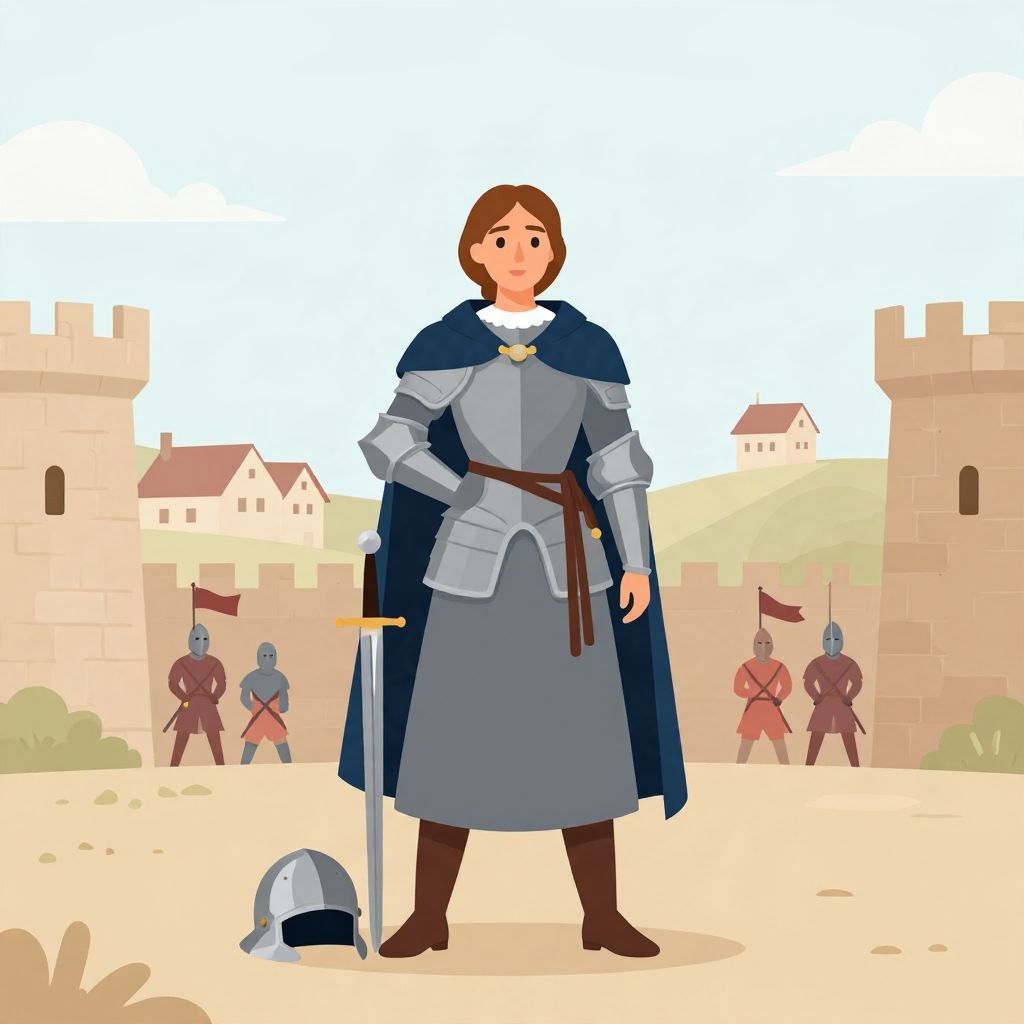
What did Joan of Arc look like? The honest answer is that we do not know exactly. No reliably identified contemporary portrait survives from her lifetime, and the famous images of Joan were created after her death, when artists and later generations shaped her into a saint, heroine, or symbol.
What historians can say with confidence comes from trial records, eyewitness descriptions, and later memory. These sources suggest a young woman of medium height, with short-cropped hair, practical clothing, and a serious, determined presence rather than the graceful, idealized face seen in many paintings.
What Did Joan Of Arc Look Like?
Joan of Arc was likely a slender teenage girl of ordinary rural appearance, with dark hair cut short, a modest face, and a practical soldier’s outfit by the time she entered public life. We have no verified portrait from her lifetime, so every visual image of Joan is an interpretation rather than a photograph-like likeness.
The Historical Evidence for Joan’s Appearance
What the trial records tell us
The best evidence comes from the records of Joan’s 1431 trial and the later nullification inquiry that reviewed her case. Witnesses described her as young, healthy, and physically capable. They also noted her clothing, especially the male-style garments she wore while traveling with soldiers and appearing before officials. These records are more useful for her general presentation than for precise facial details.
One important detail is that Joan was remembered as a young woman who looked younger than her age. She was born around 1412, so she was only in her late teens when she became famous. That youthfulness likely shaped how people saw her: not as a seasoned commander, but as an unexpectedly determined adolescent from the countryside.
What witnesses likely noticed first
Medieval people often described appearance in broad terms rather than with the exacting detail modern readers expect. For Joan, the most striking features were probably not her eye color or nose shape, but her posture, voice, and dress. She presented herself with confidence, rode on campaign, and insisted on a role that defied normal expectations for women in fifteenth-century France.
Her hair also mattered. Joan’s short hair became one of the most memorable parts of her appearance because it was associated with her rejection of conventional female dress. In medieval society, hair was a marker of gender and status, so her cropped style would have stood out immediately.
Why There Is No Certain Portrait of Joan of Arc
She lived before realistic portraiture became common
Joan lived in the early fifteenth century, when portrait painting in Western Europe was still developing. Artists often idealized subjects, especially religious or royal figures. Even when a likeness was attempted, it was rarely documented in a way that allows modern historians to confirm identity with certainty.
As a result, the portraits people now associate with Joan were usually painted long after her death in 1431. Some show her as a saint in armor, others as a visionary peasant girl, and still others as a romantic national heroine. Each reflects the era that produced it more than Joan herself.
How legend blurred the historical record
Joan’s story quickly became symbolic. She was executed by the English and Burgundian authorities, later rehabilitated by the Church, and eventually canonized in 1920. Each stage encouraged new images of her. Artists and writers emphasized whatever qualities mattered most to their own time: piety, patriotism, innocence, courage, or martyrdom.
That means the familiar “Joan of Arc” face in popular culture is a composite image, not a verified historical likeness. It tells us a great deal about how later generations imagined her, but little about her actual facial features.
What Joan of Arc Probably Looked Like in Real Life
Age, build, and clothing
Based on the available evidence, Joan was probably a young woman of average or slightly below-average height for her time, with a slim or wiry build shaped by rural labor and wartime travel. She was not described as aristocratic in appearance. She likely looked like a peasant girl who had been transformed by circumstance into a military figure.
Her clothing was the most visible part of her appearance. When traveling with troops or appearing in official settings, she wore armor or male-style garments. This was unusual, but practical. It protected her on campaign and marked her as someone operating outside ordinary social roles.
Hair and grooming
Joan’s hair was cut short, likely for practical and symbolic reasons. The short hair may have been necessary for wearing a helmet and for avoiding the maintenance associated with long hair during military movement. It also became a point of controversy at her trial, where dress and gender presentation were treated as serious religious and legal issues.
Her grooming was probably simple. As a rural young woman from Domrémy, she would not have had access to luxury cosmetics or elaborate styling. Nothing in the sources suggests a courtly fashion sense. Her appearance was likely plain, disciplined, and functional.
How Contemporaries Described Joan
Not a beauty portrait, but a presence
Surviving descriptions do not focus on Joan as a beauty. Instead, they stress her energy, seriousness, and moral force. That is important historically, because it shows how unusual she seemed to the people around her. Her authority came less from appearance than from conviction, speech, and action.
Some accounts suggest that she had a strong, direct manner and a clear voice. Others emphasize her composure in interrogation and her ability to endure scrutiny. These traits would have made a strong impression in a world where most young rural women had little public authority.
Why the sources are limited
Medieval testimony was not designed to preserve a modern-style physical description. Witnesses cared more about Joan’s behavior, orthodoxy, and social role than about exact facial measurements. Even when trial records mention appearance, they usually do so because clothing, hair, or demeanor had legal or religious significance.
So while historians can reconstruct the broad outline of Joan’s look, they cannot produce a precise face. Any claim that she had a particular eye color, complexion, or exact facial structure should be treated cautiously unless tied to a clearly identified source.
The Famous Images of Joan of Arc and Why They Differ
Medieval and early modern depictions
Some of the earliest images of Joan were not realistic portraits but symbolic representations. These works often showed her with armor, a banner, and a halo, presenting her as a holy warrior. Such images were meant to communicate meaning, not physical accuracy.
In later centuries, especially in the nineteenth century, artists reimagined Joan as a national heroine of France. Romantic painters often gave her delicate features, flowing hair, and a dramatic, almost cinematic expression. This version is powerful, but it is not a historical reconstruction.
Modern film and popular culture
Modern films, novels, and illustrations have added yet another layer. Some portray Joan as solemn and mystical, others as youthful and fierce. These versions reflect the needs of storytelling. They also show how Joan has remained a flexible symbol for faith, nationalism, resistance, and sacrifice.
Because these images are so influential, many people assume they represent her actual appearance. In reality, they are cultural portraits of Joan’s meaning, not dependable evidence of her face.
What Joan’s Appearance Meant in Her Own Time
Dress as a sign of identity and conflict
Joan’s appearance was not just a matter of curiosity; it was part of the controversy surrounding her. Her male clothing became one of the charges against her at trial. In the fifteenth century, clothing could signal obedience, rebellion, holiness, or disorder. Joan’s dress challenged social expectations and gave her enemies another reason to condemn her.
At the same time, her clothing helped her function in wartime. She was moving through dangerous spaces, riding with troops, and appearing before powerful men. Her practical appearance supported the role she claimed for herself.
How her look reinforced her message
Joan’s appearance likely reinforced the idea that she was extraordinary. A teenage peasant girl who spoke with confidence, wore armor, and led men into battle did not fit ordinary categories. Her look made her seem both vulnerable and formidable, which may help explain why she inspired devotion among supporters and suspicion among opponents.
In that sense, Joan’s appearance was inseparable from her historical impact. She was not remembered because she was beautiful in a conventional sense, but because she looked unlike what people expected a woman, a peasant, or a military leader to look like.
So, What Can We Say with Confidence?
- Joan of Arc was born around 1412 and died in 1431.
- She was a young rural woman, probably of average or slim build.
- She wore short hair and practical male-style clothing, especially during her public career.
- No verified lifetime portrait of her survives.
- Most familiar images of Joan were created after her death and are symbolic, not exact likenesses.
The safest historical conclusion is simple: Joan of Arc probably looked like a determined teenage peasant girl who had adopted the appearance of a soldier. Her true face is lost to history, but the records preserve enough to show that her appearance was memorable precisely because it broke with expectation.
For readers interested in the wider world that shaped her, Joan’s story connects closely to the Hundred Years’ War and to the religious culture of late medieval France. Her image changed over time, but the historical Joan remains most compelling when seen not as a painted icon, but as a young woman whose appearance, actions, and courage unsettled her age.