
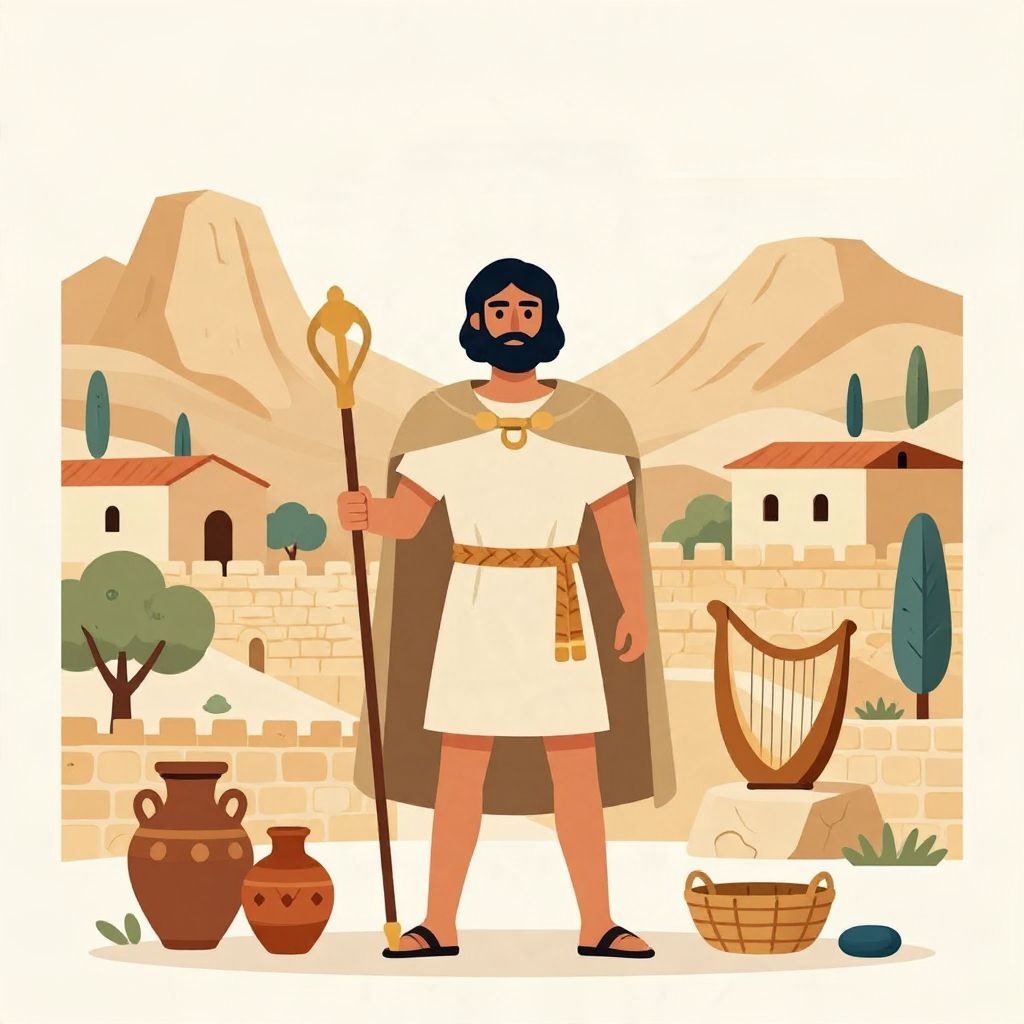
What did King David look like? The honest answer is that we do not know with certainty. No securely identified portrait from David’s lifetime survives, and the biblical texts focus on his role as king, warrior, poet, and ancestor rather than on detailed physical description.
Still, historians can say what is plausible. David likely looked like an Iron Age Judean man of the eastern Mediterranean: probably dark-haired, olive-skinned, and physically hardened by pastoral and military life. Later art and tradition often show him as youthful, handsome, and bearded, but those images reflect interpretation more than direct evidence.
What Did King David Look Like?
King David’s exact appearance is unknown. The Bible gives only a few clues: he was described as “ruddy”, handsome, and having beautiful eyes in 1 Samuel, but those phrases are literary and do not amount to a full physical portrait. Most reconstructions are educated guesses based on ancient Near Eastern history and art.
The biblical description: brief, selective, and symbolic
The clearest textual clue comes from the story of David’s anointing by Samuel. He is presented as youthful, attractive, and striking in appearance. The Hebrew word often translated as “ruddy” may suggest reddish complexion, healthy color, or possibly red hair, but scholars do not agree on a precise meaning. The passage is more concerned with David’s suitability and divine choice than with anatomy.
Another important detail is that David is contrasted with his older brothers. In that narrative, appearance matters because the reader is being taught that God chooses beyond outward stature. The text does not function like a royal portrait; it is a theological and literary scene.
What historians can infer from David’s world
If David was a historical figure associated with early Judah, he would have lived in the 10th century BCE, during the Iron Age. People in the southern Levant at that time generally wore practical clothing suited to a dry, rugged environment. Men often had beards, short or medium-length hair, and simple tunics. A shepherd-warrior like David would likely have looked weathered rather than refined.
His life story also suggests an active physical lifestyle. The biblical account places him among sheep, in wilderness settings, and in military campaigns. That does not mean he was unusually large or muscular in the modern sense, but it does suggest a body shaped by labor, travel, and combat rather than courtly comfort.
What we cannot know
We cannot know David’s exact height, eye color, hair texture, or facial features. We also cannot confirm whether he wore a beard in the style shown in later art, whether he was especially tall, or whether he matched the idealized image of a heroic king. Ancient texts rarely preserve that kind of detail unless it serves a story.
It is also important not to confuse later religious art with historical evidence. Medieval and Renaissance painters often depicted David as a European-looking youth with idealized proportions. Those images tell us about later beliefs and artistic tastes, not about the actual king of Judah.
Why the Sources Give So Little Detail
The limited description of David is typical of ancient biography. Writers in the biblical world were usually more interested in lineage, character, divine favor, and political legitimacy than in physical appearance. When appearance is mentioned, it usually supports a moral or narrative point rather than providing a realistic portrait.
Appearance as a literary device
In the David story, outward appearance is part of a larger theme: human judgment can be mistaken, while divine judgment sees deeper. Saul is described as tall and impressive, yet David is the chosen one. The contrast helps explain why the text emphasizes inner qualities such as courage, faith, and political destiny.
This means the famous question “What did King David look like?” has a historical answer and a literary one. Historically, we can only reconstruct a likely general appearance. Literarily, the texts intentionally leave much unsaid so that David becomes a figure defined by action and meaning rather than by physical detail.
How Artists Imagined King David
Because the historical record is sparse, later generations filled the gap with imagination. Jewish, Christian, and Islamic traditions all remembered David as a major figure, and artists gave him a face, body, and style that reflected their own eras.
Ancient and late antique images
Some early depictions of David appear in synagogue art, manuscripts, and Christian mosaics, but these are symbolic rather than realistic. They usually present him as a king, musician, or psalmist. The goal was to identify him, not to reconstruct his actual features.
Medieval and Renaissance David
In medieval art, David often appears as a crowned ruler or harp-playing poet. By the Renaissance, artists such as Donatello and Michelangelo transformed him into an idealized young hero. Michelangelo’s famous David is not a historical portrait of the biblical king; it is a statement about beauty, strength, and civic virtue in Renaissance Florence.
These works became so influential that many people now picture David through them. That visual tradition is powerful, but it should not be mistaken for evidence from the Iron Age.
What a Historical David May Have Looked Like
Based on the historical setting, David probably would not have looked like a modern king in robes and a jeweled crown. He may have been lean, sun-weathered, and dressed simply when not in royal settings. His appearance likely changed over time, especially if he rose from rural life to court life and then to kingship.
Likely features in context
- Skin tone: probably olive to medium-brown, shaped by the climate and ancestry of the region.
- Hair: likely dark, though the biblical term “ruddy” leaves room for debate.
- Beard: very likely, since beards were common among men in the ancient Near East.
- Build: probably fit and practical rather than ceremonial, especially if he spent years outdoors.
- Clothing: simple tunics, belts, cloaks, sandals, and later royal garments when in court.
These are informed probabilities, not certainties. They are based on archaeology, comparative history, and the broader material culture of the ancient Levant.
Did David have a distinctive face?
There is no evidence that David had a uniquely documented face the way some modern rulers do through coins or official portraits. If he existed as a historical ruler, his image would have circulated orally and through memory, not through standardized likenesses. That makes any modern reconstruction speculative.
David in History: More Than an Appearance
Although the question begins with appearance, David’s historical importance lies elsewhere. He became one of the most influential figures in biblical tradition, associated with the unification of Israel and Judah, the capture of Jerusalem, and the establishment of a royal line that later writers treated as foundational.
Political significance
David’s legacy mattered because later Judahite and Israelite writers used him to explain kingship, identity, and divine promise. Whether every detail of the biblical account reflects exact history is debated, but David’s role in later memory is undeniable. He became the model of the ideal king, even when his story included failure, conflict, and moral complexity.
Religious and cultural significance
David also became a central figure in Jewish, Christian, and Islamic traditions. He was remembered as a psalmist, warrior, prophet-like king, and symbol of covenantal legitimacy. That broad influence helped ensure that artists, theologians, and rulers kept reimagining his face long after his lifetime.
Why the Question Still Matters
People keep asking what King David looked like because physical appearance often feels like a way to make the past real. Yet with ancient figures, certainty is rare. The more responsible historical answer is to separate what the sources say, what archaeology suggests, and what later tradition invented.
In David’s case, the safest conclusion is simple: he was probably an ordinary-looking man by the standards of his time, not the polished, heroic figure of later paintings. The Bible preserves his character and significance far more clearly than his features.
So, what did King David look like? Probably like a rugged Iron Age Judean man, with dark features, practical clothing, and the weathered appearance of someone shaped by outdoor life. For the broader historical setting of his reign, see when King David lived, and for another example of how tradition shapes physical descriptions, compare it with what Moses looked like.