
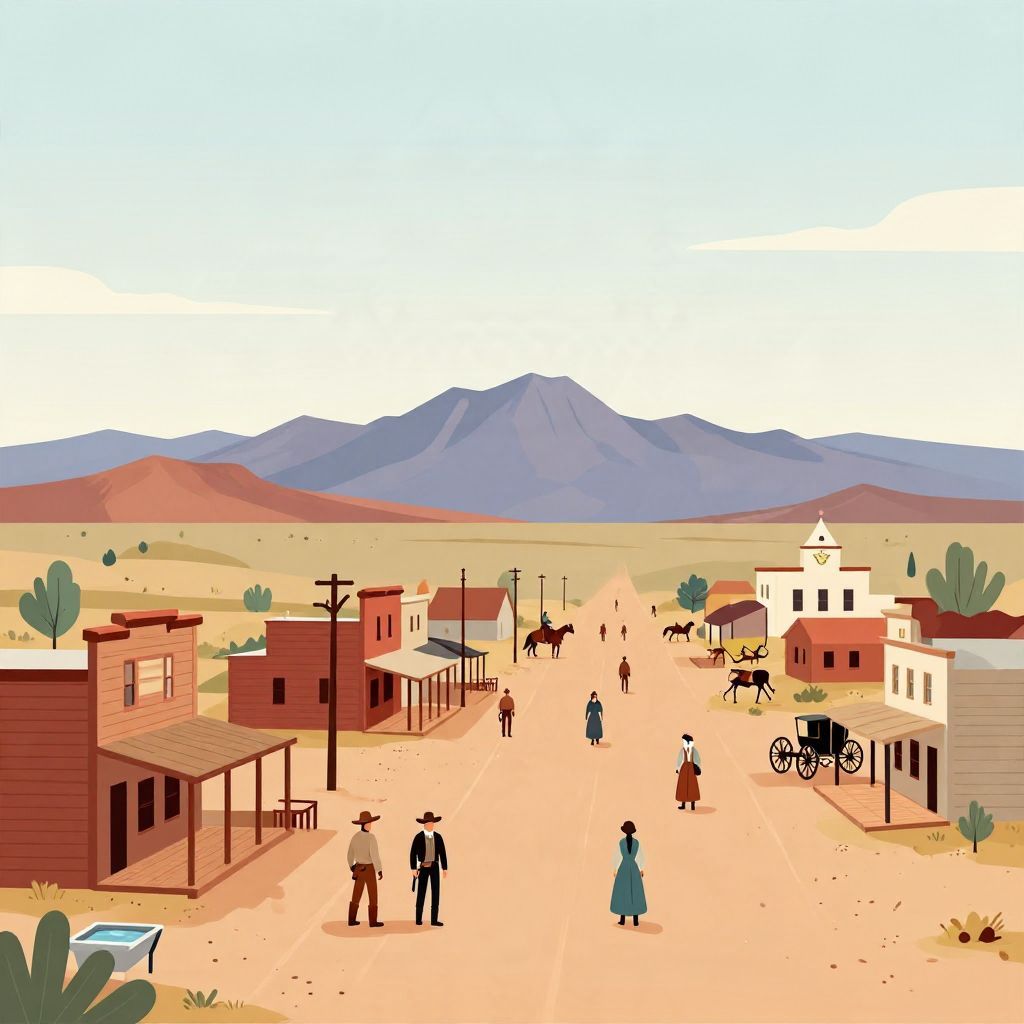
The “Wild West” was not a single place with fixed borders. It was a broad region of the United States, especially the lands west of the Mississippi River, that became associated with frontier settlement, cattle ranching, mining, railroads, and conflict during the 19th century.
In historical terms, the Wild West usually refers to the American West during the decades after the Civil War, when federal expansion, migration, and Indigenous dispossession reshaped the region. Its exact location and time period depend on who is using the phrase, but it most often points to the frontier areas of the Great Plains, Southwest, Rocky Mountains, and Pacific Coast.
Where Was the Wild West?
The Wild West was mainly the western United States beyond the Mississippi River, especially from the Great Plains to the Pacific Coast. It was not one town or state, but a shifting frontier zone that changed as railroads, farms, and towns spread westward in the 1800s.
The broad geographic meaning
When people say “the Wild West,” they usually mean the American frontier after the United States began pushing farther west in the 19th century. That included parts of present-day Kansas, Nebraska, the Dakotas, Texas, Colorado, Wyoming, Montana, New Mexico, Arizona, Nevada, Utah, Idaho, Oregon, Washington, California, and sometimes Oklahoma. The phrase is flexible because the frontier moved over time.
Why the West was called “wild”
The word “wild” reflected the perspective of settlers, journalists, and later popular culture. It suggested lawlessness, danger, and sudden change, but that image was never the full reality. Many western communities had courts, sheriffs, churches, schools, and local governments. At the same time, violence, land conflict, and unstable institutions were real parts of frontier life.
What Time Period Does the Wild West Refer To?
The classic Wild West era is usually placed between the 1860s and the early 1900s, though some historians extend it earlier or later depending on the topic. The most iconic period came after the Civil War, when railroad building, cattle drives, mining booms, and homesteading transformed the West.
Before the classic “Wild West”
Western expansion began long before the famous cowboy era. The Louisiana Purchase in 1803, the Mexican-American War in the 1840s, and the California Gold Rush of 1848–49 all helped open the region to American settlement. By the 1850s and 1860s, military campaigns, wagon trails, and federal land policies had already begun changing the West dramatically.
The peak years
The period most associated with the Wild West is roughly from the end of the Civil War in 1865 to about 1890. During these decades, cattle trails such as the Chisholm Trail, mining camps, railroad towns, and new settlements created the classic frontier image. This was also the era of major conflict between settlers, the federal government, and many Native nations.
When the frontier ended
By 1890, the U.S. Census Bureau announced that a continuous frontier line no longer existed, often treated as a symbolic end to the Wild West era. That does not mean western life became peaceful overnight. It means the open frontier, as Americans had imagined it, had largely disappeared as settlement and state institutions spread across the region.
What Places Are Most Associated with the Wild West?
Some of the best-known Wild West places were frontier towns, mining camps, cattle centers, and military outposts across the interior West. The image is often tied to places like Dodge City, Tombstone, Deadwood, Abilene, and Virginia City, but the wider story covers much more territory than these famous towns alone.
Frontier towns and boomtowns
Many famous Wild West towns grew quickly because of a single economic opportunity. Mining camps appeared near gold and silver strikes. Railroad towns emerged along new lines. Cattle towns became shipping points for herds driven north from Texas. These places often had temporary populations, rough housing, saloons, gambling halls, and rapid turnover.
Rural frontier regions
Not all of the Wild West was urban or dramatic. Much of it was open ranchland, reservation land, homestead country, and sparsely populated territory. Farmers, ranchers, soldiers, traders, railroad workers, and Indigenous communities all lived in these landscapes, often under difficult and unequal conditions.
Borderlands and the Southwest
The Southwest is especially important because it had a long history before becoming part of the United States. Areas such as New Mexico and Arizona were shaped by Spanish and Mexican rule before American annexation. This means the “Wild West” was not only an American story; it was also a borderland story involving multiple cultures, legal systems, and claims to land.
Why Did the Wild West Develop There?
The Wild West developed in the American West because of federal expansion, migration, natural resources, and transportation networks. As the United States grew, it encouraged settlement, extracted resources, and built infrastructure across lands already inhabited by Native peoples and, in some regions, long connected to Spanish and Mexican societies.
Land hunger and federal policy
Many settlers moved west because land was available or seemed available. Policies such as the Homestead Act of 1862 encouraged families to claim and farm land, while railroads received huge land grants that helped them expand. These policies did not simply “open” empty land; they accelerated the transfer of land away from Native nations and into private ownership or corporate control.
Mining, cattle, and railroads
Three economic forces helped create the classic Wild West: mining, cattle ranching, and railroads. Gold and silver strikes drew thousands of people to remote places. Cattle ranching expanded across the grasslands, and long cattle drives moved herds to railheads. Railroads tied the region to national markets, speeding settlement and reducing the isolation that had made frontier life so distinctive.
Conflict over land and sovereignty
The West was also a place of war and resistance. Native nations defended their homelands against invasion, treaty violations, forced removal, and military campaigns. The U.S. Army fought many conflicts in the region, while settlers and territorial governments often demanded more federal protection. The “Wild West” was therefore shaped by conquest as much as by opportunity.
The People Who Lived in the Wild West
The popular image of the Wild West centers on cowboys and gunfighters, but the real West was much more diverse. Native Americans, Mexican Americans, Black cowboys, Chinese laborers, immigrants from Europe, women homesteaders, soldiers, ranchers, and merchants all helped shape frontier society.
Native peoples at the center of the story
Any accurate history of the Wild West must begin with Indigenous nations. The Plains, Southwest, Plateau, and other regions were home to communities with their own governments, trade networks, and military traditions long before U.S. expansion. The frontier era brought displacement, disease, broken treaties, and violent resistance, making Native history central rather than secondary.
Women and families
Although popular stories often focus on men, many women lived and worked in the West as farmers, business owners, teachers, laundresses, cooks, and community builders. Family settlement was crucial to turning temporary camps into permanent towns. Women’s labor helped stabilize frontier communities even when the region was still seen as rough or unstable.
Black, Mexican, Asian, and immigrant communities
The West was also shaped by migration from outside the Anglo-American world. Black cowboys and soldiers played important roles, especially after the Civil War. Mexican and Mexican American communities had deep roots in the Southwest. Chinese workers were central to railroad construction and mining, though they faced discrimination and violence. European immigrants also arrived in large numbers, adding to the region’s diversity.
How the Myth of the Wild West Took Shape
The Wild West became more famous as a myth than as a precise historical region. Dime novels, traveling shows, newspapers, and later films turned frontier life into a story of gunfights, sheriffs, outlaws, and heroic settlers. This popular image is partly based on real events, but it simplifies a much more complicated history.
From history to legend
Some events and figures were real, but they were often exaggerated. Shootouts were not as common as later entertainment suggested. Many towns were more orderly than legend claims. At the same time, the West did include violence, vigilante justice, and unstable law enforcement, which made it fertile ground for dramatic storytelling.
The role of the frontier in American identity
For many Americans, the West came to symbolize independence, risk-taking, and opportunity. That symbolism helped shape national identity, especially as the frontier closed. The myth of the Wild West also helped justify expansion by presenting it as inevitable progress, even though that progress came with severe costs for Native peoples and others.
What Was Life Like in the Wild West?
Daily life in the Wild West was often hard, uncertain, and more ordinary than legend suggests. People faced long distances, harsh weather, limited medical care, unstable markets, and the constant challenge of building communities in places where institutions were still developing.
Law and order
Some frontier towns had real violence, but many also worked hard to create order. Sheriffs, marshals, judges, and local militias operated alongside informal justice systems. In newly settled areas, law could be inconsistent or biased, especially where land disputes, racial prejudice, or weak governments were involved.
Transportation and communication
Travel in the West could be slow and dangerous before railroads became widespread. Stagecoaches, wagons, horses, and river travel connected settlements. Telegraph lines later improved communication, making it easier for businesses and governments to coordinate across long distances.
Work and survival
Most people in the Wild West were not outlaws or gunfighters. They were workers trying to survive. They farmed, mined, cooked, repaired equipment, raised livestock, taught children, or served in military posts. The frontier was less a place of constant adventure than a place of exhausting labor and adaptation.
Why the Wild West Still Matters
The Wild West matters because it was a major turning point in U.S. history. It was the era when the continental United States was largely completed, Native lands were violently transformed, and western resources were tied to national and global markets. Its legacy still shapes land ownership, regional identity, and public memory.
Historical significance
The expansion of the West helped make the United States a continental power. It also intensified debates over citizenship, race, sovereignty, and federal authority. The same policies that encouraged settlement also produced dispossession and conflict. Understanding the Wild West means understanding both growth and loss.
Why the question is still asked
People keep asking “Where was the Wild West?” because the phrase is so familiar but historically slippery. It is both a real region and a cultural myth. The answer is that it was the American frontier west of the Mississippi, especially in the decades after the Civil War, but its exact boundaries shifted as the nation expanded.
In short, the Wild West was not one exact place but a changing frontier region in the western United States, shaped by settlement, conflict, and myth. For more context, see when the Wild West ended and what the Homestead Act was.