
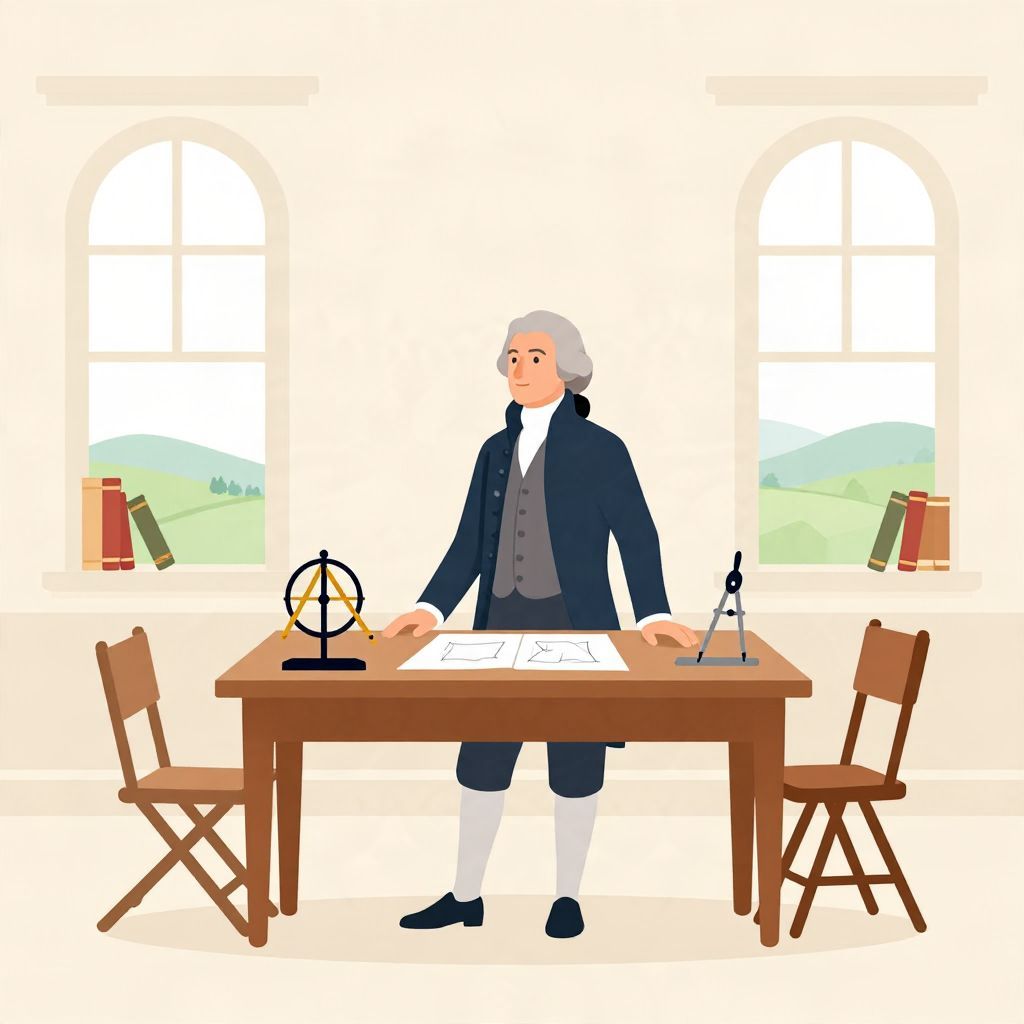
Thomas Jefferson is often remembered as a statesman, author of the Declaration of Independence, and third president of the United States. But many people also ask a simpler question: what did Thomas Jefferson invent?
The short answer is that Jefferson was not a professional inventor, and he did not patent his ideas. Still, he designed, improved, and experimented with several practical devices and systems, especially for farming, writing, and everyday life. His most notable contributions include the swivel chair, the polygraph copying machine, and improvements to agricultural tools and architecture.
What did Thomas Jefferson invent?
Thomas Jefferson did not invent a single world-changing machine in the way that later inventors did, but he created and improved several useful devices. His best-known contributions include the swivel chair, the polygraph copying device, and practical ideas for farm equipment, architecture, and home design. He also often adapted existing technology rather than originating it from scratch.
Jefferson as an inventor: the historical context
Jefferson lived in the late 18th and early 19th centuries, when educated elites often experimented with mechanics, agriculture, and household technology. In that world, invention was not always a profession. A planter, lawyer, diplomat, or president could still tinker with tools, machines, and building designs. Jefferson fit that pattern well.
He was deeply interested in efficiency, measurement, and improvement. On his Virginia plantation at Monticello, he tested ideas for crop rotation, labor-saving devices, and building plans. His inventive work reflected the practical concerns of an elite landowner in an agrarian society, as well as his belief that knowledge and progress could improve daily life.
Why Jefferson is remembered as an inventor
Jefferson’s reputation as an inventor comes partly from his wide-ranging curiosity. He read about science and mechanics, corresponded with thinkers in Europe and America, and liked to solve problems in tangible ways. He also left behind drawings, models, and descriptions of devices that show real technical engagement, even if he was not a factory inventor or commercial entrepreneur.
The swivel chair: Jefferson’s best-known invention
Jefferson is most often credited with improving or inventing the swivel chair during the 1770s. The chair allowed him to pivot while writing and working at his desk. It was likely based on an existing chair design, but Jefferson adapted it into a rotating seat that suited his needs. This is one of the clearest examples of his practical inventiveness.
He used the chair while drafting important documents, including the Declaration of Independence. The design became associated with his work habits and his desire for comfort and efficiency. Although the swivel chair existed in earlier forms, Jefferson’s version helped popularize the idea in American domestic and office life.
What made the chair innovative?
- It could rotate, making it easier to move between papers and writing surfaces.
- It improved workspace efficiency for long hours of writing.
- It reflected Jefferson’s habit of modifying existing objects for better use.
The polygraph copying machine
One of Jefferson’s most significant practical contributions was his use and promotion of the polygraph, a copying device that duplicated handwritten letters. Jefferson did not invent the original machine alone, but he strongly improved its use in America and helped spread it. The device used linked pens so that a writer could produce a copy at the same time as the original.
This mattered because Jefferson wrote enormous numbers of letters. In an age before photocopiers or carbon paper, the polygraph saved time and preserved records. It became a valuable tool for statesmen, administrators, and scholars who needed copies of outgoing correspondence.
Why the polygraph mattered
Jefferson cared deeply about recordkeeping. He understood that political power and historical memory depended on documents. The polygraph helped him manage his correspondence and preserve a paper trail. In that sense, it was not just a convenience but part of how he worked as a public figure.
Other practical inventions and improvements associated with Jefferson
Jefferson’s inventive activity extended beyond the chair and the polygraph. He designed or improved many small but useful things, especially at Monticello. Some of these were original ideas; others were adaptations of European models or local tools. In many cases, Jefferson’s role was as an improver rather than a first-time inventor.
A rotating bookstand
Jefferson devised a rotating bookstand that allowed him to keep several books open at once. This was useful for studying multiple texts side by side, a habit that suited his broad reading interests. Like many of his inventions, it was a practical solution to a daily problem.
The dumbwaiter and household devices
Jefferson also used or helped design domestic conveniences such as dumbwaiters and other food-serving mechanisms at Monticello. These devices reduced labor in the home and reflected his interest in making household routines more efficient. They were not always wholly original, but they show how he applied mechanical thinking to ordinary life.
Farm tools and agricultural experimentation
Jefferson experimented with plows, seed drills, and methods of cultivation. He was especially interested in improving agriculture because farming was central to the economy and to his own livelihood. His famous “moldboard of easiest draft” was an attempt to design a plow that moved through soil with less resistance. This was a genuine technical effort, even if it did not transform agriculture on a national scale.
Did Thomas Jefferson invent the moldboard plow?
Jefferson is sometimes said to have invented the moldboard plow, but that claim needs careful wording. He did not invent the plow itself, which had existed for centuries. What he did was study its shape mathematically and try to improve its efficiency. His work on the moldboard was an example of refinement, not invention from nothing.
He hoped to reduce the force needed to pull a plow through soil, which would save labor and improve farming. This was important in an era when agriculture depended heavily on human and animal power. Jefferson’s contribution was more theoretical than revolutionary, but it shows his habit of applying reason to practical problems.
Why the distinction matters
Historians distinguish between inventing a device and improving one because the difference affects how we understand Jefferson’s role. He was not the sole originator of many tools linked to his name. Instead, he was an inventive improver who adapted ideas to fit American needs and his own working life.
Jefferson and architecture
Jefferson’s inventive mind was visible in architecture as well as machinery. He designed and redesigned parts of Monticello, the University of Virginia, and other buildings. His architectural work was not invention in the narrow mechanical sense, but it involved creative problem-solving, spatial planning, and adaptation of classical forms to new purposes.
He studied Palladian architecture and used it to shape buildings that expressed order, symmetry, and Enlightenment ideals. He also introduced practical features such as skylights, hidden service areas, and efficient room layouts. These choices reveal a man who thought about design as a blend of beauty and utility.
Monticello as a working laboratory
Monticello was more than a home. It was a place where Jefferson tested ideas about construction, agriculture, and household management. He treated the estate as a laboratory of sorts, experimenting with everything from weather instruments to crop systems. This makes him interesting to historians of technology, even if his fame rests on politics.
Things Jefferson did not invent
Because Jefferson was so widely admired, later writers sometimes credited him with inventions he did not create. It is important to separate fact from legend. He did not invent the telegraph, the cotton gin, the light bulb, or the modern plow. He also did not invent the wheelbarrow, the telescope, or the printing press.
Some of these myths arise because Jefferson was so active in many fields that people assume he must have originated more than he actually did. In reality, his record is impressive without exaggeration. He was a gifted improver, designer, and experimenter, not a universal inventor.
Why myths grow around famous figures
Famous historical figures often accumulate inventions and quotations they never actually produced. Jefferson’s broad intellectual reputation made him a magnet for such claims. The safest historical approach is to credit him with what the evidence supports: practical improvements, designs, and experiments, rather than every popular attribution attached to his name.
How Jefferson’s inventions fit his larger legacy
Jefferson’s inventive work reflects the same qualities that shaped his political thought: curiosity, confidence in reason, and faith in improvement. He believed that knowledge could be organized, measured, and used to make life better. His inventions were part of a broader Enlightenment mindset that valued utility and progress.
At the same time, his legacy is complicated. Jefferson championed liberty while enslaving people throughout much of his life. His inventions and designs were often made possible by enslaved labor at Monticello, a fact that must remain central to any honest account of his life. His technical achievements cannot be separated from the social world in which he lived.
What his inventive habits tell us
Jefferson’s inventions show that he was a hands-on thinker who liked to solve problems directly. He was less a lone genius than a meticulous improver who borrowed, adjusted, and refined. That approach was common among educated people of his era, but Jefferson carried it further than most.
So, what did Thomas Jefferson invent?
Thomas Jefferson invented and improved several useful things, most famously the swivel chair and his use of the polygraph copying machine. He also designed practical household devices, experimented with agricultural tools, and created architectural plans. He was not a single-breakthrough inventor, but a resourceful improver whose ideas reflected the practical spirit of his age.
In historical terms, Jefferson’s real contribution was not one dramatic invention but a pattern of inventive thinking. He turned everyday problems into design challenges, and that habit helped shape both his private life and his public work. If you want to explore more about the era that produced him, related topics include the American Revolution and Thomas Jefferson’s biography.