
What does Soho stand for in NYC? The short answer is that SoHo stands for “South of Houston Street.” It is a neighborhood name, not an old colonial acronym or a formal government district. The term reflects the area’s location in Lower Manhattan, just below Houston Street, and it became widely used in the mid-20th century.
SoHo is also a reminder that New York neighborhoods often get their identities from geography, real estate, and culture as much as from official maps. Its name is modern, but the district’s history reaches back to the city’s industrial age, when cast-iron buildings, warehouses, and factories shaped the streetscape.
What does SoHo stand for in NYC?
SoHo stands for “South of Houston Street.” The name refers to the part of Lower Manhattan south of Houston Street and north of Canal Street, though neighborhood boundaries can vary slightly depending on context. The term was popularized in the 1960s, and by the 1970s it had become the standard name for the area.
Why the name SoHo was created
SoHo’s name was not inherited from early New York history. It was coined in the modern era, when planners, residents, and real estate interests needed a concise way to describe a changing district. The name followed a pattern that later appeared elsewhere in New York and other cities: a simple directional label built from a street reference.
A practical neighborhood label
“South of Houston Street” was useful because Houston Street is a major east-west divider in Manhattan. South of it, the city’s street grid shifts into an older, more irregular pattern in places, and the architecture changes as well. The name helped distinguish this section of Lower Manhattan from nearby neighborhoods such as Greenwich Village, Tribeca, and Little Italy.
Not to be confused with London’s Soho
New York’s SoHo is often compared with Soho in London, but the two names have different origins. London’s Soho is much older and has a separate history. In New York, the capitalization is often written as SoHo to emphasize the “South of Houston” abbreviation, though people also write “Soho.”
The history behind SoHo’s neighborhood identity
Before SoHo became known for art galleries and shopping, it was an industrial and commercial district. In the 19th century, the area filled with warehouses, factories, and loft buildings designed for manufacturing and storage. Its cast-iron architecture, now one of its most famous features, reflected the commercial energy of New York during the industrial boom.
From commerce to decline
By the mid-20th century, manufacturing in Lower Manhattan was changing. Many businesses moved to other parts of the city or out of New York altogether. As industry declined, large loft spaces became underused, and some buildings stood partially empty. This created the conditions for a new kind of urban reuse.
Artists move in
In the 1950s and 1960s, artists began moving into the area because the large lofts offered open space and relatively low rents. At the time, many of these spaces were not legally approved for residential use, but artists valued them for studios and live-work arrangements. Their presence helped transform the neighborhood’s reputation from industrial backwater to creative enclave.
How SoHo became famous
SoHo’s rise as a cultural district was tied to both art and preservation. As artists and galleries multiplied, the neighborhood gained attention for its architecture and its unusual urban character. The area’s cast-iron buildings became central to efforts to protect historic structures in New York City.
The cast-iron district
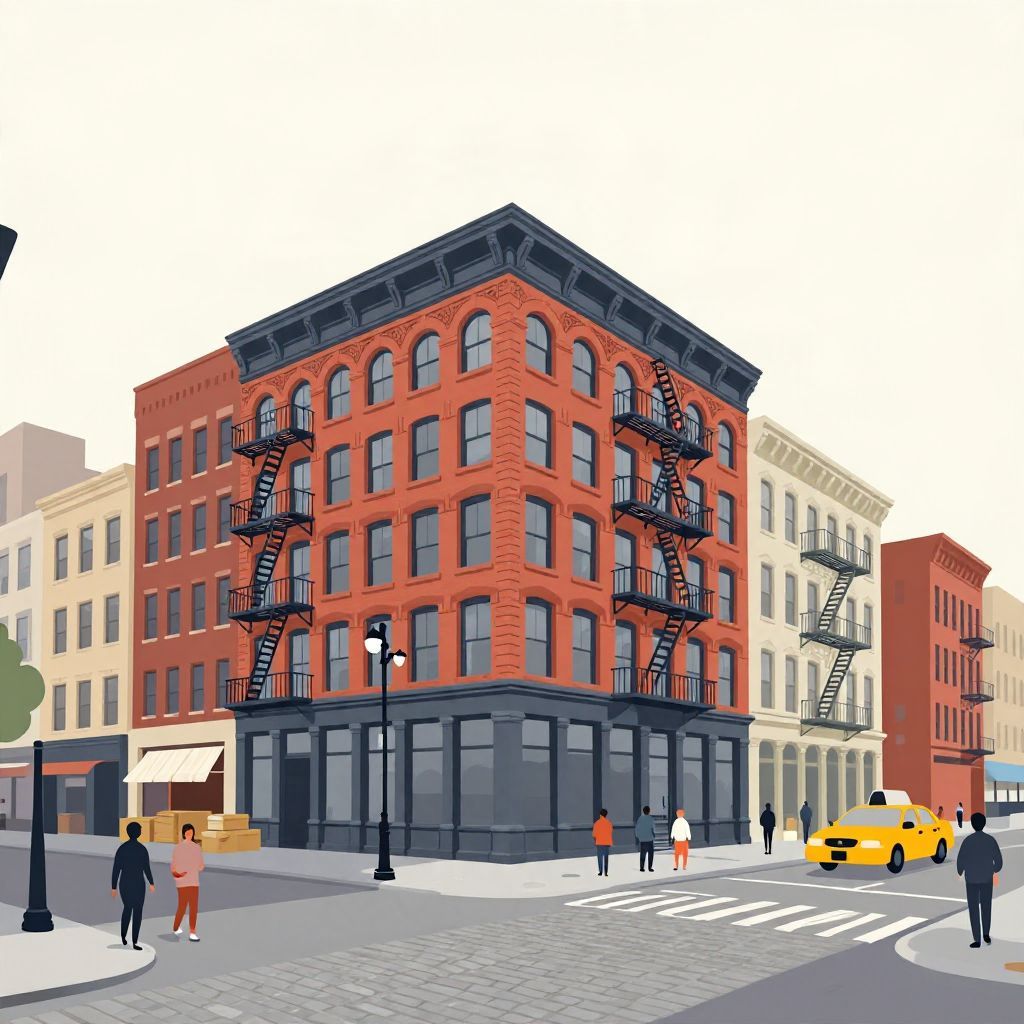
SoHo contains one of the largest collections of cast-iron architecture in the United States. Many buildings date from the 19th century and feature ornate facades made from prefabricated iron elements. This style was practical as well as decorative: it allowed for large windows, open interiors, and relatively quick construction.
Landmark protection and preservation
Preservation became a major issue as development pressures increased. In the 1970s, landmark designation helped protect much of SoHo’s historic building stock. That decision shaped the neighborhood’s future by preserving its industrial-era appearance even as its uses changed dramatically.
SoHo’s changing meaning over time
The meaning of SoHo has evolved. At first, it described a specific geographic area. Later, it became associated with artists, galleries, and urban renewal. Today, many people think of SoHo as a shopping and tourism destination, but its name still points to the neighborhood’s location south of Houston Street.
From artists’ district to retail hotspot
As the neighborhood became more desirable, rents rose and many artists were pushed out. High-end retail stores, restaurants, and luxury development replaced much of the informal creative life that once defined the area. This is a common pattern in urban history: a district becomes attractive because of creative or working-class use, then changes as property values rise.
Why the name still matters
Even though SoHo is now strongly associated with fashion and tourism, the name remains a useful shorthand for the neighborhood’s location and history. It captures the way New York neighborhoods often develop identities through a mix of geography, social change, and cultural branding.
Where SoHo is in Manhattan
SoHo is located in Lower Manhattan, generally south of Houston Street, north of Canal Street, and between roughly West Broadway and Lafayette Street on the east-west axis, though exact boundaries can vary. Its position places it near several historically distinct districts, which is part of why it has long been a crossroads of commerce and culture.
Nearby neighborhoods
- Greenwich Village lies to the north and west.
- NoHo, meaning “North of Houston Street,” lies just above SoHo.
- Tribeca sits to the south and west, with a name that also comes from a directional abbreviation.
- Little Italy and Chinatown are nearby to the east and southeast.
This cluster of neighborhood names shows how New York’s map has been shaped not only by old place names but also by modern shorthand. SoHo is one of the best-known examples of that trend.
Why SoHo’s name became so influential
SoHo helped popularize a style of neighborhood naming that is now common in New York City. Once people understood that SoHo meant “South of Houston Street,” the format became easy to reuse. This made the name memorable and marketable, which mattered in a city where identity and real estate are closely linked.
A model for later neighborhood names
Other New York neighborhoods followed similar naming patterns, especially in areas undergoing redevelopment or rebranding. These names often do more than describe location: they help create a sense of place and can influence how residents, visitors, and investors perceive an area.
Common misconceptions about SoHo
Because the name looks unusual, people sometimes assume SoHo is an old acronym with a hidden historical meaning. In fact, it is straightforward: it simply describes where the neighborhood is. Another misconception is that the name has existed for centuries. It is actually a relatively modern label from the 20th century.
What SoHo is not
- It is not a colonial-era district name.
- It is not a government acronym.
- It is not related to a founding family or a single historic event.
- It is not the same as London’s Soho, even though the names look similar.
The historical significance of SoHo
SoHo matters because it shows how urban neighborhoods can be remade over time. The area moved from industrial use to artistic occupation, then to preservation and commercial success. Its name reflects that transformation: a modern label attached to an older built environment that survived because people found new uses for it.
In that sense, SoHo is more than a neighborhood abbreviation. It is a compact summary of New York history: industry, decline, reinvention, preservation, and commercialization all visible in one small part of Manhattan.
So, to answer the question directly: SoHo stands for “South of Houston Street” in New York City. If you want to explore more about how names and labels shape public understanding, you may also enjoy what FBA means and what a black flag means.