
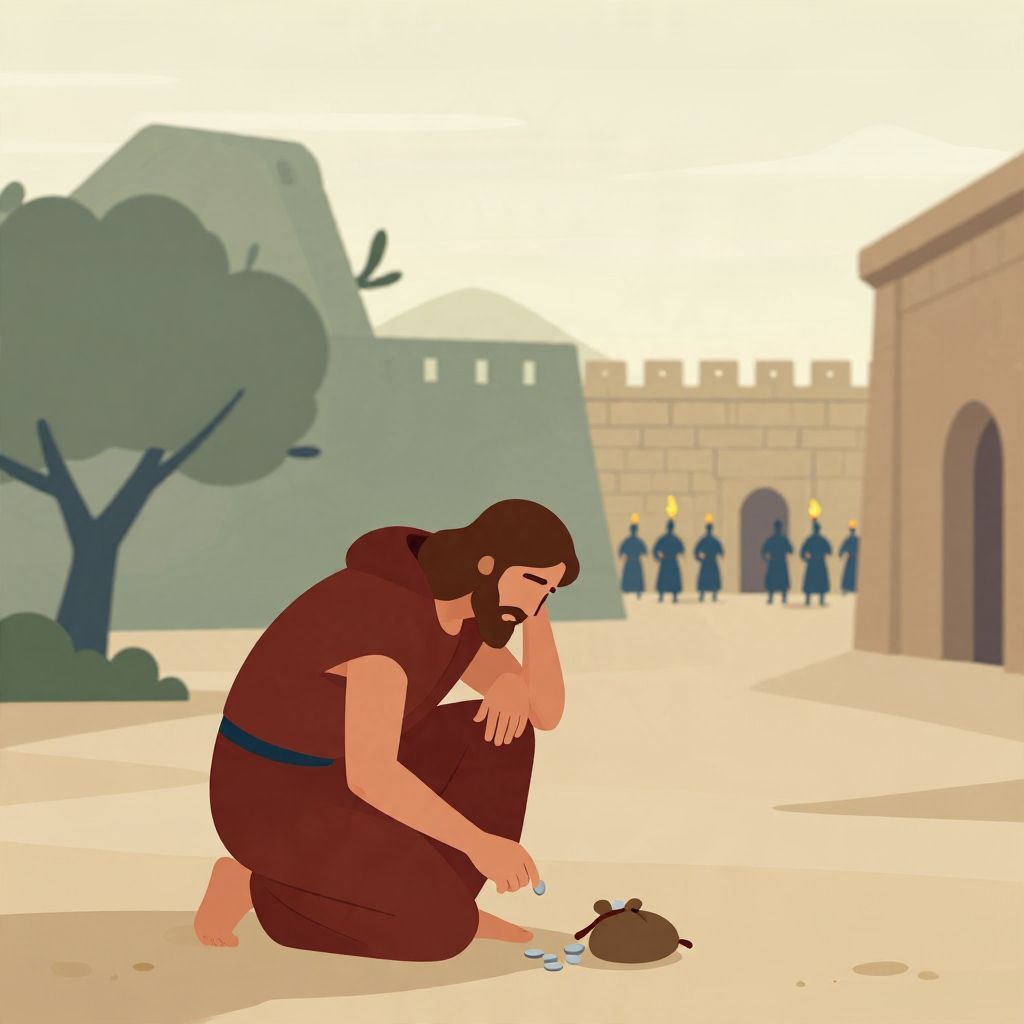
What happened to Judas after he betrayed Jesus is one of the most discussed episodes in the New Testament. The short answer is that the Gospels and Acts give different but related accounts of his fate, and later Christian tradition filled in the gaps with dramatic stories.
Historically, the strongest evidence comes from the biblical texts themselves: Judas disappears from the narrative after Jesus’s arrest, and the early Christian community remembered his death as a warning about betrayal, remorse, and the cost of the Passion.
What happened to Judas after he betrayed Jesus?
According to the New Testament, Judas Iscariot was overcome by remorse after Jesus was condemned. One account says he returned the silver and died by hanging; another says he fell headlong and died in a gruesome accident. These are not identical descriptions, but both present Judas’s end as tragic and tied directly to his betrayal.
The biblical timeline of Judas’s final days
The New Testament does not give a single continuous biography of Judas’s last hours. Instead, it offers a sequence of events that can be pieced together from the Passion narratives and the opening of Acts. The most important point is that Judas’s betrayal led to Jesus’s arrest, and Judas’s own fate followed soon after.
1. Judas arranges the betrayal
In the Gospel tradition, Judas Iscariot agrees to identify Jesus for the authorities. The Gospels of Matthew, Mark, and Luke all present Judas as one of the Twelve who turns against Jesus, though they differ in emphasis. The betrayal is usually linked to money, and Matthew specifies thirty pieces of silver, a detail that became central in later Christian interpretation.
2. Jesus is arrested and condemned
After Judas identifies Jesus in the Garden of Gethsemane, Jesus is arrested and brought before Jewish and Roman authorities. Judas does not remain part of the story during the trial and crucifixion scenes. His role is already complete once the arrest has taken place, and the narrative focus shifts to Jesus’s suffering and death.
3. Judas feels remorse
Matthew’s Gospel says Judas later regrets what he has done. He returns the silver to the chief priests and elders, declaring that he has betrayed innocent blood. This is an important detail because it shows that the tradition did not treat Judas simply as a cold villain; it also portrays him as someone who recognized the moral weight of his act.
4. Judas dies
Here the sources diverge. In Matthew, Judas goes away and hangs himself. In Acts, a different account says that Judas acquired a field with the reward of his wickedness and then fell headlong, with his body bursting open. The two descriptions are not easy to reconcile in a literal sense, but they may preserve different traditions about the same death.
Why do Matthew and Acts describe Judas’s death differently?
The difference between the two accounts has long interested historians and theologians. Ancient writers often preserved more than one tradition, even when the details did not perfectly match. Rather than treating the accounts as a modern newspaper report, scholars usually read them as theological narratives shaped by the needs of each author and community.
Matthew’s version: remorse and suicide
Matthew emphasizes Judas’s guilt and despair. His return of the silver suggests that he realizes the enormity of what he has done, but the story ends with self-destruction. This version highlights personal responsibility and the tragic consequences of betrayal. It also fits Matthew’s broader interest in fulfillment, judgment, and the moral seriousness of Jesus’s rejection.
Acts’ version: a public and shameful end
The opening chapter of Acts presents Judas’s death as part of the early Christian explanation for why the Twelve needed to be restored to twelve apostles after Jesus’s ascension. The graphic account of a fall and bodily rupture gives the story a public, shameful quality. It functions less as a psychological portrait and more as a warning about the fate of one who turned aside from apostolic calling.
Can the two accounts be harmonized?
Some later interpreters have tried to combine the accounts by suggesting that Judas hanged himself and later his body fell and burst open. That is possible as a harmonizing reading, but it is not stated explicitly in either text. Historically speaking, the safest conclusion is that the New Testament preserves two different traditions about Judas’s death, both of which agree that he died soon after the betrayal and that his end was considered disastrous.
What happened to the silver Judas received?
Matthew says Judas returned the thirty pieces of silver to the priests. Because the money was considered blood money, the priests used it to buy a potter’s field as a burial place for foreigners. This detail became important in Christian memory because it linked Judas’s betrayal to a lasting place in Jerusalem’s landscape and gave the story a concrete aftermath.
The “Field of Blood”
Acts also refers to a field associated with Judas’s death, while Matthew explains that the site became known as the Field of Blood. The name probably reflects both the money’s tainted origin and the violent end associated with Judas. Whether the field was a real location known to early Christian communities or a symbolic narrative device is debated, but the tradition clearly intended it to mark the consequences of betrayal.
What did early Christians think happened to Judas?
Early Christians generally viewed Judas as a cautionary figure. He was remembered not just as a traitor, but as a man who had been close to Jesus and yet fell away. That made his story especially powerful in Christian preaching and teaching, because it showed that proximity to holiness did not guarantee faithfulness.
Judas as a symbol of betrayal
By the second century and later, Judas had become the standard biblical example of betrayal for many Christian writers. His name entered Christian language as a byword for treachery. At the same time, different traditions tried to explain his motives in various ways: greed, disillusionment, demonic influence, or a tragic inability to cope with guilt.
Was Judas condemned forever?
The New Testament does not give a simple doctrinal statement about Judas’s eternal fate. Later Christian tradition often assumed that he was damned, but that is a theological interpretation rather than a single explicit biblical verdict. The texts focus more on the earthly consequences of his betrayal than on a final judgment scene.
How historians approach Judas’s story
For historians, Judas is a figure at the intersection of history, theology, and memory. We can say with confidence that the early Christian movement preserved a strong tradition that one of Jesus’s own followers betrayed him and died shortly afterward. Beyond that, the precise details are harder to establish because our sources are literary and religious texts, not neutral biographical records.
What is historically secure?
- Judas Iscariot was remembered as one of Jesus’s Twelve disciples.
- He was associated with Jesus’s arrest and betrayal.
- Early Christian texts agree that he died not long afterward.
- The manner of his death is reported differently in Matthew and Acts.
- His story became central to Christian reflection on guilt, remorse, and betrayal.
What remains uncertain?
- The exact motive for Judas’s betrayal.
- The precise historical manner of his death.
- Whether the field traditions in Matthew and Acts refer to the same location.
- How much later interpretation shaped the details of the story.
Why Judas’s aftermath mattered so much
Judas’s end mattered because the Passion story is not only about Jesus’s death; it is also about the human responses surrounding it. Judas represents betrayal from within the circle of discipleship, and his aftermath shows how deeply the earliest Christians thought betrayal could wound both the victim and the betrayer.
His story also helped the early church explain continuity after loss. If one apostolic figure fell away, another could take his place. That idea appears in Acts, where the community seeks to restore the Twelve. In that sense, Judas’s death was not just an ending; it was part of the transition from Jesus’s earthly ministry to the life of the early church.
The lasting legacy of Judas’s story
Over time, Judas became one of the most recognizable figures in Western religious memory. Artists, preachers, and writers used his story to explore greed, remorse, despair, and the danger of broken trust. Yet the historical core remains relatively simple: after betraying Jesus, Judas disappeared from the story, and the surviving traditions remembered his death as tragic and shameful.
So, what happened to Judas after he betrayed Jesus? In the earliest Christian sources, he was overwhelmed by remorse and died soon afterward, though the New Testament gives two different descriptions of how that death occurred. The broader historical significance lies in how his fate shaped Christian memory of betrayal, responsibility, and the aftermath of the crucifixion. For related background, see what the name Judas means and where Jesus was buried.