
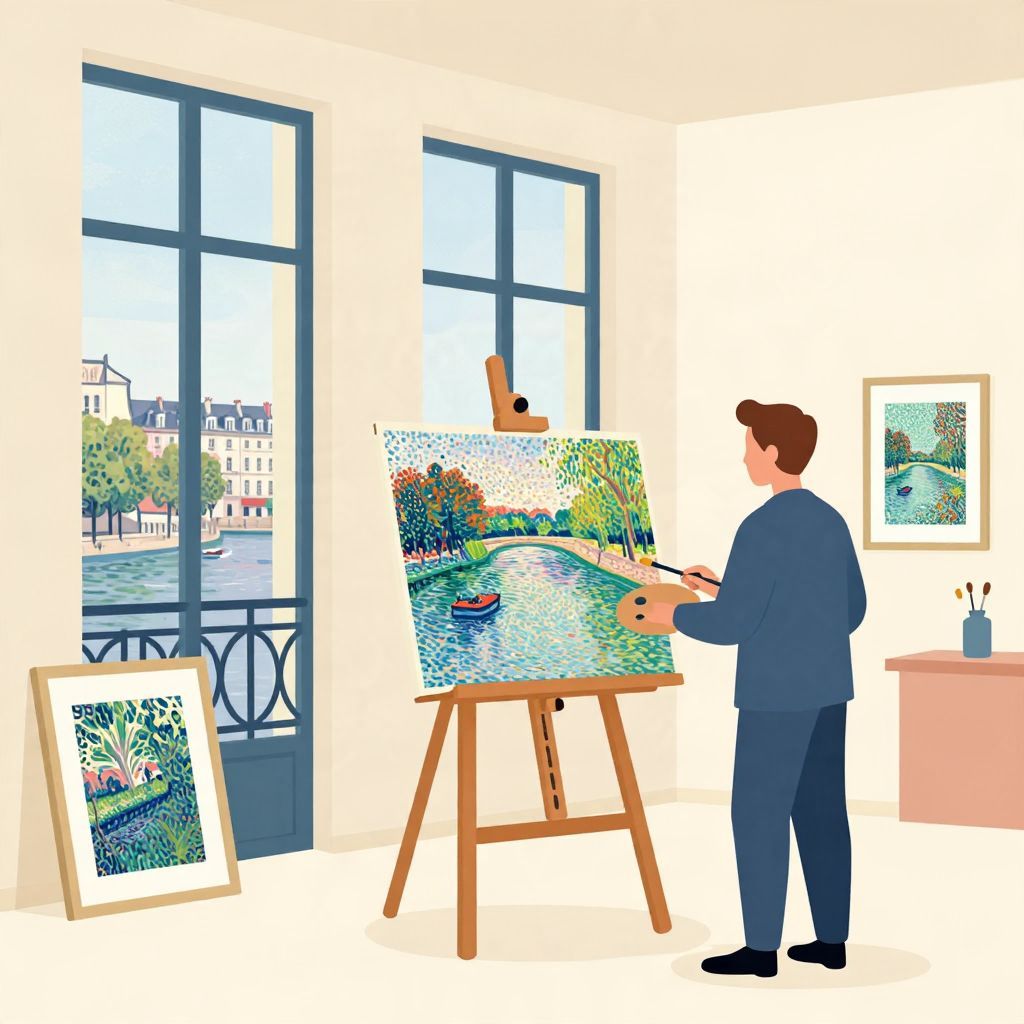
What is pointillism in art? It is a painting technique that builds an image from many small dots or touches of pure color placed side by side. When seen from a distance, the eye blends these marks into tones and forms, creating a shimmering visual effect.
Pointillism emerged in late 19th-century France, especially through the work of Georges Seurat and Paul Signac. It was both an artistic method and a response to new ideas about color, light, and modern painting, and it became one of the most recognizable styles associated with Neo-Impressionism.
What Is Pointillism in Art?
Pointillism is a painting technique in which artists apply tiny dots or small strokes of separate colors rather than mixing pigments on a palette. The viewer’s eye blends the colors optically at a distance. The method is most closely linked to Georges Seurat in the 1880s and is a hallmark of Neo-Impressionist art.
How Pointillism Developed
Pointillism did not appear out of nowhere. It grew out of Impressionism, the movement that had already challenged academic painting by focusing on modern life, light, and fleeting visual impressions. Some artists wanted to make those effects more systematic and scientifically grounded. Pointillism was one answer to that ambition.
The scientific background
In the 19th century, artists and critics were increasingly interested in color theory. Writers such as Michel Eugène Chevreul and Ogden Rood studied how colors interact, contrast, and appear to the eye. Their ideas suggested that placing complementary colors next to one another could intensify brightness and vibrancy. Seurat and his circle adapted these theories into painting practice.
Rather than blending blue and yellow into green on the palette, a pointillist painter might place blue dots beside yellow ones. From a distance, the viewer perceives a lively green. This optical mixing was central to the style. It aimed to create luminosity that could be dulled by physical mixing of pigments.
Georges Seurat and the origins of the style
Georges Seurat is the key figure in the history of pointillism. Working in Paris in the 1880s, he developed a highly disciplined approach to painting. His best-known work, A Sunday Afternoon on the Island of La Grande Jatte (painted between about 1884 and 1886), became a landmark of the new method. The painting is often treated as the clearest early example of pointillism, though the term itself was not always used consistently at the time.
Seurat was not simply making decorative dots. He was trying to control composition, light, and color with unusual precision. His approach gave his paintings a calm, structured quality that differed from the looser brushwork of many Impressionists. The result was both modern and highly formal.
Why Did Artists Use Pointillism?
Artists used pointillism to explore how the eye perceives color and light, and to give paintings a brighter, more luminous surface. The technique also reflected a broader late 19th-century interest in science, order, and experimentation. For some painters, it offered a way to make art feel modern while still grounded in careful method.
Artistic goals
- Brightness: separate dots of pure color can appear more vivid than mixed paint.
- Optical blending: the viewer’s eye combines colors at a distance.
- Structure: the method encourages careful planning and controlled composition.
- Modernity: it aligned with contemporary interest in science and perception.
Pointillism was not just a technical trick. It also expressed a larger artistic idea: that painting could be built from a rational system rather than from spontaneous brushwork alone. That made it attractive to artists who wanted both innovation and discipline.
Pointillism and Neo-Impressionism
Pointillism is often associated with Neo-Impressionism, the movement that developed around Seurat and Paul Signac in the 1880s. Neo-Impressionism was not identical to pointillism, but the two are closely connected. Neo-Impressionism was the broader artistic movement; pointillism was one of its most distinctive techniques.
Seurat, Signac, and the movement
Paul Signac became the most important advocate of the style after Seurat’s early death in 1891. He helped explain and popularize the technique through his paintings and writings. Other artists experimented with related methods, though not all used dots in the strict sense associated with pointillism.
The movement also had intellectual ambitions. Its supporters believed that art could be made more harmonious and exact through systematic color relationships. In this sense, pointillism was part of a broader late 19th-century search for order in a rapidly changing modern world.
How Pointillism Works Visually
Pointillism depends on the viewer’s distance from the painting. Up close, the canvas may look like a field of scattered marks. Step back, and the image resolves into figures, landscapes, or scenes. This shift between near and far is one of the technique’s most striking features.
Key visual effects
- Small marks: paint is applied in dots or short touches.
- Pure color: hues are often placed unmixed on the canvas.
- Optical mixing: the viewer’s eye blends the colors.
- Shimmering surface: the image can seem to vibrate or sparkle.
The method can produce a sense of light that feels especially vivid in outdoor scenes, water, and skies. But it also requires patience and careful planning, since the final effect depends on the placement of many individual marks.
Common Misconceptions About Pointillism
One common misconception is that pointillism means any painting made with dots. In historical terms, the style is more specific than that. It refers to a technique developed within Neo-Impressionism, especially in the work of Seurat and Signac. Decorative dot patterns in other traditions are not automatically pointillist.
Another misunderstanding is that pointillism was simply about copying nature with dots. In fact, it was a deliberate artistic theory about color and perception. The dots were not the goal in themselves; they were the means to create a particular optical effect.
Pointillism vs. divisionism
The terms pointillism and divisionism are related but not identical. Divisionism refers more broadly to the separation of colors into small units for optical effect. Pointillism is the dot-based version of that approach. In practice, historians and art critics sometimes use the terms interchangeably, though divisionism is the wider concept.
Important Artists Associated with Pointillism
Several artists are closely tied to the style, though not all used it in the same strict way. Seurat remains the central figure, but others adapted the method to their own goals.
- Georges Seurat — the leading pioneer of pointillism and Neo-Impressionism.
- Paul Signac — Seurat’s collaborator and the movement’s strongest advocate after Seurat’s death.
- Henri-Edmond Cross — developed related techniques with brighter, more decorative color.
- Camille Pissarro — briefly experimented with Neo-Impressionist methods later in his career.
These artists show that pointillism was not a rigid formula. Some used it more strictly than others, and many adapted it over time. The movement’s influence spread beyond its original French setting, though its core identity remained tied to Parisian avant-garde culture.
What Is the Historical Significance of Pointillism?
Pointillism matters because it marked a turning point in modern art. It showed that painting could be based on theory as well as observation, and that color itself could become the subject of systematic experimentation. It also helped open the door to later modernist approaches that valued structure, abstraction, and visual analysis.
Its legacy in modern art
Pointillism influenced later artists in different ways. Some admired its luminous color and disciplined composition. Others borrowed its broken surface or scientific interest in perception without using dots literally. Its importance lies less in the exact technique than in the broader idea that a painting could be constructed from carefully studied visual units.
Although pointillism was never the dominant style of its era, it became highly recognizable and influential. It offered a bridge between Impressionism and later modern art movements by combining close observation with a more analytical method.
How to Recognize a Pointillist Painting
If you want to identify a pointillist work, look for a few consistent features. The image is usually composed of many small, separate marks. The colors often appear bright and unmixed. From a distance, the scene resolves into a coherent whole, while up close the surface may look fragmented or abstract.
- Small dots or short brushstrokes dominate the surface
- Colors are placed side by side rather than blended smoothly
- The painting often changes noticeably with viewing distance
- Light and color effects are emphasized over loose spontaneity
Not every painting with dots is pointillist, but these features are strong clues. The best-known examples make the optical effect part of the artwork’s meaning, not just its appearance.
Conclusion
Pointillism is a late 19th-century painting technique that uses tiny dots of color to create images through optical mixing. Closely associated with Georges Seurat and Paul Signac, it grew from Neo-Impressionist ideas about science, color, and visual perception. Its lasting importance lies in how it changed the way artists thought about painting, light, and the act of seeing. For more on related art history themes, explore broader studies of Impressionism and modern art movements.