
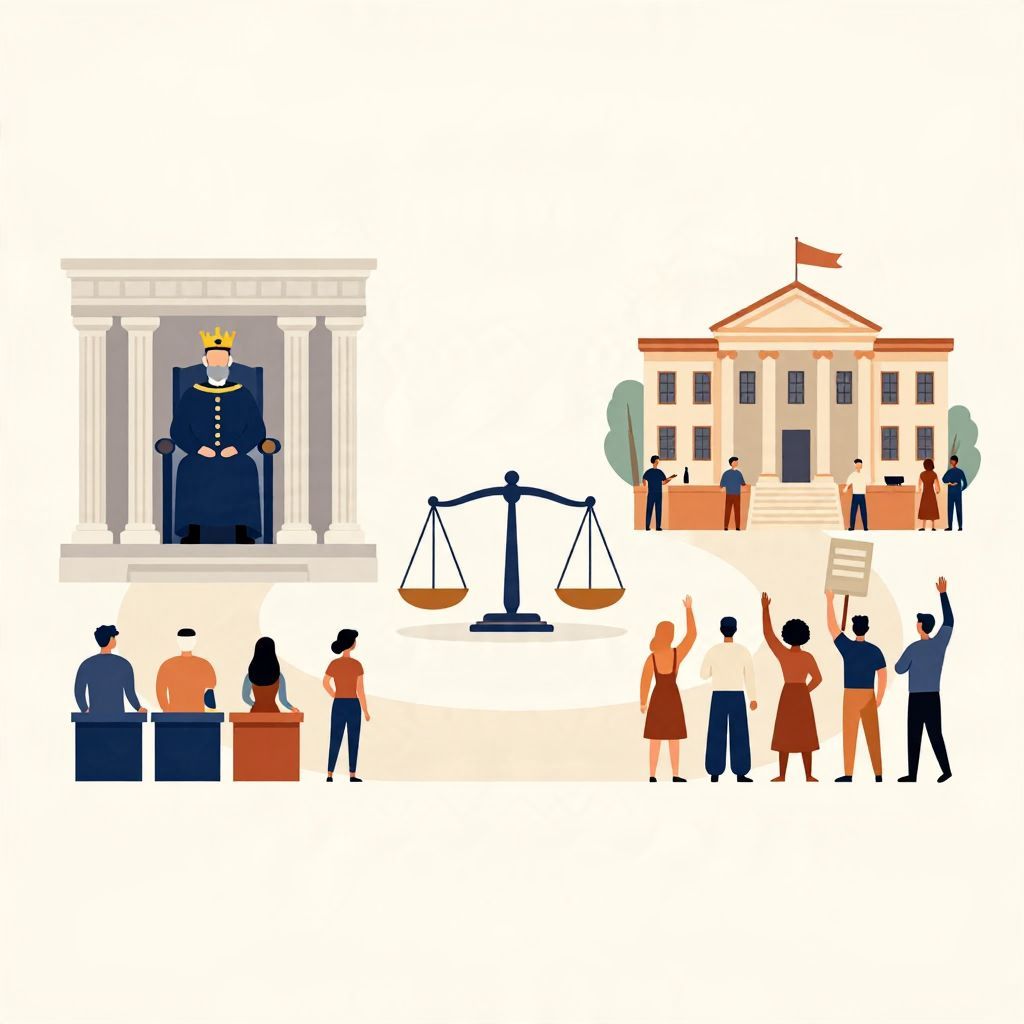
What is political change? In history, it refers to shifts in how power is organized, who holds authority, and how governments make decisions. It can happen gradually through reform or suddenly through revolution, war, collapse, or election.
Political change has shaped empires, nations, and everyday life for thousands of years. Understanding it means looking at causes, key turning points, and the long-term effects on laws, institutions, and people’s rights.
What Is Political Change?
Political change is the alteration of a political system, leadership, policy, or balance of power. It may involve new rulers, new constitutions, expanded voting rights, regime collapse, or a complete transformation of the state. Historians study it to explain how societies adapt to conflict, pressure, and new ideas.
How Historians Define Political Change
Political change is not limited to one event. It can be a single dramatic break, such as a revolution, or a slow process, such as the growth of representative government. The core question is always the same: who governs, by what rules, and with what legitimacy?
Common forms of political change
- Reform — gradual change within an existing system, such as extending voting rights or changing laws.
- Revolution — rapid and often forceful replacement of a political order.
- Coup d’état — a sudden seizure of power, usually by a small group.
- State collapse — the weakening or breakdown of central authority.
- Constitutional change — rewriting the rules that define government and rights.
These categories can overlap. For example, a revolution may lead to constitutional reform, and a reform movement may become revolutionary if leaders resist compromise.
Where Did Political Change Come From Historically?
Political change is as old as organized government itself. Once societies developed chiefs, kings, councils, and states, disputes over authority became unavoidable. Ancient kingdoms, city-states, and empires all experienced succession struggles, rebellions, reforms, and collapses as rulers tried to maintain control.
In early history, political change often came through conquest or dynastic replacement. A new ruler might inherit power, seize it in war, or be overthrown by rivals. Over time, however, political change also came from institutions and ideas: written law, assemblies, religious authority, citizenship, and later concepts such as popular sovereignty and nationalism.
Ancient and classical examples
In ancient Mesopotamia, Egypt, China, Greece, and Rome, political systems changed in response to war, economic pressure, and internal conflict. Athens developed more participatory institutions over time, while Rome moved from monarchy to republic and eventually to imperial rule. These transitions were not smooth or inevitable; they reflected intense struggles among elites, soldiers, and ordinary people.
In imperial China, dynastic change was often explained through the idea of the “Mandate of Heaven,” a belief that a dynasty lost legitimacy when it failed to govern properly. This was both a political theory and a way of interpreting collapse, rebellion, famine, and invasion. It shows that political change has always involved both material conditions and ideas about rightful rule.
What Causes Political Change?
Political change usually happens because existing arrangements no longer satisfy enough people, or because outside forces make the old system unsustainable. Economic crisis, war, inequality, corruption, demographic pressure, and new ideologies are among the most common causes. Often several of these factors combine.
Major historical causes
- War and military defeat — defeats can weaken rulers, drain resources, and expose state weakness.
- Economic distress — taxes, inflation, famine, or unemployment can fuel unrest.
- Social inequality — excluded groups may demand representation or rights.
- Leadership crises — weak succession, corruption, or personal rule can destabilize governments.
- New ideas — religious reform, liberalism, nationalism, socialism, or democracy can challenge old authority.
- Technology and communication — printing, railways, telegraphs, radio, television, and the internet have all helped spread political ideas faster.
Historians rarely treat one cause as sufficient on its own. For example, the French Revolution was shaped by fiscal crisis, social inequality, political deadlock, and Enlightenment ideas. The Russian Revolutions of 1917 emerged from war, food shortages, and the collapse of confidence in the tsarist regime.
How Political Change Happens
Political change can be peaceful or violent, legal or extra-legal. In some cases, it occurs through elections, constitutional amendments, and negotiations. In others, it comes through mass protest, armed revolt, or foreign intervention. The method matters because it shapes the legitimacy and durability of the new order.
Gradual change through reform
Reform is often the most stable path. Governments may expand suffrage, reduce censorship, improve labor protections, or redesign institutions to answer public pressure. Britain’s 19th-century Reform Acts, for example, slowly widened political participation without overthrowing the monarchy. Similar patterns appeared in many countries where elites accepted limited change to avoid deeper crisis.
Sudden change through revolution
Revolution usually occurs when compromise breaks down. The English Civil Wars in the 17th century, the French Revolution beginning in 1789, and the Russian Revolution in 1917 all transformed political authority in dramatic ways. Yet revolutions do not always produce lasting democracy; they can lead to terror, civil war, dictatorship, or new forms of authoritarian rule.
Change through collapse or invasion
Some political systems change because they cannot survive external pressure. The fall of the Western Roman Empire in the 5th century was not a single event but a long process of fragmentation, military strain, and loss of central control. In other cases, conquest or colonization imposed new political structures from outside, often with lasting consequences for local societies.
Key Turning Points in Political History
Several broad historical developments reshaped political change across the world. These shifts did not happen everywhere at once, but they altered expectations about government and authority.
The rise of constitutionalism
From the medieval period onward, rulers in some regions were increasingly constrained by law, custom, or representative bodies. The Magna Carta of 1215 is often remembered as a symbol of limited monarchy, though its original impact was narrower than later mythology suggests. Over time, however, the idea that rulers could be bound by law became central to many political systems.
The age of revolutions
From the late 18th century through the 19th century, Atlantic and global revolutions challenged monarchy, empire, and inherited privilege. The American Revolution, French Revolution, Haitian Revolution, and various independence movements in Latin America all redefined political legitimacy. This era made “the people” a powerful political idea, though not always an inclusive one.
The expansion of democracy
In the 19th and 20th centuries, many states expanded voting rights and parliamentary power. This process was uneven and often contested. Women, colonized peoples, racial minorities, and working-class men frequently had to fight for inclusion. Political change therefore meant not only new institutions, but struggles over who counted as a political subject.
Decolonization and new states
After World War II, empires in Asia, Africa, and the Middle East gave way to independent states. Political change in this period was driven by anti-colonial movements, international pressure, and the weakening of European imperial power. Independence did not automatically produce stable democracy, but it redrew the political map of the modern world.
Political Change and Power
At its heart, political change is about power: who has it, how it is justified, and how it is limited. A change in government may look dramatic, but the deeper question is whether power has actually moved to new groups or simply changed hands among old elites.
That is why historians distinguish between surface change and structural change. A new leader may promise reform while preserving the same social hierarchy. Conversely, a legal reform may seem modest but gradually transform the relationship between citizens and the state. Political change is often best understood by tracing both visible events and underlying shifts in authority.
Legitimacy matters
Governments survive not only through force but also through legitimacy, meaning the belief that their rule is rightful. Political change often begins when legitimacy weakens. People may stop trusting a king, reject a party system, or question colonial rule. Once legitimacy erodes, even a powerful state can become unstable.
What Are the Effects of Political Change?
Political change can alter nearly every part of society. It may change laws, taxation, military service, education, property rights, and freedom of speech. It can also reshape identity by creating new nations, redefining citizenship, or encouraging people to think of themselves as members of a political community.
Long-term consequences
- New institutions — parliaments, courts, ministries, or constitutions may replace older systems.
- Expanded rights — some changes increase participation and civil liberties.
- Conflict and instability — rapid change can trigger civil war, repression, or backlash.
- Social transformation — political change often affects class relations, gender roles, and education.
- Historical memory — later generations may celebrate, condemn, or reinterpret the event.
Not every political change is progressive in the modern sense. Some transitions have strengthened authoritarian rule, restricted rights, or intensified exclusion. Historians therefore avoid assuming that change always means improvement.
How to Recognize Political Change in History
When studying any historical period, political change can be identified by asking a few practical questions: Who rules? How did they gain power? What institutions support them? Who is excluded? What laws or ideas justify the system? Answers to these questions reveal whether a society is stable, reforming, or in crisis.
Useful signs historians look for
- Changes in leadership or ruling dynasties
- New constitutions, laws, or assemblies
- Mass protests, rebellions, or civil wars
- Shifts in voting rights or representation
- Foreign conquest, occupation, or decolonization
- New political ideas spreading through print, schools, or media
Why Political Change Still Matters
Political change is one of the main forces shaping history because it determines how societies organize power and respond to crisis. It helps explain the rise and fall of states, the spread of rights, and the creation of modern governments. It also reminds us that political systems are made by people and can be altered by people.
In historical terms, political change is never just about leaders at the top. It is also about pressure from below, ideas in circulation, and the institutions that connect rulers to the ruled. For related reading, see what political ideology is and what political reform is.