
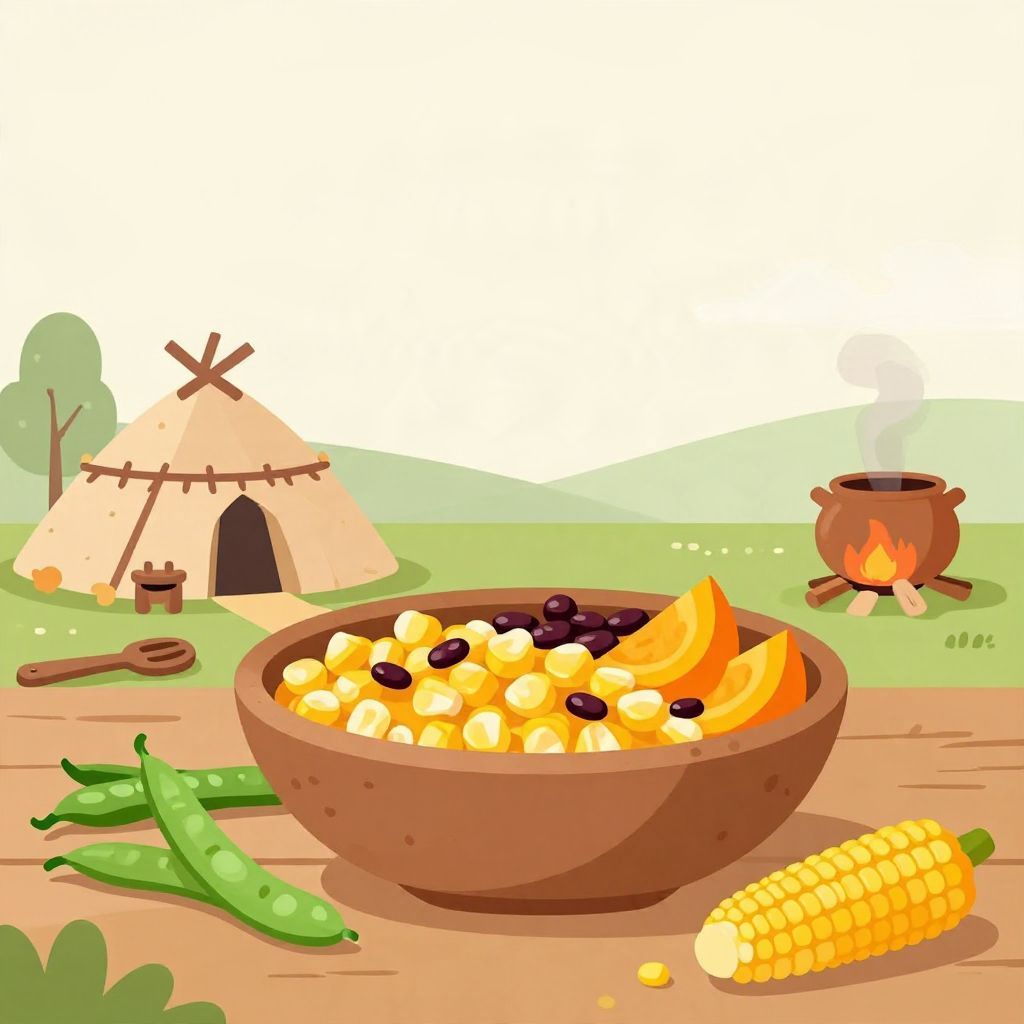
What is succotash? At its simplest, succotash is a dish made from corn and beans, often with squash, peppers, tomatoes, or other vegetables added. Today it is usually treated as a hearty side dish in American cooking, but its history reaches back much farther than the modern recipe.
Succotash is closely tied to Indigenous North American foodways and to the long exchange of crops and cooking practices between Native peoples, colonists, and later American regional cuisines. Its story is not just about a recipe; it is about survival, agriculture, adaptation, and the blending of culinary traditions over time.
What Is Succotash?
Succotash is a dish built around corn and beans, two crops that were foundational in Indigenous agriculture across the Americas. In many versions, lima beans or other shelled beans are cooked with sweet corn and sometimes enriched with butter, cream, onions, peppers, or summer squash. The basic idea is simple: combine ingredients that complement one another in flavor, texture, and nutrition.
Historically, succotash is best understood as an American dish with Native American roots rather than a single fixed recipe. It has never had one universal formula. Instead, it has changed by region, season, and household, which is one reason it remains recognizable yet flexible.
The Indigenous Origins of Succotash
Corn and beans in Native agriculture
The roots of succotash lie in the agricultural traditions of Indigenous peoples of North America, especially the cultivation of maize, beans, and squash. These crops were often grown together in ways that supported one another. Corn provided a stalk for beans to climb, beans helped enrich the soil, and squash spread along the ground, shading weeds and helping retain moisture.
This agricultural system is sometimes called the “Three Sisters,” though the name itself is not a universal Indigenous term. The practice, however, is ancient and widespread. Long before Europeans arrived, Native communities had developed sophisticated farming systems that made corn and beans central to daily life.
A dish shaped by Native food knowledge
Succotash likely emerged from these broader food traditions rather than from a single inventor or moment. The combination of corn and beans reflects a practical and nutritional logic: together they provide a more complete balance of carbohydrates and protein than either crop alone. That made the dish especially valuable in communities where food had to be nourishing, seasonal, and economical.
Because Indigenous cooking traditions were diverse, it is more accurate to say that succotash developed from Native American culinary practices than to assign it to one tribe or one exact origin date. The dish became known more widely through contact with English colonists in New England, but its deeper background is Indigenous.
How the Word “Succotash” Entered English
The term succotash is generally traced to an Algonquian-language word or related set of words for boiled corn or a dish made from corn. Scholars have proposed several spellings and forms, and the exact linguistic pathway is not fully settled. What is clear is that the word entered English through contact with Native languages in eastern North America.
By the 17th and 18th centuries, English colonists in New England were using forms of the word to describe a corn-based dish they had learned about from Native peoples. As with many loanwords, spelling varied widely before standard English usage settled on “succotash.”
Succotash in Colonial America
A practical dish in a new environment
For colonists in North America, succotash was appealing because it used ingredients that could be grown locally and stored for winter use. Maize, beans, and squash adapted better to many parts of the continent than the grains Europeans had relied on at home. Colonists gradually learned from Native agricultural knowledge, even as colonial expansion often disrupted Indigenous land and food systems.
In colonial kitchens, succotash was not always the creamy side dish many people imagine today. Early versions were likely simpler, closer to boiled corn and beans seasoned with fat or salt. The dish fit a broader pattern of colonial adaptation: European settlers borrowed ingredients and methods from Native communities while also reshaping them to suit their own tastes.
Seasonality and preservation
Succotash also reflected the seasonal rhythm of harvest life. Fresh corn and beans were summer and early autumn foods, and people often preserved surplus crops by drying or shelling them for later use. In this way, succotash was connected to both immediate abundance and winter survival. Its ingredients were humble, but their reliability made them important.
How Succotash Changed Over Time
From Indigenous staple to regional American dish
As American cuisine developed, succotash became associated especially with New England and the Mid-Atlantic, though versions spread far beyond those regions. Over time, cooks added ingredients such as butter, cream, onions, salt pork, and later tomatoes or peppers. The dish moved from a largely Native and colonial food context into a broader regional American tradition.
By the 19th century, succotash appeared in cookbooks and household guides, usually as a side dish or vegetable preparation. Its ingredients often reflected local availability. In some places, lima beans became common; in others, fresh shell beans or field corn were preferred. The dish remained adaptable, which helped it survive changing tastes.
Southern and African American influences
Succotash also belongs to the larger history of Southern foodways, where corn and beans were central staples. Enslaved Africans and their descendants contributed profoundly to American cooking, especially in the South, where knowledge of crops, stews, seasonings, and preservation methods shaped everyday meals. While succotash is not exclusively a Southern dish, its evolution was part of a wider culinary world influenced by Indigenous, African, and European traditions.
This is important because American food history is often told too narrowly. Succotash did not develop in isolation. It emerged through centuries of exchange, coercion, migration, and adaptation. The dish’s survival reflects the resilience of ingredients and the people who prepared them.
What Counts as Succotash Today?
Common modern ingredients
Modern succotash usually includes some combination of:
- corn kernels, fresh or frozen
- lima beans or other shell beans
- butter or oil
- onions or scallions
- peppers, tomatoes, or squash
- salt, herbs, and sometimes cream
There is no single official recipe. Some versions are light and vegetable-forward, while others are rich and buttery. The dish can be served as a side, a vegetarian main, or part of a larger meal. What makes it succotash is the core pairing of corn and beans, along with the dish’s historical identity.
Regional variation
In New England, succotash may lean toward butter and cream, reflecting older Yankee cooking styles. In the South, it may be made with field peas, fresh corn, okra, or bacon. In contemporary kitchens, cooks often emphasize summer vegetables and keep the dish lighter. These variations show how a historical food can remain alive without staying fixed.
Why Succotash Matters in American History
Succotash matters because it reveals how food history works. A dish can preserve older traditions even as it changes shape. In this case, succotash preserves Indigenous agricultural knowledge while also showing how colonists adopted Native foods and transformed them into new regional customs.
It also reminds us that American cuisine grew from contact and conflict. The same processes that spread crops and recipes also involved dispossession of Native lands and pressure on Indigenous communities. So when succotash is remembered only as a quaint side dish, part of its deeper history is lost. It is a food of exchange, but also of unequal power.
Succotash in memory and symbolism
By the 20th century, succotash had become a familiar but somewhat old-fashioned American dish, often associated with home cooking, harvest tables, and Thanksgiving-style meals. Its presence in holiday settings reflects a broader tendency to connect certain foods with ideas of tradition and national identity, even when their origins are much older and more complex.
That symbolic role has helped keep succotash visible, but it has also simplified its story. The dish is not merely a nostalgic relic. It is a living example of how Indigenous foodways shaped American life from the beginning.
Key Facts About Succotash
- Main ingredients: traditionally corn and beans
- Historical roots: Indigenous North American agriculture and cooking
- Word origin: derived from an Algonquian-language term, though exact linguistic details are debated
- Colonial adoption: English colonists in New England adopted the dish and the name
- Modern form: often includes lima beans, butter, onions, peppers, or squash
- Cultural significance: a symbol of Native influence on American cuisine
The Historical Meaning of Succotash
So, what is succotash? It is a corn-and-bean dish with deep Indigenous roots and a long American history. Its ingredients tell a story of agricultural ingenuity, while its name records the meeting of Native languages and English colonial culture. Over time, succotash became a regional comfort food, but its origins remain far older than the modern table.
To understand succotash is to understand that American food history was built through Indigenous knowledge, adaptation, and exchange. For more on the cultural setting that helped shape traditional American dishes, see where Thanksgiving originated and what American imperialism was.