
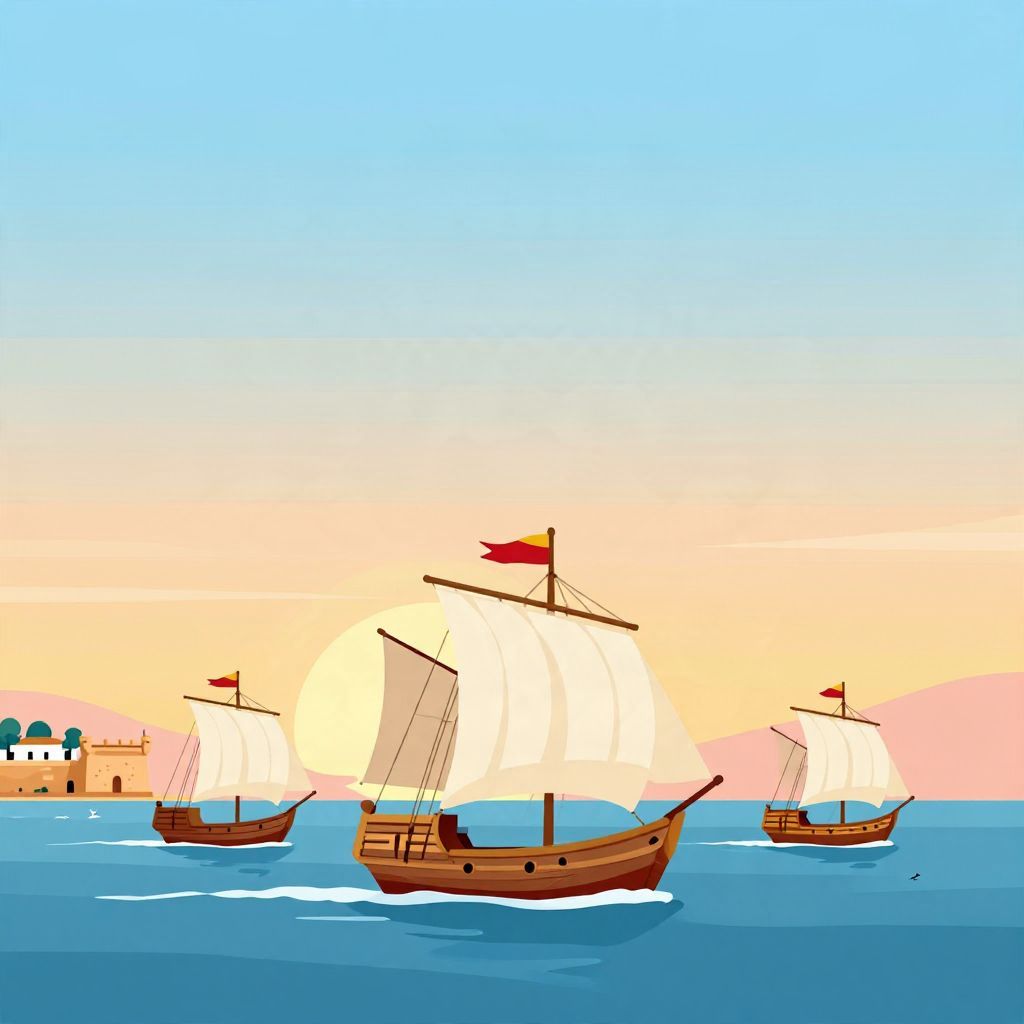
“When did Christopher Columbus sail the ocean blue?” is a familiar history question because the phrase appears in school rhymes and popular memory. The short answer is that Columbus set out on his first transatlantic voyage on August 3, 1492, and he reached the Americas on October 12, 1492.
The famous rhyme points to one of the best-known voyages in European history, but the story behind it is more complicated than the slogan suggests. Columbus did not “discover” an empty world, and his expedition was only the beginning of a much larger era of exploration, conquest, and exchange across the Atlantic.
When did Christopher Columbus sail the ocean blue?
Christopher Columbus sailed from Spain on August 3, 1492, aboard the Santa María, with the Pinta and Niña in his fleet. He reached land in the Caribbean on October 12, 1492. If the question asks for the date of the voyage itself, the key answer is August 3, 1492.
What happened on Columbus’s first voyage?
Columbus’s first voyage was an attempt to reach Asia by sailing west across the Atlantic. Backed by Spain’s Catholic Monarchs, Ferdinand and Isabella, he departed from Palos de la Frontera in southern Spain. After weeks at sea, he landed in the Bahamas, believing he had reached islands near Asia rather than a separate continent.
The departure from Spain
Columbus sailed on August 3, 1492, after years of trying to win support for his plan. His fleet was small: two caravels, the Pinta and Niña, and one larger ship, the Santa María. This was not a grand imperial armada, but a risky expedition financed in the context of late medieval Iberian competition for trade and prestige.
The Atlantic crossing
The crossing took more than five weeks. Columbus and his crew faced uncertainty, rough seas, and growing anxiety as land remained out of sight. On October 12, 1492, land was sighted in the Bahamas. Columbus named the island San Salvador, though the exact island he reached is still debated by historians and geographers.
Why the date matters
August 3, 1492 matters because it marks the beginning of Columbus’s first voyage, while October 12 marks his first landfall in the Caribbean. In popular memory, these dates are often blended together. If someone asks when Columbus “sailed the ocean blue,” the most precise answer is the departure date, not the landing date.
Why do people remember Columbus with the phrase “sail the ocean blue”?
The phrase comes from a children’s rhyme used to help students remember the year 1492. It is not a historical quote from Columbus’s time. The line is memorable because it turns a complex voyage into a simple date, but it also reflects how history is often taught through rhyme, repetition, and shorthand.
A school memory, not a primary source
There is no evidence that Columbus or his contemporaries used the phrase “sail the ocean blue.” That wording is a later educational device. The rhyme has helped generations remember the year, but it can also flatten the historical context. Columbus’s voyage was not a lone heroic leap into the unknown; it was part of a broader Atlantic world already inhabited by Indigenous peoples and connected by trade, politics, and migration.
Why did Columbus sail in 1492?
Columbus sailed in 1492 because he believed a westward route to Asia would be faster and more profitable than the long eastern routes controlled by other powers. He also sailed at a moment when Spain was expanding its influence after the completion of the Reconquista in Granada and was eager to compete with Portugal in overseas exploration.
The search for a western route
By the late 15th century, Europeans wanted direct access to Asian spices, silk, and luxury goods. Columbus argued that the Atlantic could be crossed to reach Asia, though he seriously underestimated the size of the earth. His calculations made the journey seem more feasible than it really was.
Spanish sponsorship
Spain’s rulers agreed to support Columbus after years of negotiation. Their backing reflected both ambition and risk. They hoped for trade, wealth, and strategic advantage, but they could not know that the voyage would lead to sustained European contact with lands previously unknown in Europe.
Was Columbus really the first European to reach the Americas?
No. Columbus was not the first human being to arrive in the Americas, since Indigenous peoples had lived there for thousands of years. He was also not the first European to reach parts of North America, because Norse voyagers from Greenland reached Newfoundland around the year 1000. Columbus’s significance lies in the permanent, large-scale connection his voyages helped establish between Europe and the Americas.
Indigenous peoples were already there
Any accurate history of Columbus must begin with the fact that the Americas were not empty land. They were home to diverse civilizations, societies, and nations with long histories of agriculture, trade, governance, and culture. Columbus’s arrival initiated a new and devastating era for many of those communities.
Earlier European contact
Long before 1492, Norse explorers reached parts of the North Atlantic world. Their presence did not lead to the same lasting transoceanic transformation that followed Columbus’s voyages. That is why 1492 is often treated as a turning point in global history, even though it was not the first European contact with the Western Hemisphere.
What happened after Columbus sailed?
Columbus made four voyages across the Atlantic between 1492 and 1504. His expeditions opened the door to Spanish colonization, European competition in the Americas, and the exchange of plants, animals, diseases, and people across the Atlantic. These changes reshaped world history, but they also brought conquest, enslavement, and demographic collapse for many Indigenous communities.
The Columbian Exchange
One of the most important consequences of Columbus’s voyages was the Columbian Exchange, the transfer of crops, animals, diseases, and technologies between the Old World and the New World. Maize, potatoes, and tomatoes spread to Europe and beyond, while horses, cattle, and devastating diseases spread into the Americas.
Colonization and conflict
Columbus’s voyages quickly became tied to colonization. Spanish settlement expanded in the Caribbean, and later European empires followed. The consequences were profound: forced labor, warfare, missionary activity, and the collapse of many Indigenous populations due to violence and disease. For this reason, Columbus is remembered very differently by different communities and historians.
How should we understand Columbus today?
Historians generally treat Columbus as an important but deeply controversial figure. He was a skilled navigator and a central figure in the opening of sustained Atlantic contact, but his voyages also helped launch systems of exploitation and empire. Modern historical writing tends to avoid celebrating him uncritically or reducing him to a single stereotype.
Why the story is contested
For a long time, Columbus was celebrated in many textbooks as a heroic explorer. More recent scholarship places greater emphasis on Indigenous history, colonial violence, and the broader Atlantic context. That does not erase Columbus’s historical significance; it gives it proper scale and moral complexity.
What the date means now
So when people ask, “When did Christopher Columbus sail the ocean blue?” the answer is not just a date to memorize. It is a doorway into a larger story about exploration, empire, encounter, and consequence. August 3, 1492 marks the departure of a voyage that changed world history, but not in the simple, triumphant way older myths often suggested.
In short, Columbus sailed from Spain on August 3, 1492, and reached the Caribbean on October 12, 1492. The rhyme remembers the year, but the history behind it is about much more than a memorable line: it is about the beginning of sustained Atlantic contact and the profound changes that followed. For related reading, see what year Columbus sailed the ocean blue and, for broader context, what American imperialism is.