
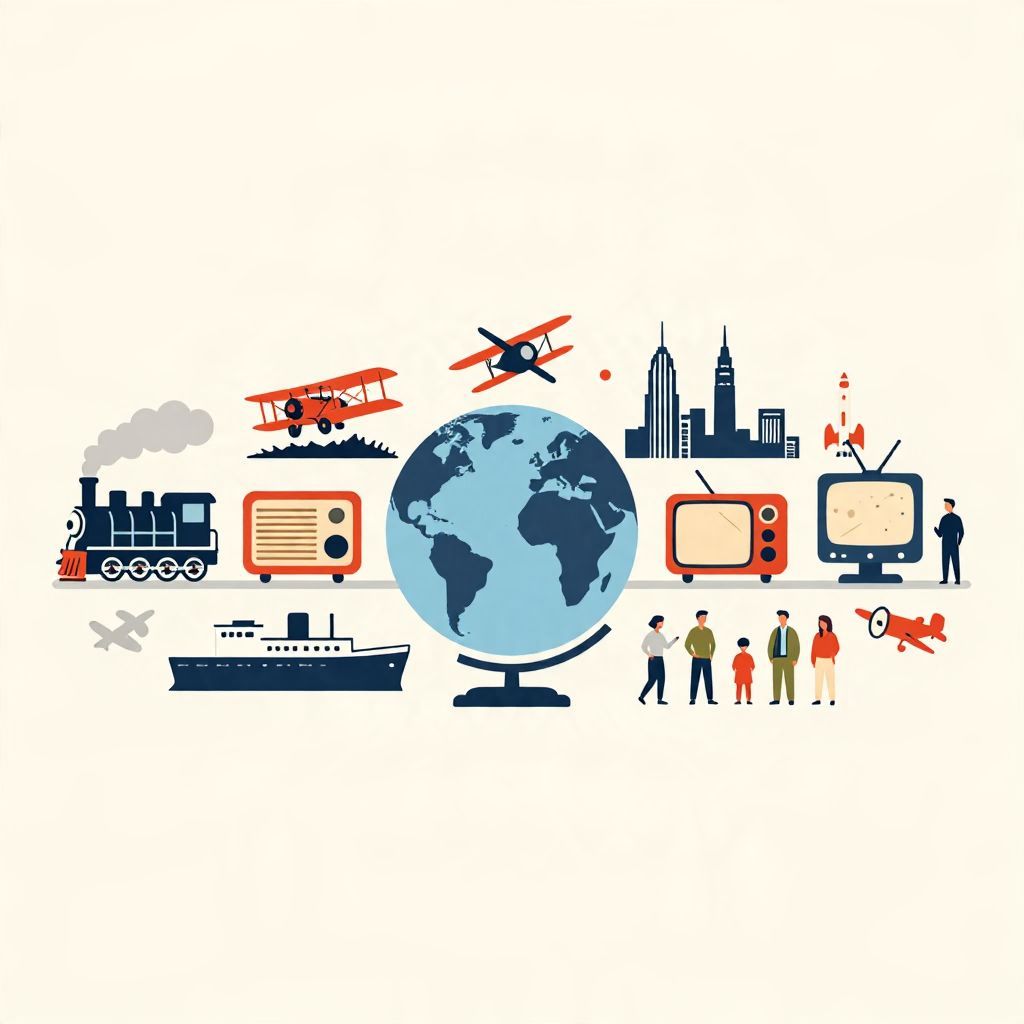
The 20th century was the one hundred-year period from January 1, 1901 to December 31, 2000. It is often remembered as an era of world wars, rapid technological change, decolonization, and major social transformation across nearly every part of the globe.
When people ask “What is the 20th century?” they usually mean more than a calendar span. They are asking about a period that reshaped politics, science, culture, and everyday life in ways that still define the modern world.
What Is the 20th Century?
The 20th century is the historical period from 1901 to 2000. It followed the 19th century and preceded the 21st century. In history, it is especially important because it saw two world wars, the rise and fall of fascism and communism in different forms, the spread of mass media, the growth of consumer society, and dramatic advances in medicine, transport, and communication.
Why the 20th Century Matters
The 20th century stands out because change happened faster and on a larger scale than in many earlier periods. Industrial production expanded, cities grew, and governments became more powerful in people’s daily lives. At the same time, ordinary people gained new political rights in many countries, while wars and authoritarian regimes caused immense suffering.
A century of global conflict
The century included World War I (1914–1918) and World War II (1939–1945), the deadliest conflicts in human history. These wars redrew borders, destroyed empires, and accelerated the decline of European dominance. The aftermath helped create the United Nations and a new international order, though peace remained fragile.
A century of innovation
Airplanes, radio, television, antibiotics, computers, nuclear power, and space flight transformed how people lived and understood the world. Many of these developments were not isolated inventions but part of wider systems of research, industry, and government investment. The pace of innovation made the 20th century feel unlike earlier centuries to the people living through it.
How the 20th Century Began
The century did not begin with a single dramatic event. Instead, it opened in a world shaped by empires, industrial capitalism, and rising nationalism. Europe still dominated much of global politics, but tensions were already building. Competition among great powers, military alliances, and imperial rivalries helped set the stage for the First World War.
1900 or 1901?
A common point of confusion is whether the 20th century started in 1900 or 1901. By the standard calendar system, there was no year zero, so centuries begin with year 1 and end with year 00. That means the 20th century began on January 1, 1901, not January 1, 1900. People often celebrate the “turn of the century” in 1900, but historically the century boundary is 1901.
Key Themes of the 20th Century
1. World wars and total war
Both world wars involved entire societies, not just armies. Governments mobilized industry, propaganda, food supplies, and civilian labor on a scale that made war “total” in character. Civilians became direct targets through bombing, genocide, famine, forced labor, and occupation. The Holocaust, in which Nazi Germany murdered six million Jews and millions of other victims, remains one of the century’s defining crimes.
2. The rise and fall of empires
The old imperial order broke apart. The Austro-Hungarian, Ottoman, German, and Russian empires collapsed after World War I, while European colonial empires in Asia and Africa weakened after World War II. New nations emerged through independence movements, negotiated transitions, and armed struggle. Decolonization was one of the century’s most important political transformations.
3. Ideological rivalry
The century was shaped by competing political systems and ideas. Liberal democracy, fascism, communism, nationalism, and various forms of anti-colonial politics all competed for influence. After 1945, the Cold War divided much of the world between the United States and the Soviet Union, turning ideology into a global struggle that affected wars, alliances, and domestic politics.
4. Social change
Women’s suffrage expanded in many countries during the century, though at different times and through different struggles. Labor movements won reforms in wages, hours, and workplace safety. Civil rights movements challenged racial segregation and discrimination, especially in the United States, South Africa, and colonial societies. These changes were uneven, but they altered public life permanently.
5. Scientific and technological transformation
The 20th century saw the spread of electricity, automobiles, mass aviation, telecommunications, and digital computing. Medicine advanced through vaccines, improved surgery, and antibiotics such as penicillin. Scientific breakthroughs also brought danger: nuclear weapons introduced the possibility of global destruction, while industrialization increased pollution and environmental strain.
Major Events That Defined the Century
Many events could be included in a history of the 20th century, but a few stand out because of their lasting consequences.
- 1914–1918: World War I and the collapse of several empires
- 1917: The Russian Revolution and the rise of the Soviet state
- 1929: The Great Depression begins, reshaping economies and politics worldwide
- 1939–1945: World War II, the Holocaust, and the defeat of Nazi Germany and Imperial Japan
- 1947 onward: The Cold War intensifies
- 1947–1970s: Decolonization across Asia, Africa, and the Middle East
- 1950s–1960s: Civil rights, women’s rights, and youth culture expand in many societies
- 1961: A year associated with Cold War tension, including the Berlin Wall’s construction and the space race
- 1989–1991: Communist regimes in Eastern Europe collapse and the Soviet Union dissolves
Everyday Life in the 20th Century
The 20th century was not only about wars and governments. It also changed ordinary life. In many countries, more people moved from farms to cities. Households increasingly used electricity, refrigerators, radios, and later televisions. Mass-produced goods became more available, while cars and public transport altered how people worked, shopped, and traveled.
Media and mass culture
New media linked people across larger distances than ever before. Radio created shared national audiences. Film became a global art form and entertainment industry. Television later transformed politics, advertising, and family life. By the late 20th century, computers and the internet began to change communication again, laying the foundation for the digital age.
Changing education and work
Many states expanded public education, literacy, and technical training. Industrial and service economies created new occupations while reducing the share of people working in agriculture. At the same time, labor conditions varied greatly by region and class. For many people, the century brought greater opportunity; for others, it brought exploitation, displacement, or war.
How Historians View the 20th Century
Historians often describe the 20th century as both an age of progress and an age of catastrophe. It produced remarkable gains in health, communication, and political participation, but also mass violence on an unprecedented scale. Some scholars emphasize “modernity” and technological acceleration; others focus on empire, genocide, and the unequal distribution of power.
Why interpretations differ
The century was experienced very differently depending on location, race, class, gender, and political position. A person in a newly independent nation might remember liberation and hope, while someone in a war zone might remember occupation and loss. Because of this, there is no single universal story of the 20th century, only overlapping histories.
The End of the 20th Century
By the century’s close, the world looked very different from the one that existed in 1901. European empires had largely disappeared, the Cold War had ended, and globalization had intensified trade, migration, and communication. Yet the century’s unresolved legacies—inequality, nationalism, environmental damage, and political conflict—continued into the 21st century.
The 20th century was the period in which the modern world took shape. It began with empires and industrial power, passed through world war and ideological struggle, and ended with a more interconnected but still deeply divided planet. If you want to explore the century further, see when the 20th century began and ended or read more about what happened in 1961, a pivotal Cold War year.