
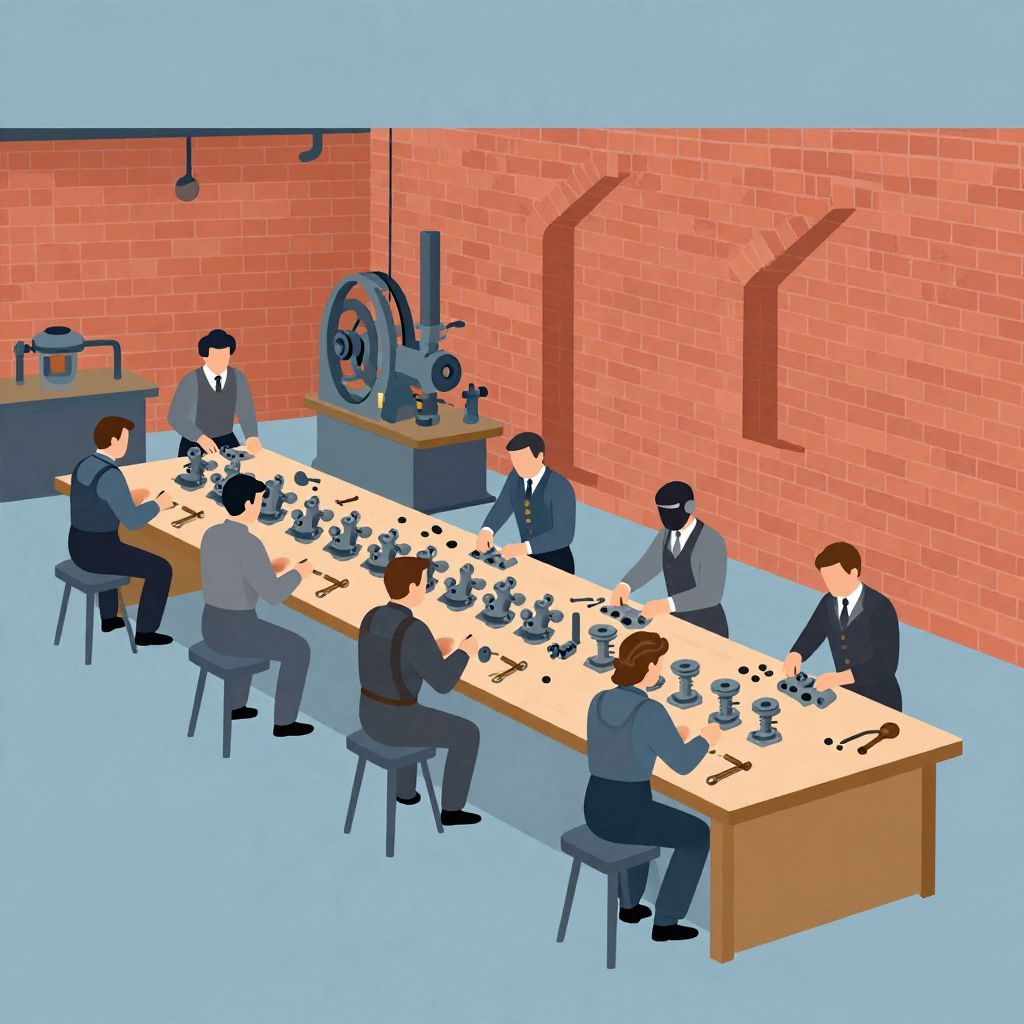
What method of manufacturing, introduced in the early 1800s, made mass production possible? The best historical answer is the use of interchangeable parts, a system in which components were made to standardized dimensions so they could be fitted together without hand-filing each one to match a specific product.
This approach did not create modern mass production by itself, but it made large-scale manufacturing practical. It helped transform weapons making, machinery, and later consumer goods by reducing skilled labor, speeding assembly, and making repairs easier.
What method of manufacturing, introduced in the early 1800s, made mass production possible?
The method was interchangeable parts manufacturing, sometimes called the American System of Manufactures. Instead of crafting each item as a unique object, factories produced standardized parts that could be swapped from one product to another. This innovation, developed in the early nineteenth century and refined over time, became a foundation of mass production.
What interchangeable parts meant in practice
Before standardization, many goods were still made by skilled artisans. Even when a product looked similar to another, its parts were often individually shaped and adjusted. If a piece broke, a replacement usually had to be custom-made. Interchangeable parts changed that by making parts uniform enough that any matching piece could fit any matching product.
Why this was revolutionary
The key breakthrough was not simply making many items at once. It was making them the same. Standardized parts reduced the need for expert fitting and allowed production to be divided into smaller, repeatable steps. That made manufacturing faster, cheaper, and more scalable than craft production.
How it supported mass production
- Parts could be produced in larger quantities with greater consistency.
- Workers could specialize in one task instead of building an entire object.
- Assembly became quicker because pieces were designed to fit without extensive adjustment.
- Repairs and replacements became easier, especially for military equipment and machines.
Where the idea came from
Interchangeable parts are often associated with the early United States, but the idea developed gradually and had roots in earlier European manufacturing. By the late eighteenth and early nineteenth centuries, governments and inventors were seeking ways to make weapons and machinery more efficiently. The need for reliable firearms encouraged experimentation with standardization, precision tools, and production methods that could be repeated.
The early American context
In the United States, the system became especially important in the production of firearms. The federal armories at Springfield in Massachusetts and Harpers Ferry in what is now West Virginia became important centers of experimentation. The goal was to produce weapons with parts that could be assembled and repaired using standardized components rather than individually fitted pieces.
Names often linked to the system
Several inventors and manufacturers are tied to this development. Thomas Blanchard created machines that could help shape irregular wooden forms and contributed to standardized production methods. Eli Whitney is often credited in popular history with promoting interchangeable parts, especially in relation to muskets, though historians note that the process was more gradual than a single invention or a single person’s achievement. John H. Hall also played a major role in advancing firearm standardization in the early nineteenth century.
Why historians are careful about the “Eli Whitney” story
Whitney is one of the most famous names in the history of manufacturing, but the story is more complicated than a simple invention legend. He did not suddenly invent mass production in one moment. Instead, he became part of a broader movement toward standardized manufacturing. His contracts, demonstrations, and public reputation helped popularize the idea, even as other armories and machinists were also contributing to the same technological shift.
A useful distinction
It is accurate to say that Whitney helped advance the concept and public awareness of interchangeable parts. It is less accurate to say that he alone invented the entire system. The historical record shows a collaborative, incremental process involving government armories, machinists, and factory experimentation.
How interchangeable parts changed manufacturing
The importance of interchangeable parts went far beyond one industry. Once manufacturers proved that standardization worked, they could apply the same logic to many other goods. This helped move production away from the workshop model and toward the factory system, where machines, labor, and planning were organized around repeatable output.
From craft production to factory production
In craft production, a skilled worker often made an entire item from start to finish. In factory production, a product could be broken into many steps. One worker or machine might cut a piece, another might shape it, and another might assemble it. Interchangeable parts made this division of labor much more effective because the pieces were designed to fit reliably.
Connection to the Industrial Revolution
This method fit perfectly with the broader Industrial Revolution. Steam power, improved machine tools, textile machinery, and better transportation all helped factories grow. Interchangeable parts solved one of the biggest problems of large-scale production: how to make goods consistently enough that they could be assembled quickly and repaired easily.
The role of machine tools and precision
Interchangeable parts depended on more than an idea. They required machine tools capable of cutting metal and wood with a degree of precision that handcraft alone could not reliably achieve. Lathes, milling machines, gauges, jigs, and other tools made it possible to reproduce dimensions again and again.
Why precision mattered
If one screw, barrel, gear, or trigger component differed too much from another, the whole system failed. Standardization demanded measurement, discipline, and quality control. In that sense, interchangeable parts were as much about industrial organization as about invention.
Quality control and repeatability
Factories had to establish tolerances—acceptable ranges of size and shape—so parts would function together. This was a major step toward modern manufacturing, where consistency is often as important as speed.
Military demand helped drive the change
Weapons production was one of the earliest and most important areas where interchangeable parts mattered. Armies needed large numbers of reliable muskets, rifles, and replacement components. Standardization made it easier to equip troops, maintain arsenals, and repair damaged weapons in the field or at depots.
Why firearms were a natural test case
Firearms contain many parts that must work together precisely. If one component fails, the weapon may not fire safely or correctly. That made guns a strong incentive for standardization and a useful proving ground for industrial methods that later spread into civilian manufacturing.
How this led to modern mass production
Interchangeable parts did not create the fully automated assembly line of the twentieth century, but they made it possible. Once products were standardized, factories could organize production more efficiently, train workers for narrow tasks, and increase output dramatically. Later innovations, including mechanized assembly lines, built on this earlier foundation.
From interchangeable parts to the assembly line
The assembly line is often associated with Henry Ford and the automobile industry in the early twentieth century. Ford’s system depended on the principle that parts had to be uniform. Without standardized components, the moving assembly line would have been far less efficient, if it worked at all. In that sense, interchangeable parts were a prerequisite for later mass-production systems.
Broader economic effects
- Lower production costs made goods more affordable to more people.
- Factories expanded employment, though often with repetitive and demanding labor.
- Standardized goods encouraged national markets and large-scale distribution.
- Manufacturers could scale up output in ways that were impossible in small workshops.
Limits and challenges of the early system
Interchangeable parts were not easy to achieve. Early manufacturers struggled with inconsistent measurements, tool wear, and the difficulty of making complex objects to exact standards. Many products still required hand fitting well into the nineteenth century. The transition from artisanal production to true standardization was uneven and took decades.
Not every industry changed at the same pace
Some sectors, such as firearms and certain metal goods, adopted standardization earlier than others. Textiles, agriculture, and consumer goods each followed different paths. The spread of interchangeable parts was gradual, shaped by technology, capital investment, and market demand.
Why the early 1800s matter
The early nineteenth century was a turning point because it combined new industrial machinery with new ideas about standardization. The method of interchangeable parts emerged from practical needs, especially in weapons manufacturing, but it soon influenced much broader industrial development. It helped make modern manufacturing systems possible by replacing custom fitting with repeatable production.
The lasting historical significance
The deeper significance of interchangeable parts is that it changed how people thought about making things. Products were no longer necessarily unique objects shaped by one craftsperson’s hands. They became systems of standardized components, designed for efficiency, repair, and scale. That shift helped define the industrial world that followed.
So, the historical answer is interchangeable parts manufacturing—a method that emerged in the early 1800s and became one of the most important foundations of mass production. If you want to explore the wider economic background of this transformation, see also the Commercial Revolution and, for a later example of industrial change, what happened in 1924.