
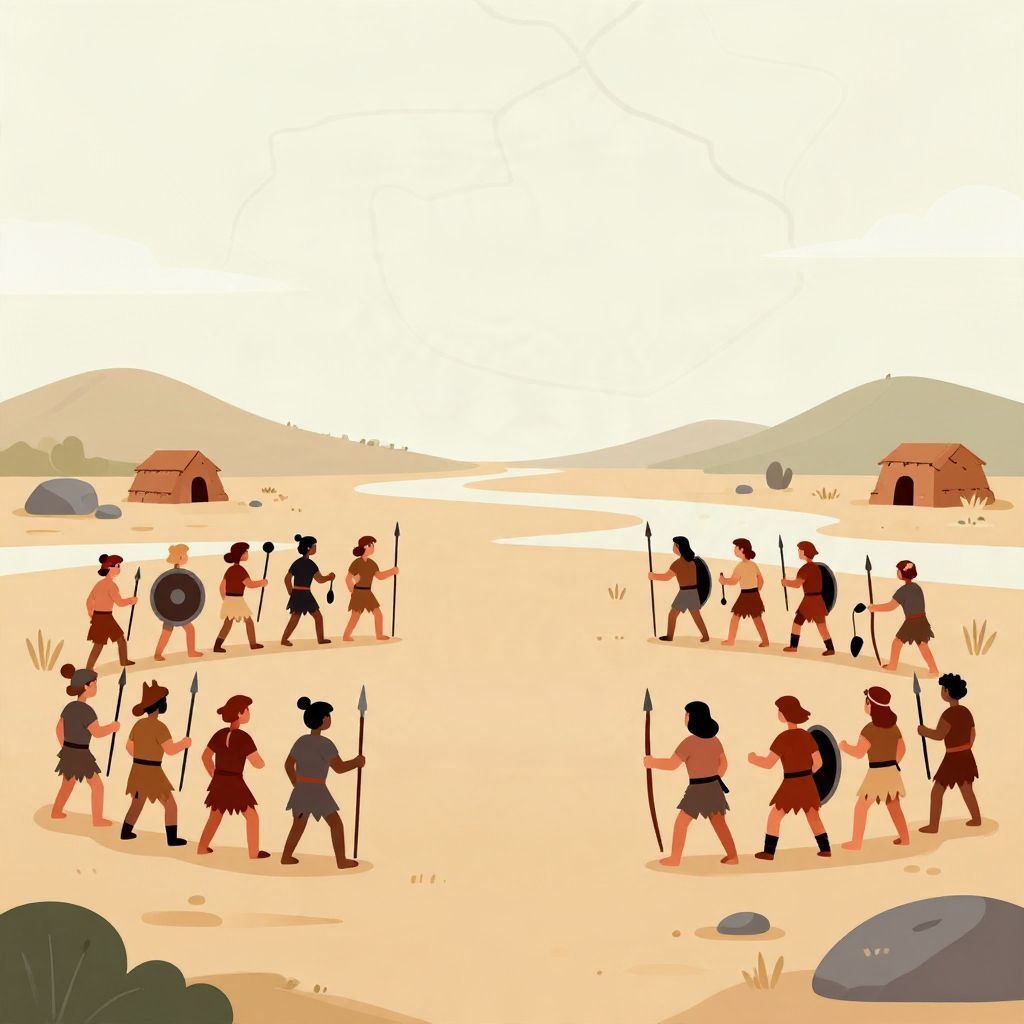
What was the first war? The answer depends on how broadly you define “war.” If you mean the earliest recorded interstate conflict in written history, one of the best-known candidates is the conflict between Lagash and Umma in ancient Mesopotamia, around the mid-third millennium BCE. If you mean the earliest fighting between organized human groups, warfare is much older than writing and likely began in prehistory.
So the “first war” is not a single fixed event. Historians distinguish between the first documented war and the first war that may have happened in human history, which cannot be dated with certainty.
What was the first war?
The earliest clearly documented war is usually considered the conflict between the Sumerian city-states of Lagash and Umma in Mesopotamia, roughly around 2450 BCE. It is known from inscriptions, boundary stones, and royal records. However, warfare almost certainly existed long before this, so it is best understood as the first war we can identify from surviving evidence, not the first war ever fought.
Why historians do not name one single “first war”
Human conflict did not begin with writing, and writing itself appeared only after long periods of social development. Because of that, the earliest wars are invisible except where archaeology preserves weapons, mass graves, fortifications, or signs of violent injury. Written records begin much later, so the “first war” depends on whether you mean the first war recorded, the first war reconstructed by archaeologists, or the first war in a broad human sense.
Three different meanings of “first war”
- First recorded war: the earliest conflict mentioned in surviving texts.
- First archaeologically inferred war: violence identified from material remains, often without written evidence.
- First war in human history: impossible to identify exactly, because it predates history in the strict written sense.
This is why historians avoid a simplistic answer. The evidence is uneven, and different regions developed states, armies, and writing at different times.
The earliest recorded war: Lagash and Umma
The conflict between Lagash and Umma, two Sumerian city-states in southern Mesopotamia, is one of the earliest wars known from written sources. The dispute centered on fertile land and water rights along a border region called Gu’edena. Kings of Lagash, especially Eannatum, claimed victory and recorded the conflict on monuments such as the famous Stele of the Vultures.
What we know from the evidence
The surviving inscriptions are not neutral reports. They are royal propaganda, meant to justify rule and celebrate victory. Even so, they show that organized warfare already existed by the third millennium BCE. The conflict involved infantry formations, border fortifications, and the political use of religion to legitimize territorial claims.
Key features of this war include:
- Territorial dispute: control of land and irrigation channels.
- City-state politics: independent urban centers competing for power.
- Military organization: trained forces rather than spontaneous raiding alone.
- Written commemoration: rulers used inscriptions to present war as lawful and divinely sanctioned.
Did war exist before written history?
Yes, very likely. Archaeology suggests that violence among human groups is far older than the first written records. Prehistoric communities sometimes built fortified settlements, carried weapons, and suffered injuries consistent with organized conflict. But evidence for “war” in the strict sense is harder to prove than evidence for individual violence, because war implies repeated, collective, organized fighting between groups.
What archaeology can and cannot prove
Archaeologists look for patterns such as mass burials, defensive walls, projectile points embedded in skeletons, and destroyed settlements. These remains can suggest warfare, but they do not always prove it. A violent death might result from a raid, a feud, or a massacre rather than a full-scale war. That is why the earliest prehistoric wars remain debated.
Some of the oldest possible evidence for organized conflict comes from prehistoric sites in Africa, the Near East, and Europe. These findings are important, but they rarely allow historians to name a specific “first war” with confidence.
Why war emerged in early civilizations
War became more visible after the rise of agriculture, cities, and states. When communities settled in one place, they accumulated land, grain, labor, and water systems worth fighting over. Population growth and social hierarchy also made conflict more organized. In many early states, war was tied to taxation, kingship, and the need to defend or expand territory.
Common causes in the ancient world
- Land and water: especially in river valleys where irrigation mattered.
- Trade routes: control of movement and exchange brought wealth.
- Prestige and power: rulers used war to prove authority.
- Retaliation: cycles of revenge could escalate into larger conflicts.
- State formation: armies helped rulers centralize control.
In Mesopotamia, these pressures were especially intense. Cities depended on managed water systems, and borderlands could be highly contested. That makes the Lagash-Umma conflict a strong candidate for the earliest recorded war.
How the first recorded wars were fought
Early wars were not fought with modern weapons or large standing armies. They were usually clashes between city militias, seasonal forces, or small professional groups led by rulers. Weapons included spears, maces, axes, bows, and shields. Chariots appear later in some regions and changed warfare dramatically, but they were not part of the earliest Mesopotamian conflicts.
Typical characteristics of early warfare
- Local leaders mobilized men from nearby settlements.
- Armies fought over fields, canals, and border zones.
- Victory was often followed by the destruction of crops or fortifications.
- Rulers recorded triumphs to strengthen legitimacy at home.
These wars were often limited in scale compared with later imperial campaigns, but they were still highly consequential for the communities involved.
Other early candidates for the “first war”
Although Lagash and Umma are the most commonly cited answer, other ancient conflicts also belong in the conversation. Some of the earliest Egyptian and Near Eastern records describe military campaigns, and later texts from the Bronze Age preserve accounts of battles between kingdoms. Yet these are generally later than the Sumerian city-state conflicts or are less clearly documented as the earliest example.
Why no alternative is universally accepted
There is no single global archive of early warfare. Different civilizations left different kinds of evidence, and many records have been lost. A conflict may be the earliest known in one region, but not the earliest in the world. That is why historians prefer careful language such as “earliest recorded war” rather than “the first war ever.”
What the first war tells us about human history
The earliest wars show that organized violence developed alongside political complexity. Once societies had property, leadership, borders, and surplus resources, conflict could become structured and repeated. War was not simply chaos; it was often connected to governance, economy, and identity. The first recorded wars also show that rulers quickly learned to use memory and propaganda to justify violence.
These early conflicts mattered because they helped shape the state systems that later dominated the ancient world. Fortifications, military leadership, territorial claims, and diplomatic rivalry all became lasting features of civilization.
So what was the first war, in plain terms?
If you are asking for the earliest war we can name from surviving evidence, the best answer is the Lagash-Umma conflict in ancient Mesopotamia, around the mid-third millennium BCE. If you are asking about the first war in human history, the honest answer is that we do not know, because warfare almost certainly began before writing and before clear historical records.
The most accurate conclusion is that the “first war” is not a single provable event but a historical threshold: the point at which human conflict became visible in the record. For more context on how religion, politics, and power could drive major conflicts, you may also want to read about why the Crusades happened, alongside this overview of what the first war was.