
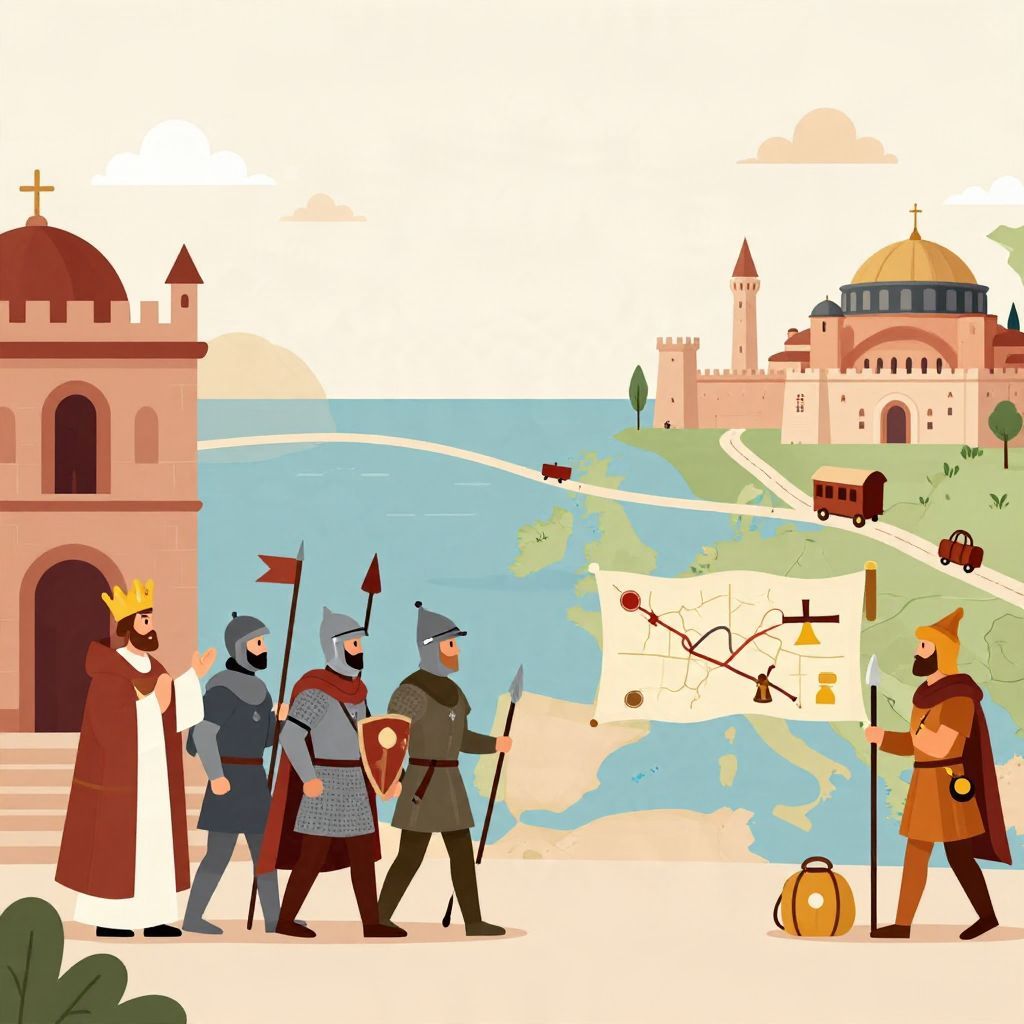
Why did the Crusades happen? The short answer is that they grew out of a mix of religious belief, political ambition, military pressure, and social conditions in medieval Europe and the eastern Mediterranean. They were not caused by one single event or one simple motive.
From the late 11th century onward, popes, kings, nobles, merchants, and ordinary believers all saw different reasons to support armed expeditions to the eastern Mediterranean. To understand the Crusades, it helps to look at the world that produced them: a deeply religious Latin Christian society, a contested Byzantine Empire, expanding Turkish power, and a papacy eager to assert leadership.
Why Did the Crusades Happen?
The Crusades happened because medieval Christians believed armed pilgrimage could defend fellow Christians, recover holy places, and win spiritual reward. At the same time, popes wanted to direct knightly violence, Byzantine emperors sought military help, and European nobles saw opportunity for land, status, and salvation.
The Religious Reason: Holy War and Salvation
Religion was the central language of the Crusades. In medieval Latin Christianity, Jerusalem was the most sacred city because it was associated with the life, death, and resurrection of Jesus. Many people believed that visiting or protecting holy places had profound spiritual value. When Pope Urban II called for the First Crusade in 1095, he presented the expedition as a sacred duty.
Pilgrimage and penance
Crusading was closely tied to pilgrimage. Many participants understood the journey as an act of devotion, not just warfare. The church offered spiritual incentives, including indulgences, meaning remission of temporal punishment for sins. For people worried about salvation, this was powerful motivation. In a world where religion shaped daily life, the promise of spiritual benefit could be as compelling as material reward.
Defending fellow Christians
Another religious argument was protection. Latin Christian leaders heard reports that Christians in the East, especially in Byzantine lands and around Jerusalem, were under threat. Whether every report was accurate mattered less than the fact that many western Europeans believed the East needed rescue. The Crusades were therefore framed not only as conquest, but as defense of the faith.
The Political Reason: Papal Leadership and Power
The papacy also had strong political reasons to promote crusading. By the late 11th century, popes were trying to strengthen their authority over Christian Europe. Calling a crusade allowed the pope to act as a leader above kings and nobles, uniting them under a religious cause. This was especially important during the broader struggle between church and secular rulers over power and reform.
Urban II and the First Crusade
Pope Urban II’s appeal at the Council of Clermont in 1095 is the best-known starting point for the First Crusade. The exact wording of his speech is not fully recoverable, because surviving accounts were written later and differ in detail. Still, historians agree on the broad message: Urban urged Christians to aid the East and take up arms in a holy cause. His call turned an idea into a movement.
Channeling knightly violence
Medieval Europe had a warrior aristocracy. Nobles and knights often fought each other in local conflicts, raids, and feuds. Church leaders had long worried about this violence. Crusading offered a way to redirect military aggression outward. Instead of fighting neighbors, armed elites could be encouraged to fight for the church. In that sense, the Crusades were also a social solution to a political problem.
The Eastern Christian Reason: Byzantine Appeals for Help
The Crusades did not begin in a vacuum. The Byzantine Empire, the eastern continuation of the Roman Empire, had been under pressure for decades. After the Battle of Manzikert in 1071, Byzantine forces lost much of Anatolia to Turkish groups, especially the Seljuk Turks. This weakened the empire and alarmed its rulers.
Why Byzantium mattered
Emperor Alexios I Komnenos asked the West for military assistance, probably expecting a limited number of mercenaries or allied troops. He did not necessarily anticipate a massive religious movement. Yet his request helped create the conditions for the First Crusade. Western Christians saw an opportunity to help an eastern Christian emperor, even though Latin and Greek Christians had their own theological and political tensions.
Misunderstanding and mutual suspicion
Byzantines and western Europeans did not always share the same goals. The Byzantines wanted territory restored to imperial control. Many western crusaders, however, were motivated by devotion, adventure, or the hope of gaining land for themselves. This difference in expectations later caused mistrust, especially after crusading armies captured and held territories that Byzantium considered its own.
The Military Reason: Turkish Expansion and Fear of Loss
One of the immediate background causes of the First Crusade was the expansion of Muslim Turkish powers in the eastern Mediterranean. It is important to be precise here: the Crusades were not simply a war between “Christians” and “Muslims” in a modern sense. The medieval world was more complex. Still, military conflict over territory, trade routes, and sacred sites was real.
Jerusalem and the eastern Mediterranean
Jerusalem had changed hands many times over the centuries. By the late 11th century, Muslim rulers controlled the city, as they had for generations, though access for Christian pilgrims varied over time and circumstance. What changed was the political and military balance in the region. Reports of instability, danger on pilgrimage routes, and Byzantine losses made the situation seem urgent to western observers.
Fear as a mobilizing force
Fear helped drive crusading enthusiasm. Preachers emphasized the danger to holy places and Christian communities. In medieval society, where news traveled slowly and often imperfectly, vivid stories could shape public response. The Crusades thus grew partly from a sense that Christendom itself was under threat and needed active defense.
The Social and Economic Reasons: Opportunity and Mobility
Not everyone joined the Crusades for the same reason. Many participants were sincerely religious, but social and economic motives mattered too. Younger sons of noble families, landless knights, and ambitious leaders may have seen crusading as a path to wealth, land, and status. For some, the East represented opportunity that was hard to find at home.
Land hunger and inheritance
In parts of medieval Europe, land was limited and inheritance often favored the eldest son. This created pressure among lesser nobles and knights who had few prospects. Crusading could offer new estates or lordships if a campaign succeeded. That was not the only motive, but it was a real one, especially in the later crusading states established in the Levant.
Trade and urban interests
Italian maritime cities such as Venice, Genoa, and Pisa also became involved. Their merchants and shipbuilders saw commercial advantage in eastern trade and transport. While they were not the original drivers of the First Crusade, they benefited from the movement and helped sustain later crusading efforts. Trade, religion, and warfare became intertwined.
What Made the First Crusade Possible?
The First Crusade succeeded because several conditions came together at once. Religious enthusiasm, papal leadership, Byzantine appeals, and military opportunity aligned in a way that had not happened before. The result was a large armed movement that captured Jerusalem in 1099 and established crusader states in the eastern Mediterranean.
A simple timeline of the opening phase
- 1071: Byzantine defeat at Manzikert weakens imperial control in Anatolia.
- 1095: Urban II calls for aid at Clermont.
- 1096–1099: Western armies travel east in what became known as the First Crusade.
- 1099: Crusaders capture Jerusalem and form new Latin Christian states.
This timeline matters because it shows that the Crusades were not a spontaneous outbreak of fanaticism. They were the result of long-term pressures and a moment of political and religious convergence.
Were the Crusades Only About Religion?
No. Religion was essential, but it was not the only cause. Modern historians generally agree that crusading cannot be explained by a single motive. Some participants were deeply devout. Others were drawn by family ambition, social advancement, or the hope of profit. Leaders often used religious language to serve political goals, but that does not mean belief was fake. Medieval people often experienced faith and practical interest together.
A caution against oversimplification
It is tempting to describe the Crusades as either pure religious zeal or pure greed. Both explanations are incomplete. The movement worked because it spoke to many needs at once: spiritual anxiety, elite competition, imperial distress, and the desire for order in a violent age. That complexity is one reason the Crusades lasted for centuries rather than a few years.
How the Crusades Changed Over Time
The first expedition is the best known, but the Crusades became a much broader phenomenon. Later crusades were launched not only to the Levant but also against Muslims in Iberia, against pagan groups in the Baltic, and even against political enemies within Europe. Over time, the idea of crusade expanded from a specific campaign to a general model of holy war sanctioned by the church.
From Jerusalem to a wider movement
As the centuries passed, crusading became part of papal policy. It could be used to defend territories, support allies, or punish opponents. This expansion shows that the Crusades were not caused by one battlefield or one city alone. They emerged from a broader medieval culture in which religion, warfare, and authority were tightly linked.
The Lasting Significance of Why the Crusades Happened
The reasons the Crusades happened reveal much about medieval Europe. They show a society in which religion shaped politics, war could be sanctified, and leaders used spiritual language to mobilize mass action. They also reveal the fragility of relations between Latin Christendom, Byzantium, and the Islamic world. The Crusades were both a product of their time and a force that reshaped it.
In the end, the Crusades happened because medieval people saw them as meaningful: a way to defend faith, answer a call for help, pursue honor, and seek salvation. Their causes were layered, not simple, and that is what made them such a powerful and enduring historical movement. For more background, you may also want to explore what a feudal system was and what historians mean by the Dark Ages.