
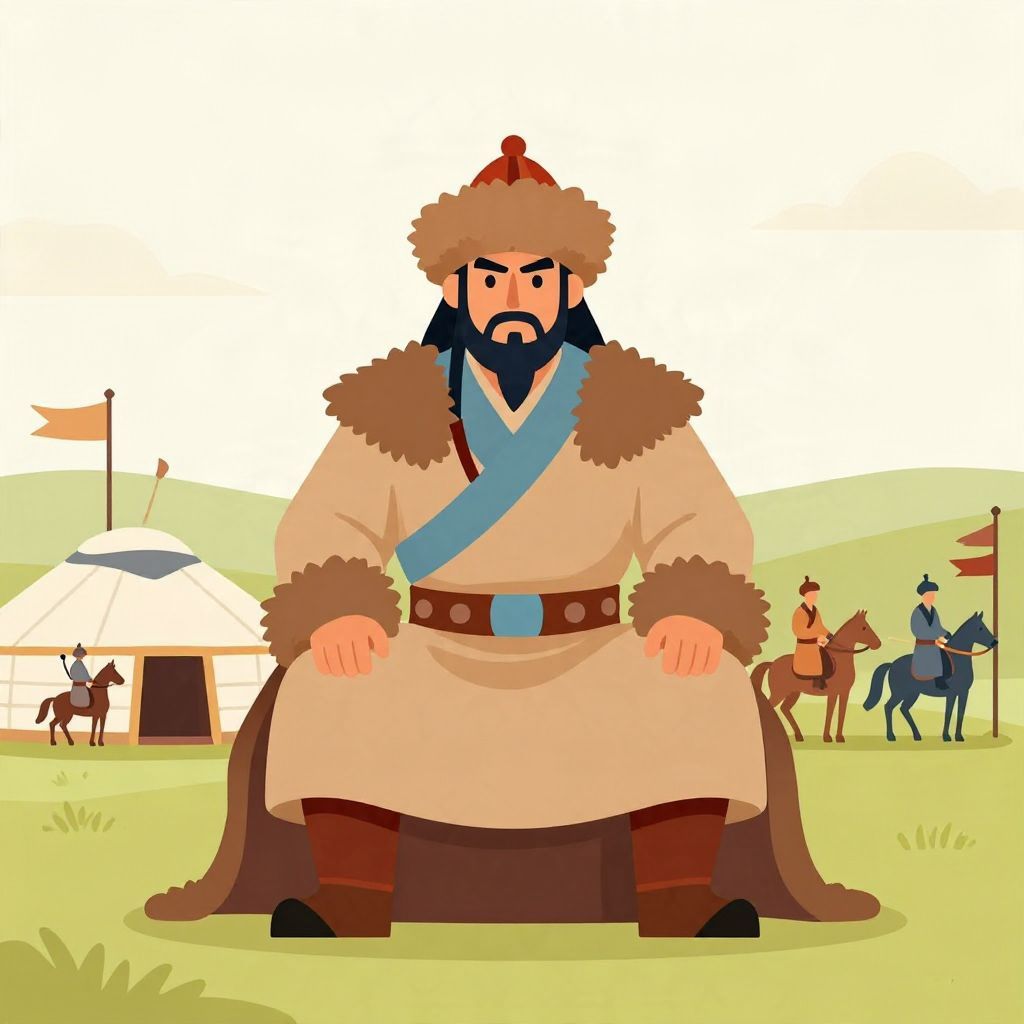
What did Genghis Khan look like? It is a deceptively simple question, but the answer is limited by the evidence. Genghis Khan, born Temüjin around 1162 and died in 1227, left no confirmed portrait made from life, and later images often reflect artistic tradition more than eyewitness accuracy.
What historians can say with confidence comes from a mix of Mongol, Persian, Chinese, and later European sources. These descriptions suggest a man of steppe nomad origin: physically hardy, likely broad-faced, with distinctive East and Inner Asian features, but not the single standardized “face” often seen in modern pictures.
What Did Genghis Khan Look Like?
Genghis Khan was probably a sturdy, weathered steppe warrior with East Asian and Inner Asian features, but no verified contemporary portrait survives. Most surviving images were created decades or centuries later, so they are shaped by politics, artistic style, and legend as much as by memory.
The Problem With Knowing His Exact Appearance
The main difficulty is that Genghis Khan lived before the age of reliable portraiture in Mongolia. Unlike later rulers who sat for painted likenesses or whose faces were carved on monuments, he appears in sources mostly through written description and later artistic reconstruction. That means any confident modern image should be treated cautiously.
No confirmed life portrait
There is no universally accepted portrait painted from life. Some later depictions may preserve older traditions, but historians cannot verify that they show his actual face. In other words, the famous “Genghis Khan look” is partly historical, partly imagined.
Why later images can mislead
Artists often adapted his appearance to suit the cultural world they lived in. Chinese painters might render him in a style familiar to imperial portraiture, while Persian illustrators could emphasize the visual language of the Islamic courts. Later national and popular images often make him look more uniform, noble, or fearsome than the evidence allows.
What the Historical Sources Suggest
Written sources provide the best clues. They do not give a single exact facial description, but they do point to a man whose appearance fit the Mongol steppe world. He was likely of average to slightly tall height for his environment, powerful in build, and marked by the hard life of mounted nomad warfare.
Descriptions from Mongol and neighboring traditions
Some accounts describe Genghis Khan as having a strong physique, a broad or firm face, and a commanding presence. Sources associated with the Mongol world often stress his authority, gaze, and bearing more than fine facial details. That emphasis matters: in steppe political culture, a ruler’s presence and charisma were often as important as exact features.
Likely facial and bodily traits
Based on the historical context, he probably had features typical of Mongol and related Inner Asian populations of the time: a broad face, dark hair, dark eyes, and a complexion shaped by outdoor life. He was not likely to have looked like the stylized “barbarian conqueror” of later European imagination, nor like a modernized cinematic hero.
What the Famous Descriptions Actually Say
Some sources describe Genghis Khan in ways that are suggestive but not precise. They often focus on his eyes, posture, or overall presence rather than a detailed facial map. This is common in medieval writing, where physical appearance was frequently tied to character, leadership, and destiny.
Presence mattered more than portrait detail
Medieval observers often judged rulers by how they carried themselves. A strong voice, a penetrating look, and a controlled demeanor could be described as signs of greatness. For Genghis Khan, this means that “what he looked like” in the historical record is inseparable from how contemporaries experienced his authority.
Ethnic identity and appearance
Genghis Khan belonged to the Mongol people, part of the broader Inner Asian steppe world. That does not mean every Mongol looked the same, and it certainly does not justify modern racial simplifications. Still, his appearance would have reflected the physical diversity of the eastern Eurasian steppe rather than the features associated with later Europeanized portraits.
Why So Many Images of Genghis Khan Look Different
Modern viewers encounter many versions of Genghis Khan: stern warrior, imperial founder, bearded elder, or almost generic Asian ruler. These differences come from the long afterlife of his image. Each region that remembered him reshaped him for its own purposes.
Chinese artistic traditions
In China, rulers were often portrayed in formal, idealized ways. Mongol emperors of the Yuan dynasty were sometimes represented in courtly style, which could soften or standardize features. Such images are valuable, but they are not straightforward photographs of the man himself.
Persian and Islamic miniatures
Persian manuscript art often presents Mongol rulers in a highly stylized visual language. These images are historically important because they show how later societies imagined imperial power, yet they are not exact likenesses. They tell us more about memory and prestige than about facial anatomy.
Modern nationalism and popular culture
In modern times, Genghis Khan has been claimed by different political and cultural narratives. Some portray him as a national hero, others as a ruthless destroyer. These agendas can influence visual reconstructions, making him look more heroic, more menacing, or more “authentically Mongol” than the evidence supports.
How Historians Reconstruct His Appearance
Historians and historical artists use several tools to make careful reconstructions, but these are educated approximations rather than certainties. They combine textual evidence, knowledge of Mongol clothing and grooming, and broader information about steppe populations of the era.
What can be inferred with some confidence
- He was a Mongol man from the late 12th and early 13th century steppe world.
- He likely had dark hair and dark eyes, consistent with many Inner Asian populations.
- He probably wore practical nomadic clothing rather than ornate court dress in daily life.
- As a mounted warrior, he would have had a physically hardened appearance.
- His public image was designed to project authority, discipline, and command.
What cannot be known for sure
- His exact nose, jawline, or eye shape.
- Whether he had facial hair at specific moments in life.
- The precise color tone of his skin from surviving evidence.
- Whether any surviving portrait is truly based on direct observation.
Genghis Khan’s Clothing and Grooming
Appearance in the medieval steppe world was not only about the face. Clothing, hair, and grooming shaped how a ruler was seen. Genghis Khan would have been presented in ways that signaled rank, mobility, and martial power.
Practical steppe dress
Mongol elites wore garments suited to riding and harsh weather: layered robes, belts, boots, and fur or felt materials when needed. A ruler’s clothing could be simple in form but rich in quality, combining practicality with status.
Hair and beard traditions
Medieval Mongol grooming practices varied over time and by rank. Some later visual traditions show him with a mustache or beard, while others present a clean-shaven or minimally bearded face. Because grooming styles changed and artists adapted them, this remains uncertain.
How His Appearance Was Tied to Power
For Genghis Khan, appearance was never just personal. In a society built on alliances, conquest, and loyalty, a ruler’s look helped communicate legitimacy. A commanding body, disciplined clothing, and a controlled expression all reinforced the image of a leader chosen to unite the steppe.
The political meaning of a face
Medieval rulers were often described in moral terms through their appearance. A strong face could suggest resolve; a severe gaze could imply judgment. In Genghis Khan’s case, later traditions likely amplified these qualities because his empire was so vast and his reputation so formidable.
Fear and admiration shaped memory
People who feared him may have remembered him as more imposing than he actually was, while followers may have emphasized dignity and strength. That is one reason historical descriptions of famous conquerors are often as much about reputation as about physical detail.
So, What Is the Best Historical Answer?
The best answer is that Genghis Khan probably looked like a tough, imposing Mongol steppe leader: dark-haired, dark-eyed, weathered by travel and warfare, and physically suited to a life on horseback. But no surviving source lets us know his exact face with certainty, and later portraits should be read as interpretations, not proof.
In historical terms, the real story is not that we can identify one true image of Genghis Khan, but that his appearance was repeatedly reinvented as his reputation spread across Eurasia. If you want to compare how historians reconstruct other famous figures, you may also enjoy what Joan of Arc looked like and what Vikings looked like.