
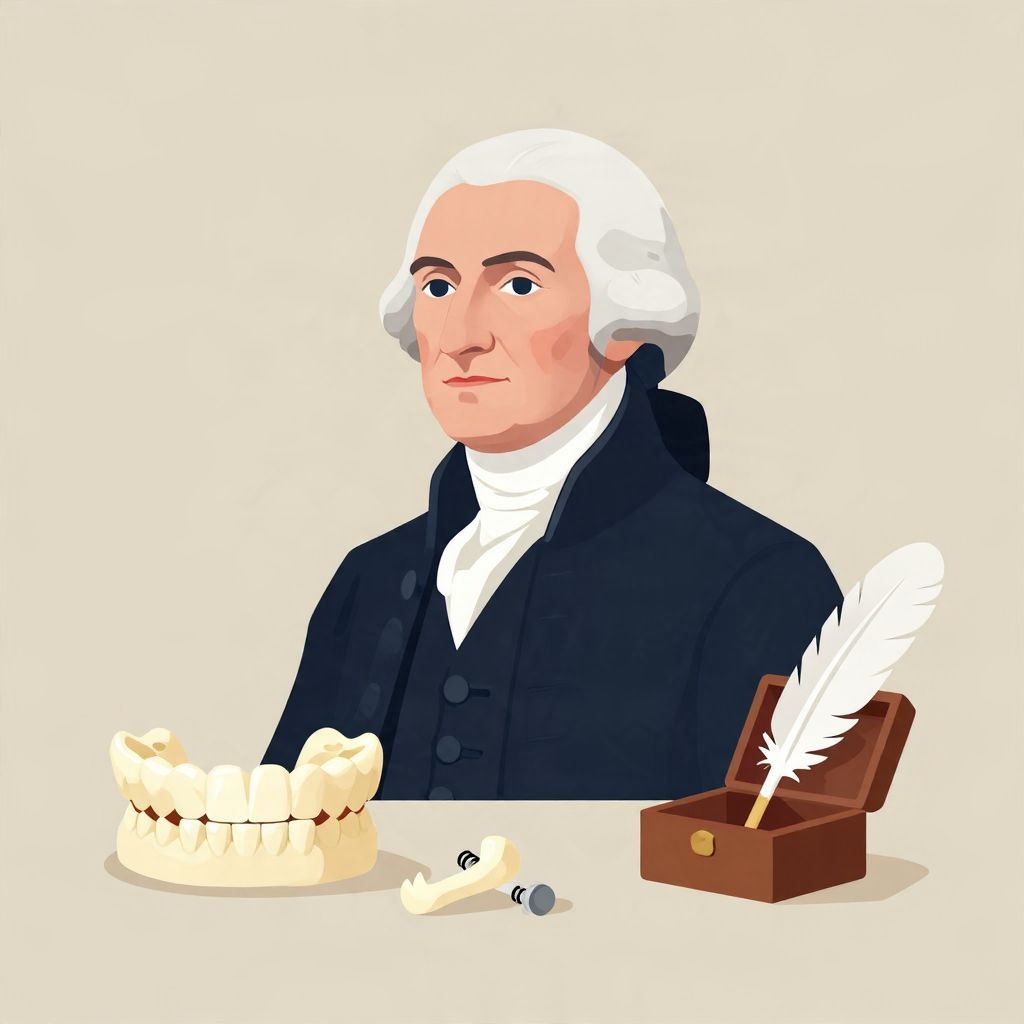
George Washington’s teeth have long been the subject of rumor, especially the famous claim that they were made of wood. In reality, that story is false. Washington’s dentures were made from a mix of materials common in the 18th century, including human teeth, animal teeth, ivory, metal fasteners, and lead or gold components.
The question matters because it reveals both the limits of early dentistry and the way myths can attach themselves to famous people. Washington’s dental troubles were real, painful, and well documented, but the “wooden teeth” legend is not part of the historical record.
What were George Washington’s teeth made of?
George Washington’s dentures were not made of wood. They were assembled from ivory, metal springs and fasteners, and teeth taken from animals and possibly people. His dental appliances were custom-made by dentists and craftsmen, reflecting 18th-century dentistry, which relied on a patchwork of materials rather than modern prosthetics.
The short answer: not wood, but a mix of materials
Washington’s false teeth were made from several materials used in elite dentistry during the late 1700s. Surviving dentures associated with him and contemporary accounts indicate the use of hippopotamus ivory, cow or horse teeth, human teeth, and metal parts such as springs, screws, and plates. The exact composition varied from set to set.
Why the wooden-teeth story is wrong
Wood would have been a poor material for dentures because it absorbs moisture, swells, and wears quickly. No reliable evidence shows that Washington wore wooden dentures. The myth likely arose because old ivory can discolor over time and resemble wood grain, especially after years of use.
How George Washington’s dentures were made
In Washington’s lifetime, dentistry was still developing as a profession. Dentures were handcrafted to fit individual mouths, often combining several materials to create something stable enough to chew with. Washington’s dentists and dental suppliers worked with the materials available to them, not with the synthetic plastics and porcelain used much later.
Common materials in 18th-century dentures
- Ivory — usually from elephant or hippopotamus tusk, shaped into denture bases
- Human teeth — sometimes purchased or acquired from donors, including extracted teeth
- Animal teeth — such as cow or horse teeth, used as substitutes
- Metal parts — gold, silver, lead, or brass for springs, screws, and fittings
- Wire and clasps — to hold the appliance in place
These dentures were uncomfortable by modern standards. They could be heavy, difficult to clean, and prone to odor and wear. Yet for wealthy patients, they were among the best options available.
Why Washington needed dentures
Washington struggled with severe dental problems for much of his adult life. By the time he became president, he had lost most or all of his natural teeth. His dental troubles likely came from a combination of tooth decay, gum disease, and repeated extractions, which were common in the 18th century.
Dental care in Washington’s era
Before modern preventive dentistry, people often lost teeth early. Sugar consumption was rising among elites, and dental hygiene practices were limited. Tooth extraction was common, while fillings, root canals, and reliable anesthesia did not yet exist. Painful dental treatment was a normal part of life for many people, even the powerful.
Who made George Washington’s dentures?
Washington worked with several dentists over the years, including John Greenwood, a dentist in New York who made some of his dentures, and earlier practitioners such as Jean-Pierre Le Mayeur and others connected to his circle. The surviving evidence suggests that Washington’s dental appliances were repeatedly repaired, adjusted, and replaced as his mouth changed.
Not a single set, but many
It is important to understand that Washington did not have one permanent pair of false teeth. He likely used multiple sets over time. As his jaw changed and his remaining teeth were removed, dentists altered the fit. This helps explain why different descriptions of his dentures exist in letters, bills, and surviving artifacts.
The materials behind the myth
The “wooden teeth” legend probably spread because Washington’s dentures looked rough, bulky, and unnatural. Ivory, especially after staining from use, can take on a yellow-brown appearance. Combined with metal hardware and the visible strain of the appliance, the dentures may have seemed wooden to later observers.
Why myths about famous people spread
Famous figures often become simplified into memorable stories. A dramatic image like “wooden teeth” is easy to repeat, even when it is inaccurate. Once a myth enters popular culture, it can outlast the evidence, especially when it seems to fit a person’s image or era.
What surviving evidence tells historians
Historians rely on surviving dentures, accounts from Washington’s dentists, and documentary records such as correspondence and receipts. These sources show that his dental appliances were made from mixed materials. They also show that Washington was deeply self-conscious about his teeth, which affected his appearance and comfort in public life.
What the evidence does and does not prove
The evidence is strong enough to reject the wooden-teeth story. It is less precise when it comes to every material in every denture Washington used. Some details remain uncertain because the dentures were modified over time and not all records survive. That uncertainty is normal in historical research.
How Washington’s dental problems affected his life
Washington’s dental pain was more than a personal inconvenience. It affected his ability to eat, speak, and sit for portraits. He often appears tight-lipped in images, which may reflect discomfort and the awkwardness of his dentures. His experience also humanizes him: the first president dealt with chronic pain like many people of his age.
Appearance and public image
Portraits of Washington were carefully managed, but his teeth still influenced how he was depicted. Artists tried to present him as dignified and calm, even when he was suffering. The dentures helped preserve his public image, though they could not fully hide the physical burden he carried.
What were Washington’s teeth made of in historical context?
Washington’s dentures were typical of elite 18th-century dentistry, even if they seem unusual today. Before industrial manufacturing, false teeth were handcrafted from whatever durable materials were available. Wealthy patients could obtain better-made appliances, but they were still far from comfortable or natural-looking.
From ivory and human teeth to modern dentures
Modern dentures are usually made of acrylic resin, porcelain, or other synthetic materials designed for comfort and hygiene. Washington’s dentures belong to an earlier world, when dentistry was part craft, part surgery, and part improvisation. Their materials reflect the medical knowledge and social inequalities of the time.
Key facts about George Washington’s teeth
- George Washington did not have wooden teeth.
- His dentures were made from a combination of ivory, human teeth, animal teeth, and metal.
- He suffered from serious dental problems throughout adulthood.
- He used multiple dentures over time, not just one fixed set.
- The wooden-teeth myth likely came from the appearance of aged ivory and the persistence of popular folklore.
Conclusion
So, what were George Washington’s teeth made of? Not wood, but a complicated mix of ivory, teeth from humans and animals, and metal fittings shaped by the limits of 18th-century dentistry. The famous myth is memorable, but the historical reality is more revealing: Washington’s dentures show how painful and improvised dental care could be in the early United States. For more on Washington’s image and legacy, see what George Washington might look like today and how many presidents came before George Washington.