
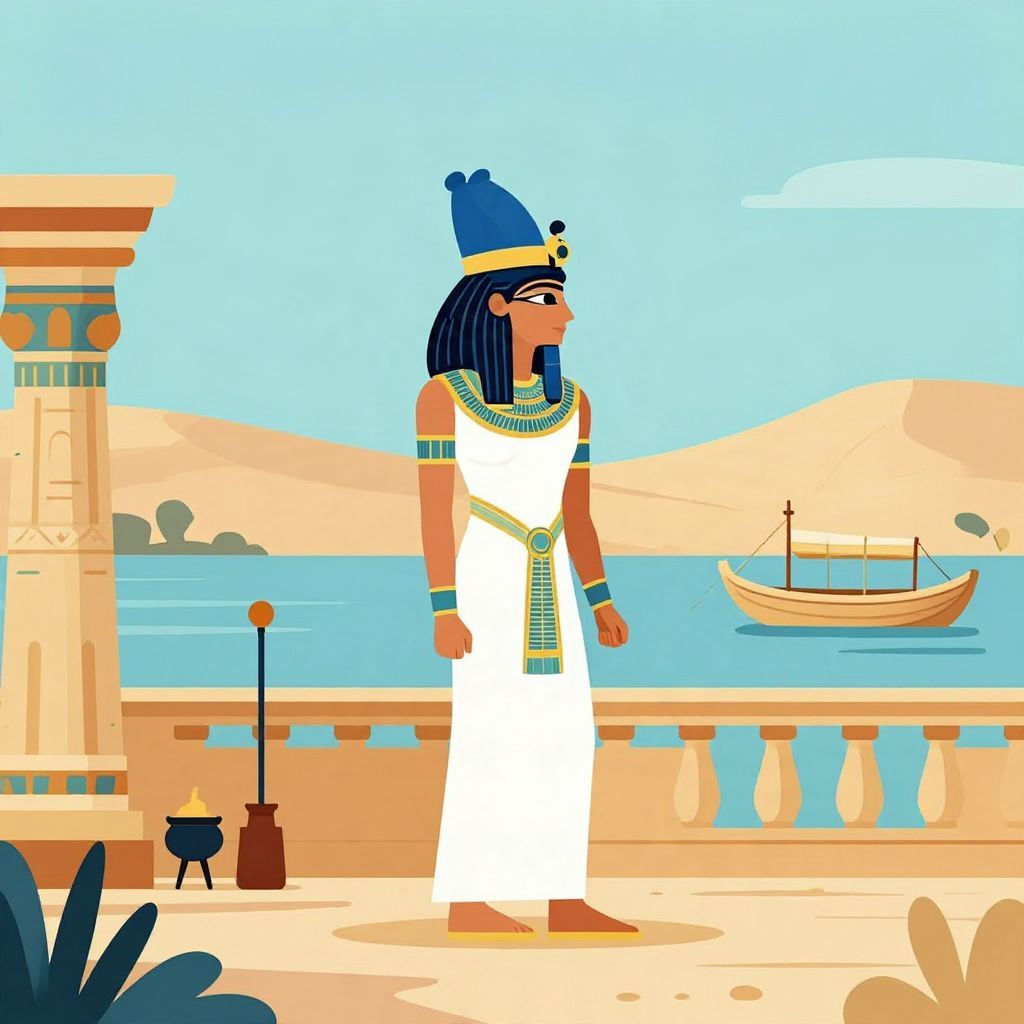
When did Cleopatra live? Cleopatra VII, the last active ruler of Ptolemaic Egypt, lived in the first century BCE. She was born in 69 BCE and died in 30 BCE, during the final decades of the Hellenistic world, when Rome was rapidly becoming the dominant power around the Mediterranean.
Her life overlapped with some of the most famous figures in Roman history, including Julius Caesar and Mark Antony. To understand Cleopatra’s dates is also to understand the collapse of ancient Egypt’s independence and the transformation of the ancient Mediterranean world.
When did Cleopatra live?
Cleopatra VII lived from 69 BCE to 30 BCE. She ruled Egypt from 51 BCE until her death, first alongside her brother-husband Ptolemy XIII and later with Ptolemy XIV, before becoming the sole ruler in practice. Her reign ended when Octavian, the future Augustus, defeated her and Mark Antony.
Cleopatra’s place in history
Cleopatra was not an Egyptian pharaoh in the old native dynastic sense, but a member of the Greek-speaking Ptolemaic dynasty founded after Alexander the Great’s conquests. The Ptolemies had ruled Egypt since 305 BCE, and Cleopatra was the dynasty’s final ruler. Her story belongs to the Hellenistic age, a period when Greek culture spread across the eastern Mediterranean and Near East after Alexander’s death.
A ruler at the end of an era
By Cleopatra’s time, Egypt was still wealthy and strategically important, but it was no longer the independent superpower it had once been. Rome had become the decisive military force in the Mediterranean. Cleopatra’s reign was shaped by this reality: she had to preserve her throne by navigating Roman politics, civil wars, and shifting alliances.
The timeline of Cleopatra’s life
Although many people know Cleopatra mainly through her relationships with Roman leaders, her life can be placed on a clear historical timeline. The dates below are the generally accepted ones used by historians, though exact details of her early life are less certain than the broad chronology.
- 69 BCE — Cleopatra VII is born in Alexandria.
- 51 BCE — She becomes queen of Egypt, ruling with her brother Ptolemy XIII.
- 48 BCE — Julius Caesar arrives in Egypt during a dynastic conflict; Cleopatra gains his support.
- 47 BCE — Caesar and Cleopatra’s alliance helps secure her position.
- 46–44 BCE — Cleopatra spends time in Rome.
- 41 BCE — She meets Mark Antony in Tarsus and forms a political and personal alliance with him.
- 31 BCE — Cleopatra and Antony are defeated at the Battle of Actium.
- 30 BCE — Octavian takes Alexandria; Cleopatra dies, and Egypt becomes a Roman province.
What was happening in the world when Cleopatra lived?
Cleopatra lived during a period of intense political upheaval. In Rome, the Republic was breaking down under the pressure of ambition, civil war, and military power. Julius Caesar’s rise, his assassination in 44 BCE, and the struggle among his successors all shaped Cleopatra’s fate. Egypt was pulled into these conflicts because its grain, money, and location made it too valuable for Rome to ignore.
The Roman connection
Cleopatra’s alliances with Caesar and Antony were not simply romantic stories. They were political strategies. She needed Roman backing to defend her throne, while Roman leaders valued Egypt’s wealth and strategic position. Her choices were made in a world where diplomacy, dynastic marriage, and military force were tightly linked.
How old was Cleopatra when major events happened?
Cleopatra’s age helps place her life in context. She was likely about 18 when she became queen in 51 BCE. She was around 21 when she met Julius Caesar in 48 BCE, and about 28 when she met Mark Antony in 41 BCE. She died at roughly 39 years old in 30 BCE. These ages are approximate, but they fit the accepted chronology.
Why her age matters
Modern retellings often portray Cleopatra as a timeless figure of glamour, but she was a young ruler facing extraordinary political pressure. By the time she died, she had spent nearly two decades trying to protect her kingdom in a world increasingly controlled by Rome.
Was Cleopatra Egyptian?
Cleopatra ruled Egypt, but she was descended from the Macedonian Greek Ptolemaic dynasty, not from native Egyptian royal lines. That said, she was unusual among the Ptolemies because she learned the Egyptian language and presented herself as pharaoh in traditional Egyptian religious and political forms. This helped her connect with her subjects and strengthen her legitimacy.
Why she is still treated as an Egyptian queen
Even though her dynasty was Greek in origin, Cleopatra ruled from Egypt, adopted Egyptian royal symbolism, and became one of the most famous figures in Egyptian history. In historical memory, she belongs to both the Hellenistic Greek world and the history of ancient Egypt.
The end of Cleopatra’s life and reign
Cleopatra’s death in 30 BCE marked a turning point. After Octavian captured Alexandria, she died under circumstances that remain debated. The traditional story says she died by suicide, possibly by the bite of an asp, but historians cannot verify the exact method with certainty. What is clear is that her death ended the last independent Egyptian monarchy.
What happened after her death?
Egypt became a Roman province, directly controlled by Augustus, the new ruler of Rome. This was a major geopolitical shift. The Ptolemaic kingdom, which had lasted nearly three centuries, disappeared, and Egypt entered a new phase as one of the most important provinces in the Roman Empire.
Cleopatra in history and legend
Cleopatra’s life has often been reshaped by later writers, artists, and filmmakers. Some traditions exaggerate her beauty, while others reduce her to a love story. Ancient sources were themselves influenced by Roman politics, especially after her defeat, so they do not provide a neutral portrait. Modern historians therefore try to separate the evidence from the legend.
What we know and what we do not
We know Cleopatra was an intelligent and politically skilled ruler who used diplomacy, symbolism, and alliance-building to defend her kingdom. We do not know every detail of her private life, and some famous stories about her come from hostile Roman accounts or later imagination. The historical Cleopatra is more complex than the myth.
Why Cleopatra’s dates still matter
Knowing when Cleopatra lived helps place her in the broader transition from the ancient Greek world to the Roman Empire. She was born more than 300 years after Alexander the Great and died just before the Roman Empire fully emerged under Augustus. Her life sits at the hinge of two great historical eras.
That is why Cleopatra remains such an important figure: her dates are not just biographical facts, but markers of a world in transition. If you want to place her alongside the wider ancient timeline, you may also be interested in where Alexander the Great is buried and when the Pyramids of Giza were built, both of which help frame the longer history of the ancient Mediterranean and Egypt.