
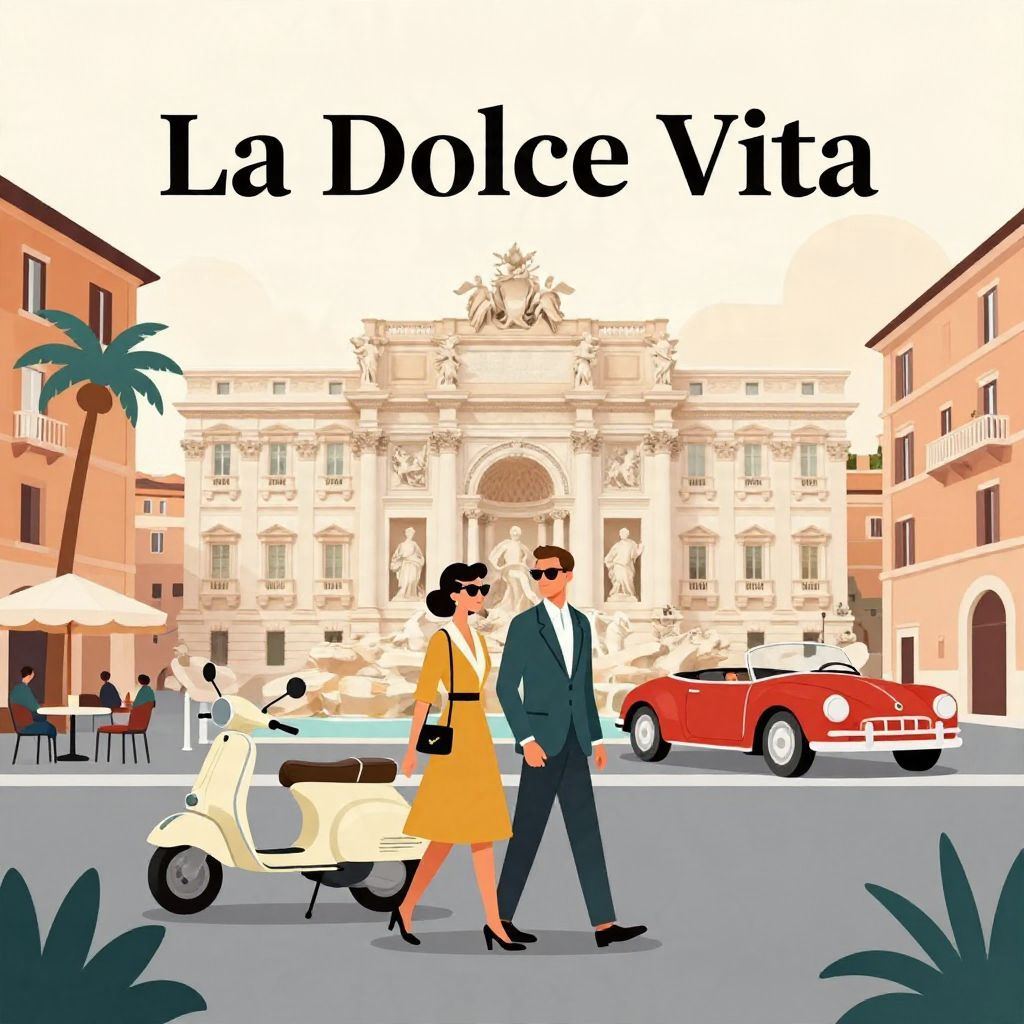
What does la dolce vita mean? Literally, the Italian phrase means “the sweet life.” In historical and cultural use, it refers to a life of pleasure, elegance, leisure, and indulgence—especially the glamorous, cosmopolitan world associated with Italy in the postwar era. The phrase became famous worldwide after Federico Fellini’s 1960 film La Dolce Vita.
But the expression did not begin with the movie. It reflects older Italian ideas about enjoyment, style, and social life, later reshaped by modern mass media, tourism, and celebrity culture. Its history reveals how a simple phrase can become a symbol of an entire age.
What does la dolce vita mean?
La dolce vita means “the sweet life” in Italian. Historically, it describes a desirable life of comfort, pleasure, beauty, and sociability. After Fellini’s 1960 film, the phrase also came to suggest glamorous nightlife, luxury, and the fashionable excess of Rome in the 1950s and early 1960s.
Where did the phrase come from?
The phrase is made from ordinary Italian words: la (“the”), dolce (“sweet”), and vita (“life”). It is not an ancient slogan or a medieval proverb with a single known origin. Rather, it belongs to the broader Romance-language tradition of praising a pleasant life, much as other cultures have spoken of “the good life.”
Language and meaning before the film
Before 1960, Italians could use dolce vita in a general sense to describe a comfortable or enjoyable way of living. The phrase was not yet a fixed global symbol. Its power came from the way Fellini’s film attached it to a specific historical moment: postwar Rome, where wealth, celebrity, journalism, and nightlife collided.
Why did La Dolce Vita become so famous?
Fellini’s film transformed the phrase into an international cultural shorthand. Released in 1960, La Dolce Vita portrayed a journalist moving through Rome’s elite social world, encountering parties, paparazzi, actors, aristocrats, and spiritual emptiness. The film did not simply celebrate pleasure; it also questioned whether glamour could satisfy modern life.
Rome in the postwar boom
The film emerged during Italy’s economic recovery after World War II. In the 1950s, Rome became a center of cinema, fashion, tourism, and international attention. American productions filmed there, the city attracted stars, and a new urban elite enjoyed restaurants, clubs, and public spectacle. This atmosphere gave the phrase its modern meaning.
The role of the paparazzi
La Dolce Vita also helped popularize the image of the paparazzo, the aggressive celebrity photographer. The film’s portrayal of relentless attention to famous people captured a new media age in which private life became public entertainment. In that sense, the phrase is tied not only to luxury but also to modern fame and its costs.
What did “the sweet life” mean in historical context?
Historically, “the sweet life” was never just about wealth. It pointed to a style of living marked by leisure, taste, and freedom from hardship. In postwar Italy, this ideal was especially visible in Rome’s cafés, nightclubs, seaside resorts, and film culture. Yet the phrase also carried irony, because such pleasures were unevenly distributed and often fleeting.
From hardship to aspiration
Italy in the years after 1945 had endured war damage, political instability, and poverty. Against that background, images of elegance and abundance had special appeal. La dolce vita therefore expressed aspiration as much as reality: the desire for a better life, not simply the fact of having one.
Not a purely Italian idea
The concept also fits a wider European and global pattern. Many societies have imagined an ideal life defined by ease, refinement, and enjoyment. What made the Italian phrase distinctive was its association with Rome’s visual glamour and Fellini’s sharp, sometimes critical, portrayal of modern leisure culture.
How did the 1960 film change the phrase’s meaning?
Before the film, la dolce vita suggested sweetness and enjoyment in a general sense. After the film, it became a cultural label for a whole lifestyle: chic restaurants, fashionable clothes, late nights, social climbing, and celebrity spectacle. The movie gave the phrase both glamour and ambiguity.
Celebration and critique at the same time
Fellini did not present this world as purely admirable. The film shows beauty, temptation, boredom, and spiritual dissatisfaction side by side. That tension is one reason the phrase endured. It can mean pleasure and sophistication, but also emptiness beneath the surface of luxury.
A global export
Once the film became famous internationally, the phrase entered many languages as a symbol of Italian style. Travel writers, advertisers, journalists, and fashion magazines used it to evoke Mediterranean luxury. Over time, it became less a literal translation than a cultural brand.
Is la dolce vita the same as “the good life”?
They overlap, but they are not identical. “The good life” can mean moral fulfillment, family stability, prosperity, or simple contentment. La dolce vita usually emphasizes pleasure, elegance, and sensual enjoyment. It often suggests atmosphere and style, not just material success.
Subtle differences in tone
“The good life” can sound practical or ethical. La dolce vita sounds more aesthetic and romantic. It evokes fine food, beautiful settings, nightlife, and charm. In historical usage, it can also imply a certain detachment from ordinary concerns, which is why it so often appears in discussions of celebrity culture.
What historical facts are often misunderstood?
One common misunderstanding is that la dolce vita refers only to luxury or decadence. In fact, the phrase has a broader meaning rooted in pleasure, comfort, and the search for a satisfying life. Another mistake is to treat it as an ancient Italian motto rather than a modern cultural symbol shaped by film and media.
Myth versus history
It is also easy to imagine that the phrase describes all of Italy in the 1950s and 1960s. That would be too simple. The “sweet life” was a visible urban phenomenon, especially in Rome, but much of Italy remained marked by inequality, rural poverty, and social change. The phrase captures a powerful image, not the whole society.
Why does the phrase still matter today?
La dolce vita remains popular because it names a dream that never disappears: a life that feels beautiful, pleasurable, and free. It continues to appear in tourism, fashion, food culture, and lifestyle writing because it carries both admiration and nostalgia. The phrase suggests not only enjoyment, but the hope that life can be lived stylishly.
Modern uses of the phrase
Today, people may use la dolce vita to describe a relaxed vacation, a luxurious home, or a glamorous social scene. At the same time, the phrase can still hint at irony. It may suggest that a life of pleasure is attractive, but also fragile, performative, or disconnected from deeper meaning.
The historical legacy of la dolce vita
The phrase’s lasting importance lies in how it captures a moment when Italy became a symbol of modern elegance and media spectacle. It reflects the postwar rise of consumer culture, the growth of celebrity journalism, and the global appeal of Italian style. Few phrases have traveled so far while keeping such a rich emotional charge.
So, what does la dolce vita mean? It means “the sweet life,” but historically it means much more: a modern ideal of pleasure and refinement, made famous by Fellini’s Rome and still used today to evoke glamour, leisure, and the seductive appeal of a beautiful life. For more on the cultural background behind such ideas, see what culture means in history and how cultures diverge over time.