
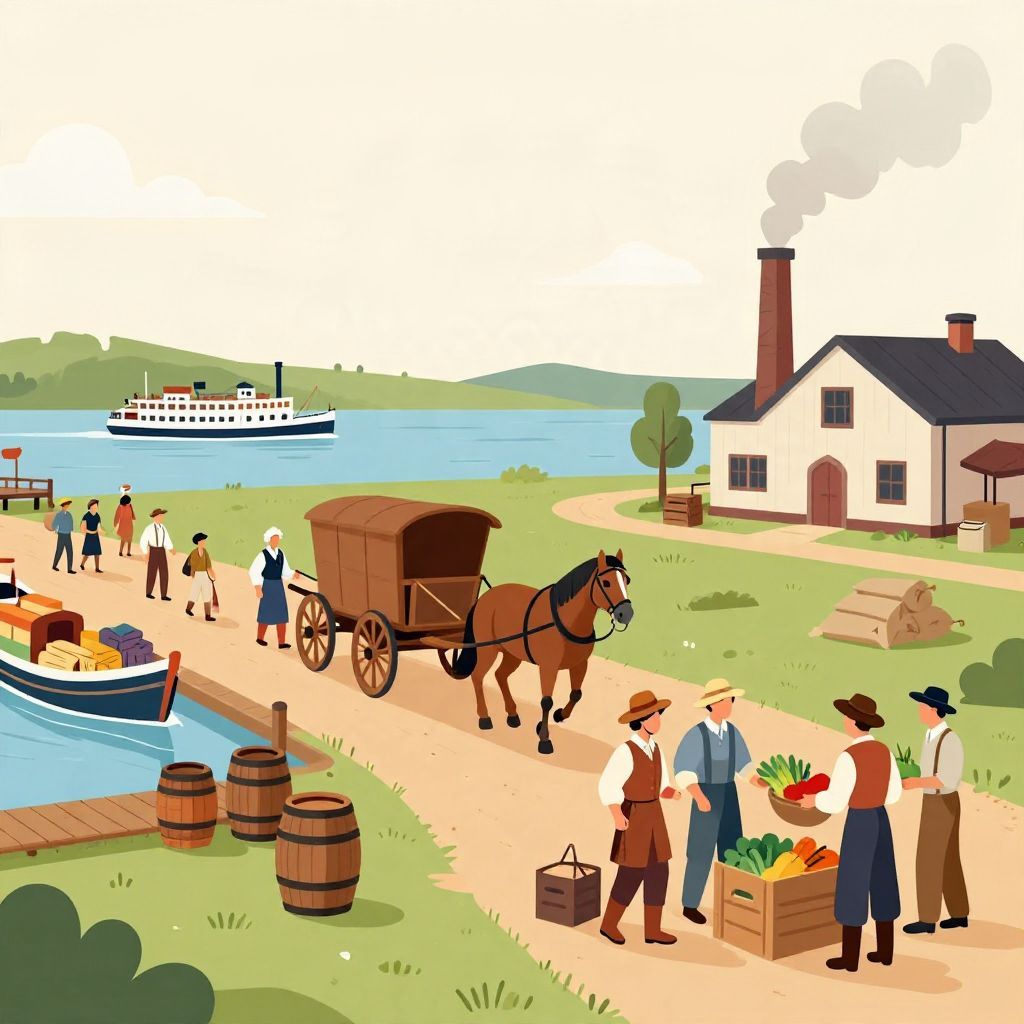
When was the Market Revolution? In the United States, historians usually place it in the early 19th century, roughly from the 1810s through the 1840s, with its strongest momentum after the War of 1812. It was not a single event but a broad transformation in how Americans produced, bought, sold, and transported goods.
The Market Revolution marked the shift from a mostly local, household-based economy toward a more connected, commercial one. Roads, canals, steamboats, banks, factories, and new forms of labor tied distant regions together and changed daily life for farmers, workers, and merchants alike.
When was the Market Revolution?
The Market Revolution is generally dated to the 1810s to the 1840s, especially in the United States. Some historians extend its beginnings into the late 18th century and its effects into the 1850s, but the core transformation took place in the decades after the War of 1812, when transportation, finance, and manufacturing expanded rapidly.
Why historians use that date range
There is no single day when the Market Revolution began. Historians use the term to describe a gradual economic and social shift. The date range reflects when several changes came together: improved transportation, wider access to markets, increasing specialization in production, and the growth of wage labor and factory work.
Key reasons the timeline centers on the early 1800s
- After 1812, Americans invested more heavily in internal improvements such as roads and canals.
- The 1820s and 1830s saw major growth in commercial farming and regional trade.
- Factories, especially in textiles, expanded in New England and other areas.
- Banking and credit systems made larger-scale commerce possible.
Because these developments unfolded unevenly across regions, the Market Revolution did not arrive everywhere at once. Urban centers and connected river valleys changed earlier, while many rural communities remained partly self-sufficient for longer.
What was the Market Revolution?
The Market Revolution was the transformation of the American economy from local exchange and household production to a market-oriented system. Families increasingly produced goods for sale rather than only for their own use, and more people depended on wages, distant buyers, and national or international markets.
This shift affected more than economics. It changed social relations, family labor, migration patterns, and ideas about opportunity. It also widened inequality in some places, since not everyone benefited equally from the new market economy.
How the Market Revolution began
Several forces helped trigger the Market Revolution. The end of the War of 1812 encouraged Americans to build a stronger domestic economy. Population growth increased demand for land and goods. New transportation networks made it easier to move crops and manufactured items. At the same time, entrepreneurs and state governments pushed for more investment and development.
Transportation improvements
Transportation was one of the most important drivers. Roads such as the National Road, canals like the Erie Canal, and steamboats on major rivers reduced travel time and shipping costs. These innovations connected farmers to cities and markets far beyond their immediate communities.
The Erie Canal, completed in 1825, became a symbol of this era because it linked the Great Lakes region to the Atlantic seaboard. It helped turn New York City into a major commercial center and showed how infrastructure could reshape regional economies.
Manufacturing and the factory system
Industrialization also played a major role. In New England, textile mills introduced the factory system, concentrating production in one place and relying on wage labor rather than home-based spinning and weaving. This system changed the rhythm of work and created new labor relationships, especially for women and young people.
Factory production did not replace household labor overnight, but it marked a major break from older patterns. Goods that had once been made in homes or small workshops increasingly came from larger, mechanized operations.
Finance, credit, and banks
Markets require money, credit, and trust. During the early 19th century, banks and credit networks expanded, making it easier for merchants, farmers, and manufacturers to borrow, invest, and trade. This financial growth supported larger business ventures, though it also made the economy more vulnerable to boom-and-bust cycles.
What changed in everyday life?
The Market Revolution altered ordinary life in practical ways. Many farm families began growing crops for sale rather than only for subsistence. People bought more goods from stores instead of making everything at home. Men and women increasingly worked for wages, and communities became more dependent on prices, contracts, and distant buyers.
This did not mean that self-sufficiency disappeared. Many households still produced food, clothing, and tools for their own use. But the balance shifted, and market participation became more central to survival and success.
Effects on farmers
Farmers were among the most affected. In some regions, they gained access to new markets and could specialize in cash crops. In others, they faced debt, price fluctuations, and pressure to produce more efficiently. The promise of opportunity often came with greater risk.
Effects on workers
For workers, the Market Revolution created new possibilities and new hardships. Some found paid employment in mills, shops, or transport networks. Others experienced longer hours, stricter discipline, and less control over their labor than in earlier household systems. Labor became more standardized and more dependent on employers.
How did the Market Revolution reshape society?
The Market Revolution did more than expand trade. It changed social expectations and power relationships. As the economy became more commercial, Americans debated what progress meant, who should benefit from growth, and whether market values were improving or corrupting society.
Regional differences
The North, South, and West experienced the Market Revolution differently. The North saw the strongest growth in manufacturing, finance, and urban commerce. The West became a region of expanding farms and transportation links. The South integrated into markets too, but largely through cotton production and slavery, which tied commercial growth to forced labor.
These regional differences mattered enormously. The same market forces that encouraged economic expansion also deepened sectional tensions, especially because cotton profits depended on enslaved labor. In that sense, the Market Revolution was connected to the broader history that led toward the Civil War.
Women and family labor
Women’s work changed significantly during this period. In some places, young women left home to work in mills, earning wages and experiencing a degree of independence uncommon in earlier rural life. At the same time, middle-class ideals increasingly emphasized separate spheres, placing men in public economic life and women in domestic roles.
This was not a simple story of liberation or restriction. The Market Revolution opened some opportunities for women while also reinforcing new gender expectations.
Was the Market Revolution a revolution?
Historians use the word revolution because the changes were deep and far-reaching, even though they happened gradually. Unlike a political revolution, it did not overthrow a government. Instead, it transformed the structure of the economy and the social order so thoroughly that everyday life looked different by mid-century.
Some scholars prefer to emphasize continuity, noting that many people still lived in mixed economies and that change was uneven. Others stress the dramatic speed of commercialization and industrial growth. Both views are useful: the Market Revolution was gradual, but its cumulative impact was revolutionary.
How the Market Revolution fits into broader American history
The Market Revolution belongs to the larger story of early American expansion. It followed independence, grew after the War of 1812, and helped create the economic conditions of the antebellum United States. It also overlapped with westward migration, reform movements, and debates over slavery, labor, and democracy.
By the 1840s, the United States had become more connected by roads, canals, steamboats, banks, and markets than it had been a few decades earlier. That new interconnectedness helped fuel growth, but it also exposed social divisions and economic instability.
Timeline of the Market Revolution
- Late 1700s to early 1800s: Early commercial growth and experimentation with transportation and manufacturing.
- 1810s: Postwar expansion accelerates after the War of 1812.
- 1820s: Canals, roads, and regional trade networks expand rapidly.
- 1830s: Factory production, wage labor, and market farming become more widespread.
- 1840s: The market economy is firmly established in many parts of the United States.
The lasting significance of the Market Revolution
The Market Revolution matters because it helped create modern American economic life. It connected regions, encouraged industrial growth, expanded consumer culture, and changed how people worked and lived. It also sharpened conflicts over class, gender, and slavery that would shape the rest of the 19th century.
So, when was the Market Revolution? Most accurately, it was an early 19th-century transformation, centered on the 1810s through the 1840s, with roots before and consequences after those decades. If you want to understand the era more fully, it also helps to explore what the Market Revolution was and how it differed from older systems such as mercantilism.