
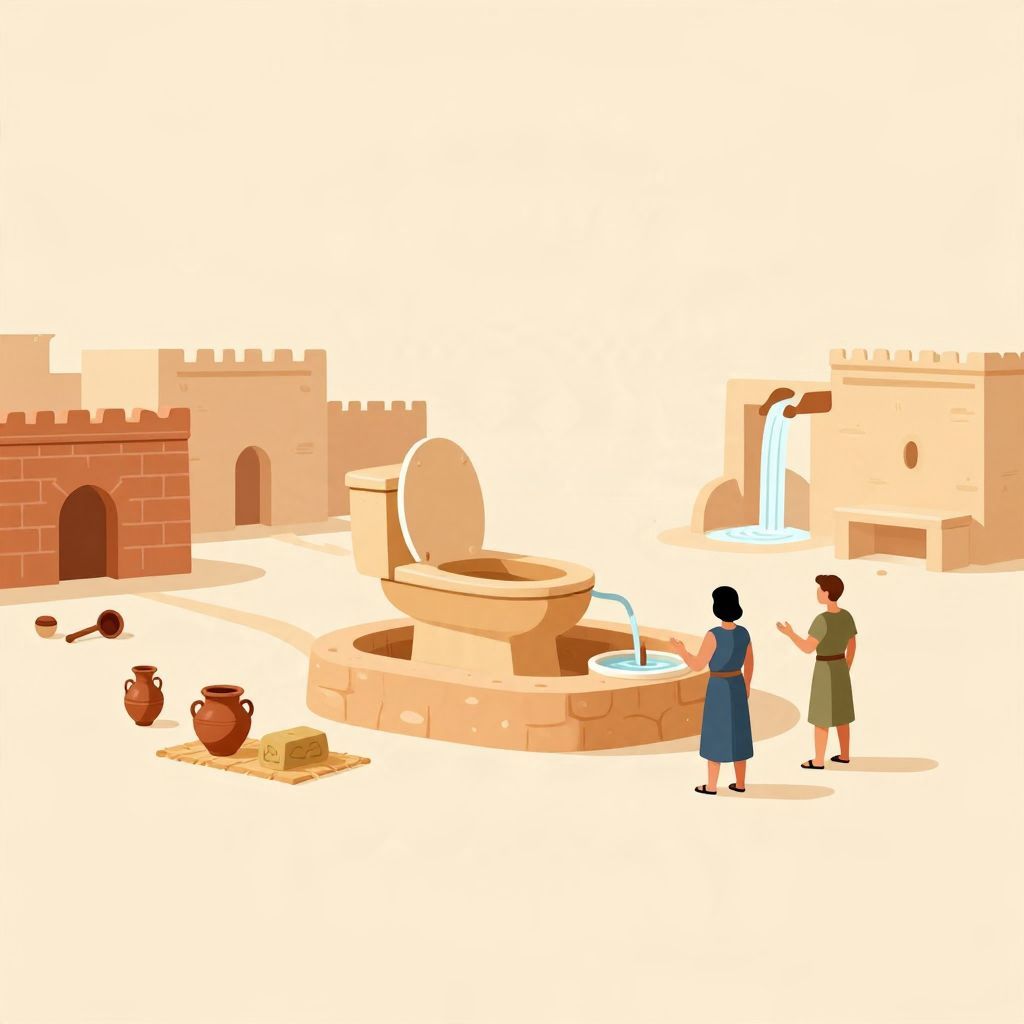
The toilet was not invented on a single date. It emerged gradually over thousands of years, as different societies developed ways to separate human waste from living spaces. The earliest known flush-style toilets appeared in the ancient Indus Valley around 2600 BCE, while the modern household toilet was refined much later.
So if you are asking when the toilet was invented, the best answer is that its history stretches from ancient sanitation systems to the late 19th-century water closet that became common in modern homes.
When was the toilet invented?
The toilet was invented in stages, not all at once. The earliest known toilets date to around 2600 BCE in the Indus Valley civilization, where homes in cities like Mohenjo-daro had brick-lined drainage and seated latrines. The familiar flush toilet, however, developed much later, with major improvements in the 16th century and a practical modern version in the 19th century.
The earliest toilets in history
Indus Valley sanitation, c. 2600 BCE
One of the oldest known toilet systems comes from the Indus Valley civilization in present-day Pakistan and northwest India. Archaeologists have found evidence of private toilets connected to covered drains and sewer channels. These were not modern flush toilets, but they show a remarkably advanced concern for sanitation in urban life.
In many Indus homes, waste appears to have been washed away with water into drainage systems. This matters because it suggests that the idea of a toilet was already tied to plumbing, cleanliness, and city planning thousands of years ago.
Ancient Egypt, Greece, and Rome
Other ancient civilizations also developed toilet-like systems. In Egypt, some elite households used simple indoor facilities. In the Greek and Roman worlds, public latrines became more common, especially in cities. Roman latrines often featured stone benches with openings and a continuous flow of water for cleaning.
These were not private, flushing household toilets in the modern sense. They were communal and often connected to sophisticated aqueducts and sewer systems. Still, they show that the basic human need for waste disposal was being solved in increasingly engineered ways.
Who invented the modern toilet?
There is no single inventor of the toilet in the modern sense. The most famous early design is usually credited to Sir John Harington, an English courtier and writer, who built a flushing water closet in 1596. His design used water to carry waste away, and he installed one for Queen Elizabeth I. It was innovative, but it did not immediately become widespread.
Harington’s device is important because it introduced the basic principle behind the modern flush toilet: a bowl, water, and a waste channel. But it was still a luxury curiosity rather than a mass household fixture.
Why Harington’s toilet did not spread quickly
Early flush toilets were limited by the plumbing of the time. Cities lacked the sewer networks needed to handle large numbers of toilets, and water supply was often unreliable. Without proper drainage, indoor toilets could create more problems than they solved.
As a result, many people in Europe and elsewhere continued using chamber pots, privies, and cesspits for centuries after Harington’s invention.
How the toilet became modern
The 18th century: practical improvements
During the 1700s, inventors worked on making toilets more reliable and sanitary. One of the most important figures was Alexander Cummings, who patented the S-bend in 1775. This curved pipe held water and helped block sewer gases from rising into the home.
The S-bend was a crucial breakthrough. It solved one of the biggest problems with early indoor toilets: bad smells and unhealthy air. Without this feature, the modern toilet would not have worked nearly as well.
The 19th century: mass adoption
The toilet became a true household fixture in the 19th century, especially in Britain and the United States, as cities expanded and sewer systems improved. Industrialization brought denser urban populations, which made old waste-disposal methods increasingly dangerous. Cholera outbreaks and other public health crises pushed governments and engineers to improve sanitation.
By this period, the “water closet” was becoming more practical for ordinary homes. Manufacturers improved ceramic bowls, flushing mechanisms, traps, and pipes. The toilet was no longer just an experiment or a luxury item; it was becoming part of modern urban infrastructure.
Thomas Crapper and the myth of invention
People sometimes say Thomas Crapper invented the toilet, but that is a myth. Crapper was a real 19th-century English plumber and manufacturer who helped popularize and improve toilet technology, but he did not invent the toilet itself. His name became linked to toilets partly through later popular culture and misunderstanding.
This is a good example of how invention histories can become simplified. The toilet evolved through many hands, not one brilliant inventor alone.
A brief timeline of toilet history
- c. 2600 BCE — Indus Valley cities use advanced drainage and toilet systems.
- Ancient Egypt, Greece, and Rome — Various forms of latrines and waste channels appear.
- 1596 — Sir John Harington designs an early flush water closet in England.
- 1775 — Alexander Cummings patents the S-bend, improving indoor sanitation.
- 19th century — Modern toilets spread with urban plumbing and sewer systems.
- Late 1800s — The toilet becomes common in many middle-class homes in industrial cities.
Why toilets mattered so much in history
The toilet may seem ordinary today, but historically it transformed daily life. Better toilets reduced disease, improved city living, and changed how homes were designed. They also helped make indoor plumbing possible, which reshaped domestic life in the modern world.
Sanitation is one of the quiet foundations of modern civilization. The spread of toilets was not just a matter of comfort; it was part of a larger public health revolution. Clean water, sewer systems, and waste removal all worked together to reduce the spread of illness.
From private convenience to public health
In earlier societies, waste was often handled in ways that exposed people to contamination. As cities grew, this became unsustainable. The modern toilet developed alongside new ideas about hygiene, disease prevention, and urban planning.
That is why the history of the toilet is also the history of modern public health. It reflects a shift from simply disposing of waste to engineering entire systems around sanitation.
So, when was the toilet invented?
If you mean the earliest toilet-like systems, the answer is around 2600 BCE in the Indus Valley. If you mean the first flush toilet, a famous early version appeared in 1596 with Sir John Harington. If you mean the modern toilet used in homes today, it took shape in the 18th and 19th centuries, especially after the S-bend and urban sewer systems made it practical.
In other words, the toilet was not invented in one moment. It was developed over a very long history of engineering, sanitation, and urban change. For more on everyday life in the past, you may also enjoy related history articles on ancient civilizations and the history of public health.