
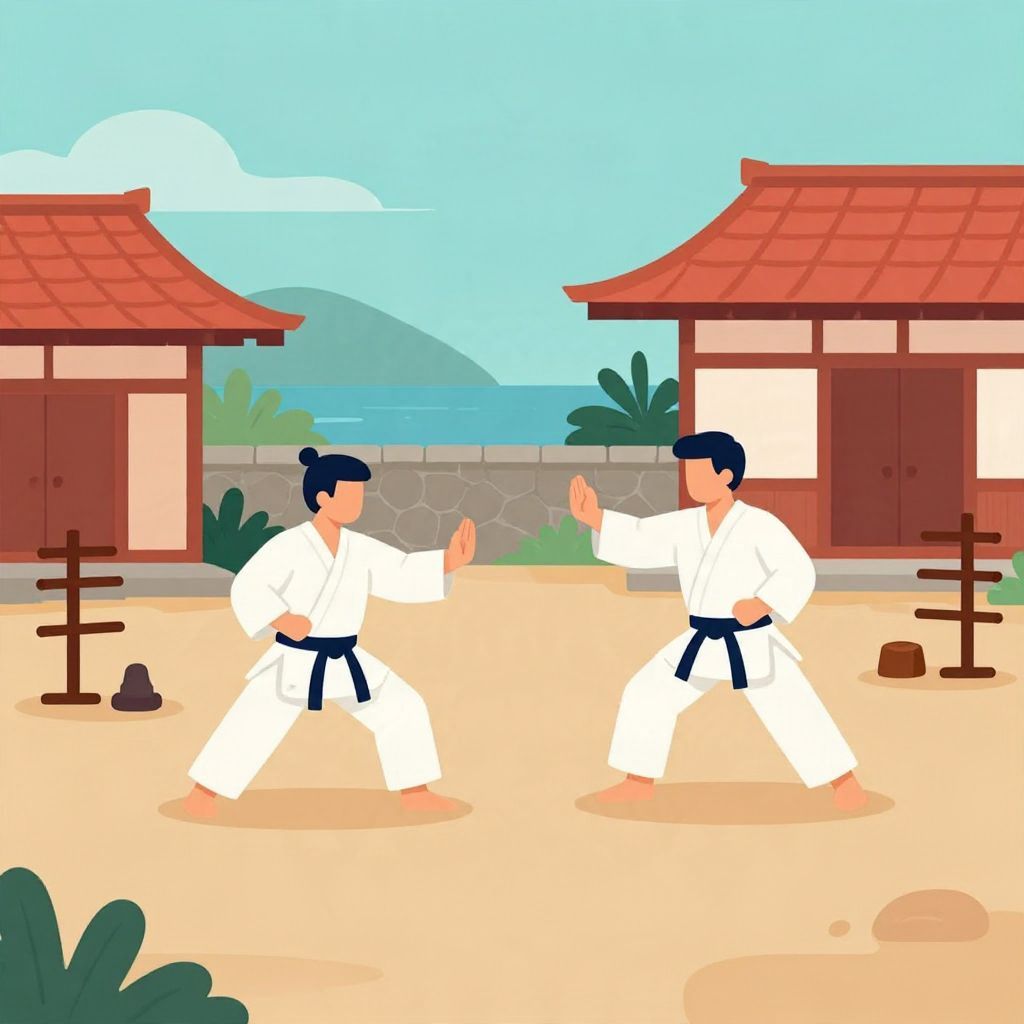
Where is karate from? The short answer is that karate developed in Okinawa, the Ryukyu Islands of present-day Japan, before spreading to mainland Japan in the early 20th century. Its roots lie in a long exchange of fighting methods, trade, and diplomacy between Okinawa, China, and Japan.
Karate is often called a Japanese martial art, but its history is more geographically complex. It grew out of Okinawan self-defense traditions and was shaped by centuries of contact with Chinese martial arts, local practices, and the political conditions of the Ryukyu Kingdom.
Where Is Karate From?
Karate comes from Okinawa, especially the city of Shuri and other centers of the Ryukyu Islands. The art took shape there over several centuries, drawing on indigenous fighting methods and Chinese influence. Modern karate later became associated with Japan after it was introduced to the Japanese mainland in the early 1900s.
Karate’s Geographic Origin: Okinawa and the Ryukyu Islands
To answer the question precisely, karate is from Okinawa, not originally from the Japanese mainland. Okinawa was once the heart of the independent Ryukyu Kingdom, a maritime state that connected Japan, China, Korea, and Southeast Asia through trade and diplomacy. That position made Okinawa a place where ideas and techniques moved easily across borders.
Why Okinawa mattered
Okinawa’s location in the East China Sea made it a crossroads rather than an isolated island society. Merchants, envoys, and travelers brought weapons, customs, and martial ideas with them. Over time, Okinawan fighters adapted outside influences to local needs, creating a distinct tradition that would eventually become karate.
The role of Shuri, Naha, and Tomari
Karate history is often linked to three Okinawan communities: Shuri, the royal capital; Naha, a major port; and Tomari, another important settlement. Different training traditions developed in these places, and later historians and practitioners sometimes describe them as separate lineages. These labels are useful, though the historical record is not always neat or complete.
How Karate Developed Over Time
Karate did not appear all at once. It emerged gradually from older Okinawan fighting systems, often called te or “hand.” These methods were influenced by local self-defense needs, social status rules, and contact with Chinese martial arts. By the 18th and 19th centuries, Okinawan martial practice had become more organized and recognizable as a distinct tradition.
Chinese influence and cultural exchange
One of the strongest scholarly conclusions is that Chinese martial and cultural influence helped shape karate. Okinawa maintained contact with Fujian and other parts of southern China for centuries. Some Okinawan practitioners studied with Chinese teachers or learned methods transmitted through trade networks and diplomatic contact. Because of this, karate is best understood as a hybrid tradition, not a purely isolated invention.
Local Okinawan development
At the same time, karate was not simply imported from China. Okinawan practitioners adapted techniques to their own environment, social structure, and training culture. The result was a martial art with Okinawan identity, even if it absorbed outside ideas. This is why historians usually describe karate as Okinawan in origin and East Asian in background.
Why Weapons Restrictions Matter in Karate History
Popular explanations often say karate was created because Okinawans were forbidden to carry weapons. There is some historical basis for this idea, but it is often oversimplified. Weapons restrictions did exist at different times under the Ryukyu Kingdom and later under Japanese control, yet karate cannot be reduced to a single ban.
More than a simple “weapons ban” story
Restrictions on weapons may have encouraged the refinement of unarmed techniques, but martial practice also developed for many other reasons: personal protection, status, training culture, and the influence of elite and civilian communities. The “weapons ban” story is popular because it is easy to remember, but the real history is broader and more complex.
Social class and martial training
In Okinawa, martial knowledge was not spread evenly across all social groups. Some traditions were associated with officials, guards, or educated elites, while others circulated more widely. Over time, training became more systematized, and teachers began passing on forms, drills, and principles to selected students.
From Okinawa to Mainland Japan
Karate’s move from Okinawa to mainland Japan was a turning point. In the early 20th century, Okinawan teachers introduced karate to Japanese audiences, especially through schools and martial arts organizations. This helped transform karate from a regional Okinawan practice into a national and eventually global martial art.
Key figures in the transition
Several Okinawan masters played important roles in this process, including Funakoshi Gichin, who helped popularize karate in Japan. He and others adapted the art for new audiences, including changing terminology and presentation. The word “karate” itself came to be written with characters meaning “empty hand,” a shift that helped align the art with Japanese martial culture.
Why the name changed
Earlier forms of the word could be written with a character meaning “China,” reflecting the art’s historical connections. In the early 20th century, the writing was changed to “empty hand.” This was not just a linguistic detail; it also signaled a new identity for karate as a modern Japanese budō, or martial way.
Is Karate Chinese or Japanese?
This is one of the most common follow-up questions, and the best answer is that karate is Okinawan in origin, with strong Chinese influence, and it later became part of Japanese martial culture. It is not accurate to label it as purely Chinese or purely Japanese.
A blended historical tradition
Karate’s techniques, terminology, and training methods reflect centuries of exchange across the East China Sea. Okinawa served as the meeting point where these influences were adapted into a local system. That is why karate’s history is best understood as a product of cultural contact rather than a single national invention.
How modern nationalism shaped the story
In the modern era, nations often tried to present martial arts as uniquely their own. This affected how karate was taught, named, and explained. As karate spread in Japan and later around the world, its Okinawan roots were sometimes minimized in favor of a more general “Japanese” identity. Today, historians and practitioners increasingly emphasize its Okinawan origins.
How Karate Spread Around the World
Karate’s global spread began in the 20th century, especially after it was introduced into Japanese universities, military circles, and public demonstrations. After World War II, American servicemen stationed in Okinawa and Japan encountered karate and helped carry it abroad. From there, karate schools spread across Asia, Europe, and the Americas.
From local practice to global martial art
As karate expanded internationally, it changed. Different schools emphasized striking, forms, sparring, self-defense, or sport competition. Some lineages preserved older Okinawan methods, while others developed new approaches in Japan and overseas. This diversity is part of karate’s history, not a departure from it.
Okinawa’s continuing importance
Even though karate is now practiced worldwide, Okinawa remains central to its identity. The island is still regarded as the birthplace of karate, and many practitioners travel there to study its history, teachers, and traditions. That enduring connection shows how strongly the art remains tied to its original place.
Timeline of Karate’s Origins and Early Development
Karate’s history is long and layered, but a few broad milestones help place it in time:
- 14th–16th centuries: Okinawa develops as a maritime kingdom with active contact with China and other regions.
- 17th century: Political changes and social controls in the Ryukyu Kingdom help shape local martial practice.
- 18th–19th centuries: Okinawan te traditions become more organized and are influenced by Chinese martial methods.
- Early 1900s: Karate is introduced more widely in mainland Japan.
- Mid-20th century onward: Karate spreads internationally and develops multiple modern styles.
What Makes Karate Historically Important?
Karate matters because it shows how culture moves across borders and becomes something new. It is not just a fighting system; it is a record of Okinawa’s place in East Asian history, of exchange between societies, and of the way local traditions can survive political change and global expansion.
Karate as cultural heritage
For Okinawa, karate is part of a broader cultural identity shaped by the Ryukyu Kingdom’s history. For Japan, it became one of the best-known martial arts in the modern era. For the world, it became a shared practice with many styles and interpretations. Its story is therefore both local and international.
So, where is karate from? Historically, it is from Okinawa in the Ryukyu Islands, where local martial traditions developed under strong Chinese influence and later spread to Japan and the wider world. If you want to explore more about Japanese cultural history, you may also enjoy what kawaii means in Japanese culture and the history of Japan’s emperor.